







A sectional sofa takes up a lot of floor space, so choosing and placing a rug under it can feel tricky. Pick a rug that is too small and the seating area looks cramped and disconnected. Place it badly and the sectional rocks, the rug curls or the room feels unbalanced.
The good news is that a few simple rules solve almost every layout. This guide explains how to place a rug under a sectional sofa, how to choose the right size, which placement styles work best and what mistakes to avoid. You will also find a step-by-step process you can follow in about half an hour.
Quick answer
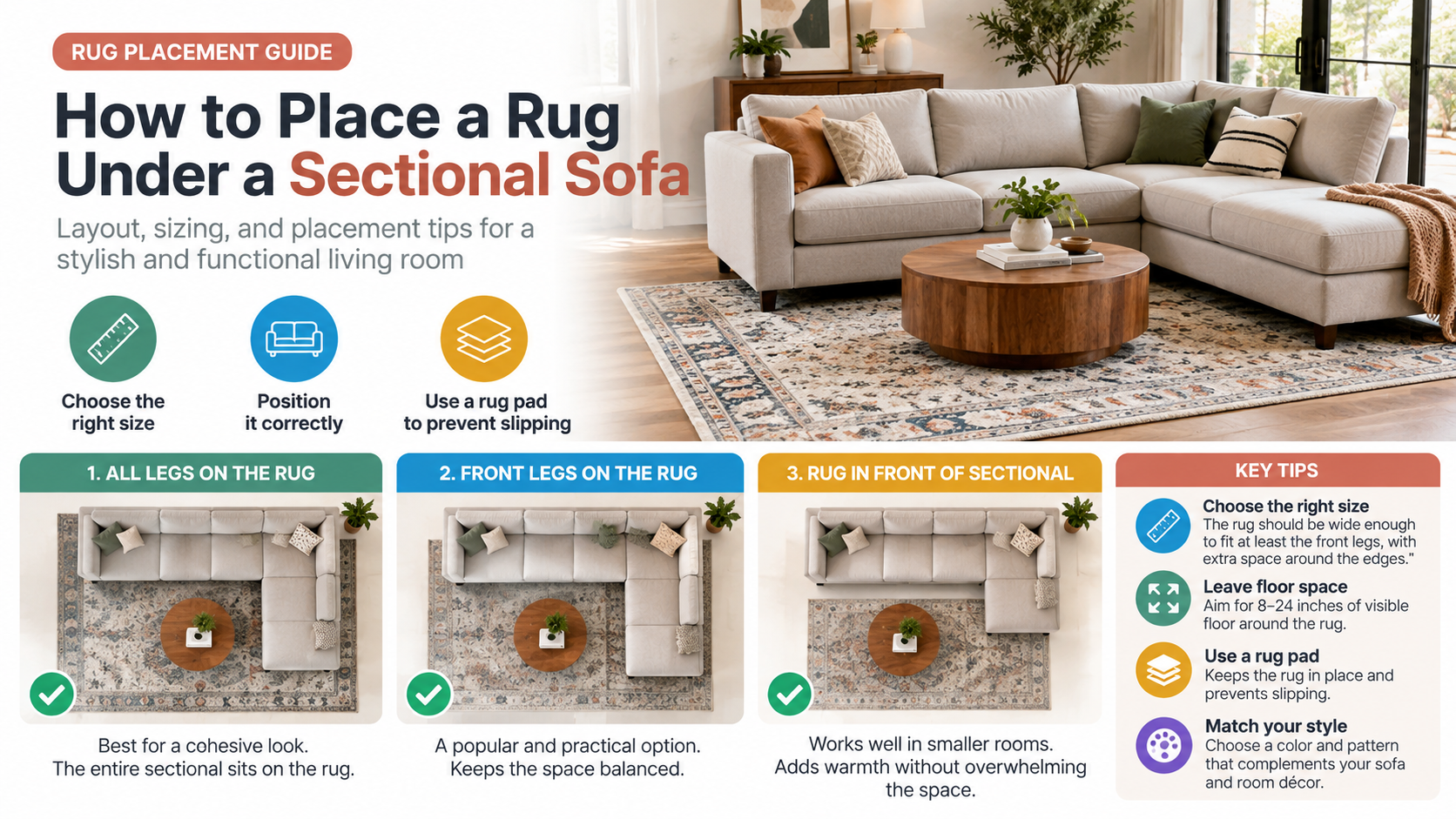
Choose a rug large enough that at least the front legs of every sectional piece sit on it, and ideally all legs if the room allows. Make the rug roughly 12 to 24 inches larger than the sectional’s overall length and depth, center it under the seating area with the coffee table fully on it, and add a rug pad to keep everything from sliding. For most sectionals, an 8 x 10 or 9 x 12 foot rug works best.
Why Rug Placement Matters With a Sectional
A rug does far more than add color. Under a sectional, it does several jobs at once:
- Anchors the seating area: It ties the sofa, chaise and coffee table into one visual group, especially in open-plan rooms.
- Defines the zone: In a large room or a combined living and dining space, the rug marks where the lounge begins and ends.
- Adds comfort and warmth: Soft flooring underfoot makes the seating area feel cozier, particularly on hardwood, tile or laminate.
- Protects your floors: A rug and a good pad reduce scratches from heavy furniture and everyday foot traffic.
- Dampens noise: Fabric absorbs sound and reduces echo in rooms with hard surfaces.
Because a sectional is large and often L-shaped or U-shaped, rug size and position matter more than they do with a standard sofa.
Three Ways to Position a Rug Under a Sectional
Designers generally describe three layouts. Each one affects how large the rug needs to be and how the room feels.
1. All Legs on the Rug
In this layout the rug extends beneath the entire sectional, with space to spare on every open side. It gives the most polished, cohesive look and works especially well in larger rooms. It needs a bigger rug, often 9 x 12 feet or more, and it keeps the sectional from wobbling because all the legs rest on the same surface.
2. Front Legs on the Rug
Here the rug sits partly under the sectional so that the front legs of every piece rest on it while the back legs stay on the floor. This is the most popular approach because it connects the sofa and rug visually without needing an enormous rug. It suits medium rooms and sectionals that sit against a wall.
3. No Legs on the Rug
With this layout the rug sits entirely in front of the sectional. It can work with a very small seating area or an unusual room shape, but with a sectional it usually looks undersized and disconnected, because the sofa seems to float away from the rug. Avoid it unless the rug is wide enough to reach both ends of the seating group and the room truly cannot fit a larger rug.
| Layout | Best for | Typical rug size | Watch out for |
|---|---|---|---|
| All legs on | Large or open-plan rooms, formal looks | 9 x 12 ft or 10 x 14 ft | Needs a big rug and more budget |
| Front legs on | Most living rooms and sectionals | 8 x 10 ft or 9 x 12 ft | Make sure every piece, including the chaise, has its front legs on the rug |
| No legs on | Very small spaces only | 5 x 8 ft or 6 x 9 ft | Looks undersized and does not anchor the sofa |
How to Choose the Right Rug Size for a Sectional
Start with the size of the sectional itself. Measure the longest side and the longest depth, including the chaise if your sectional has one. Those two numbers tell you the footprint the rug needs to cover.
A reliable rule is to choose a rug that is roughly 12 to 24 inches larger than the sectional’s overall length and depth. That lets the rug peek out past the open sides of the sofa and keeps the sectional from looking like it is sitting on a mat.
Example: A sectional measuring 120 inches along the back and 90 inches along the chaise side needs a rug of about 132 to 144 inches by 102 to 114 inches. A 9 x 12 foot rug (108 x 144 inches) fits that layout comfortably.
Also think about the room itself. Leave around 12 to 18 inches of bare floor between the rug and the walls in a large room, or at least 6 to 8 inches in a small one. That visible border makes the room feel intentional and keeps the rug from looking like wall-to-wall carpet.
Which Rug Shape Works Best?
- Rectangular: The safest choice for L-shaped and U-shaped sectionals. It echoes the lines of the sofa and fits most rooms.
- Square: Works well when the sectional and coffee table form a roughly square seating area.
- Round: Best reserved for curved or modular sectionals, where the rug shape matches the sofa. With a standard L-shaped sectional a round rug can leave awkward corners.
- Runner: Not suitable for a sectional, since it is far too narrow to anchor the seating group.
When in doubt, orient a rectangular rug parallel to the longest side of the sectional so the lines of the furniture and the rug agree.
Step-by-Step: How to Place the Rug
Use this process to avoid guesswork and costly returns.
Step 1: Measure the Sectional
Record the overall length, depth and chaise length. Note where the front legs sit on each piece. Also measure the room so you know how much floor is available on each side.
Step 2: Choose the Rug Size
Add 12 to 24 inches to the sectional’s overall dimensions and compare the result with standard rug sizes. When a rug falls between two sizes, choose the larger one. Rugs that are too big can be tucked around furniture, but rugs that are too small cannot be stretched.
Step 3: Tape the Outline on the Floor
Use painter’s tape to mark the rug’s edges on the floor before you buy or unroll it. Check that the tape rectangle reaches under the front legs of every sectional piece and still leaves a clear border against the walls. Walk around it to confirm there is enough room for traffic and doors.
Step 4: Position the Rug
Center the rug under the seating area so it includes the sectional and the coffee table. Square its edges with the room or the sofa. If the sectional sits against a wall, push the rug to the right distance from the wall so the front legs are on it and the back legs stay on the floor, or all legs are on it if you are using a larger rug.
Step 5: Add a Rug Pad
Place a pad under the rug, trimmed to be about an inch smaller than the rug on every side. The pad keeps the rug in place, adds cushioning and protects the floor. Pads also help the sectional sit more securely, because a rug without a pad can slide when people sit down.
Step 6: Set the Sectional and Adjust
Lift, rather than drag, each piece of the sectional onto the rug. Ask a helper to lift the ends so you do not crush the pile or bend the rug’s edges. Then check that the sofa is level, the rug is flat and the coffee table sits fully on the rug. If anything looks off, make small adjustments before you walk away.
Rug Placement for Different Sectional Layouts
The shape of your sectional and the way it sits in the room changes the best approach.
| Sectional layout | Best rug placement | Extra tip |
|---|---|---|
| L-shaped against a wall | Front legs of both the long side and the chaise on the rug | Keep the rug edge a few inches past the chaise end |
| L-shaped floating in an open room | All legs on the rug, rug extends past the back too | Choose a larger rug to define the zone |
| U-shaped | All legs on, with the coffee table in the center | Measure the full width carefully before choosing |
| Corner sectional | Rug centered on the seating group, front legs on | Orient the rug diagonally only if the room is truly square |
| Sectional with recliners | Rug large enough for all legs, low pile | Make sure reclining mechanisms can open without catching the rug |
| Modular or curved sectional | Round or oval rug that follows the curve | Keep at least a few inches visible beyond the curve |
Placing the Coffee Table and Other Furniture
The rug has to work for more than the sectional. A few simple rules keep everything in proportion:
- Coffee table: It should sit fully on the rug, centered within the sectional’s footprint, with about 14 to 18 inches between the table and the sofa for walking space.
- Accent chairs: At least the front legs should rest on the rug so they look like part of the same group.
- Side tables: They can sit on the rug or on the floor beside it. Just keep the legs consistent so tables do not wobble across the edge.
- Media console or shelving: Keep these off the rug entirely, with the rug stopping a comfortable distance away.
Do You Need a Rug Pad?
Yes. A rug pad is one of the most useful additions for a sectional, because it does several things at once.
- Stops slipping: Sectionals are heavy and people sit down with force, so unpadded rugs often creep or bunch.
- Adds cushioning: Even a thin pad makes the rug feel more comfortable and helps it hold its shape.
- Protects the floor: The right pad prevents scratches and, depending on the type, helps avoid marks on hardwood.
- Extends rug life: A pad absorbs some of the wear from foot traffic and furniture weight.
Choose a pad that is labeled as safe for your floor type, because some rubber-based products can react with certain finishes. A felt and natural rubber pad of about one quarter inch thick is a common choice for living rooms. Trim it about an inch smaller than the rug on every side so the edges do not show.
Best Rug Materials, Pile Height and Colors for Under a Sectional
A sectional sees heavy use, so durability matters as much as style.
| Material | Pros | Cons |
|---|---|---|
| Wool | Durable, soft and naturally resilient to crushing | Costs more and may shed at first |
| Polypropylene (synthetic) | Stain-resistant, affordable and easy to clean | Can feel less luxurious underfoot |
| Nylon | Very durable and bounces back from furniture weight | Higher price than basic synthetics |
| Cotton flatweave | Lightweight and often machine washable | Thin, so it needs a good pad |
| Jute or sisal | Natural texture and strong look | Rough on bare feet and hard to clean after spills |
| Shag or very high pile | Plush and cozy | Shows furniture dents and traps crumbs, not ideal under heavy sofas |
For pile height, low to medium pile is usually best under a sectional. It handles furniture weight better, helps the sofa sit level and makes vacuuming easier. Medium tones and patterns hide dirt and stains better than very light or solid colors, which is useful when the rug sits in a high-traffic family room.
Common Mistakes to Avoid
- Buying a rug that is too small: This is the number one problem. If the rug does not reach under at least the front legs of every piece, the sectional appears to float away from it.
- Forgetting the chaise: Measure from the end of the chaise, not only along the main sofa back.
- Skipping the rug pad: Without one, the rug slides and wrinkles.
- Leaving the coffee table half on, half off: It wobbles and looks accidental.
- Dragging heavy furniture over the rug: This damages fibers and can distort the backing. Always lift.
- Ignoring the room’s walkways: Make sure doors, vents and traffic paths still work with the rug in place.
- Choosing a very thick pile for heavy furniture: It leaves deep dents and can make the sectional sit unevenly.
Styling Tips for a Polished Look
- Coordinate, do not match: Pick a rug that complements the sectional’s color instead of copying it. A neutral sofa pairs well with a bolder rug, and a bold sofa pairs well with a quieter rug.
- Use pattern wisely: Subtle patterns such as geometric or vintage-style designs hide wear and give the room character.
- Keep the border even: Aim for a consistent strip of rug showing on each open side.
- Layer carefully: A small accent rug can go under a coffee table on top of a neutral base, but keep both pieces flat so nothing curls.
- Match the room’s scale: A large sectional in a small room needs a rug that does not overwhelm the floor, so leave some wood or tile visible.
Caring for a Rug Under Heavy Furniture
A little maintenance keeps the rug looking good and prevents permanent dents.
- Vacuum regularly with the suction or a rug setting appropriate for the fiber, and avoid beater bars on delicate rugs.
- Rotate the rug every six to twelve months if the sectional does not cover it entirely, so wear and sun fading are spread out.
- Place furniture coasters or wide cups under the legs to spread weight and reduce indentations.
- Lift the sectional occasionally and brush or steam the pile to help the fibers recover.
- Blot spills immediately and follow the manufacturer’s cleaning instructions.
Helpful Accessories to Consider
- Rug pad: The most important accessory, available in felt, rubber and combination styles.
- Furniture coasters or leg cups: Spread the weight of the sectional and reduce dents in the pile.
- Painter’s tape: Lets you test the layout without any commitment.
- Rug gripper tape for corners: Stops edges from curling.
- A long tape measure: Essential for measuring both the sectional and the room.
- A vacuum suitable for rugs: Keeps the fibers clean and upright.
Frequently Asked Questions
Should all sectional legs be on the rug?
Ideally yes, if the room and budget allow. At the very least, the front legs of every piece should sit on the rug so the sofa and rug look connected.
How far should the rug stick out from the sectional?
Aim for about 6 to 12 inches beyond the open sides of the sofa, and make the rug roughly 12 to 24 inches larger than the overall footprint of the sectional.
Can I use a 5 x 8 rug under a sectional?
Usually not. A 5 x 8 rug is generally too small to reach under the front legs of a sectional and will look undersized. It is better suited to a small apartment seating area or a layered look.
What size rug do I need for a large L-shaped sectional?
Most large L-shaped sectionals work best with a 9 x 12 foot rug. Very large or U-shaped models may need a 10 x 14 foot rug.
Should the rug go under the chaise too?
Yes. Make sure the front legs of the chaise sit on the rug, otherwise the chaise will look separate from the rest of the sofa.
Can I use two rugs under one sectional?
It is possible, but one large rug almost always looks cleaner and avoids height differences and gaps. If you must use two, choose rugs with the same pile height and keep the seam away from the main walking area.
Do I need a rug pad under a sectional?
Yes. A pad prevents sliding, adds comfort and protects the floor and the rug.
Should a rug go under a sectional that is against a wall?
Yes. Place the rug so the front legs sit on it and the back legs stay on the floor, or use a larger rug to include all legs if the room allows.
Final Thoughts
Learning how to place a rug under a sectional sofa comes down to three things: size, position and stability. Choose a rug that is large enough to reach at least the front legs of every piece, center it under the whole seating group, leave a tidy border of exposed floor and always add a pad.
Test the layout with painter’s tape, measure twice and lift rather than drag your furniture. With a little planning, the rug will anchor your sectional, define the room and keep everything looking neat for years.