







Winter is on its way, and the big question for many households is simple: oil filled radiator vs electric heater, which one should you buy? Both plug into a wall socket, both are easy to use, and both promise a warm room. But they behave very differently once you switch them on. One gives you instant hot air. The other warms slowly and keeps the room cosy long after the power cycles off.
In this guide we compare the two across heat-up speed, running cost, safety, noise, comfort, lifespan and price. By the end you will know exactly which type suits your room, your budget and your daily routine.
Quick Answer
- Choose an oil filled radiator if you want steady, silent, all-night warmth in a bedroom, living room or home office that you heat for hours.
- Choose an electric heater (fan, ceramic or infrared) if you want fast heat for a short time, a lightweight unit to carry around, or a lower purchase price.
What Is an Oil Filled Radiator?
An oil filled radiator looks like a traditional central heating radiator on wheels. Inside the metal fins is a sealed reservoir of thermal oil. An electric element at the bottom heats the oil, the oil spreads heat through the fins, and the fins warm the room by radiation and natural convection. There is no fan, no glowing coil and no moving parts.
The oil is not a fuel and is never burned or consumed. It is simply an excellent heat store, which is why these heaters stay warm after they switch off.

What Is an Electric Heater?
"Electric heater" is a broad term. When people compare it with an oil filled radiator, they usually mean one of the following portable types:
- Fan heaters blow air across a hot element. They are the fastest and cheapest, but also the loudest.
- Ceramic heaters use ceramic plates and a fan for quick, even warmth with better safety characteristics than a bare coil.
- Convector or panel heaters warm air that rises naturally, giving quiet and moderate heat. They are often wall mounted.
- Infrared or radiant heaters warm people and objects directly rather than the air, useful for spot heating.
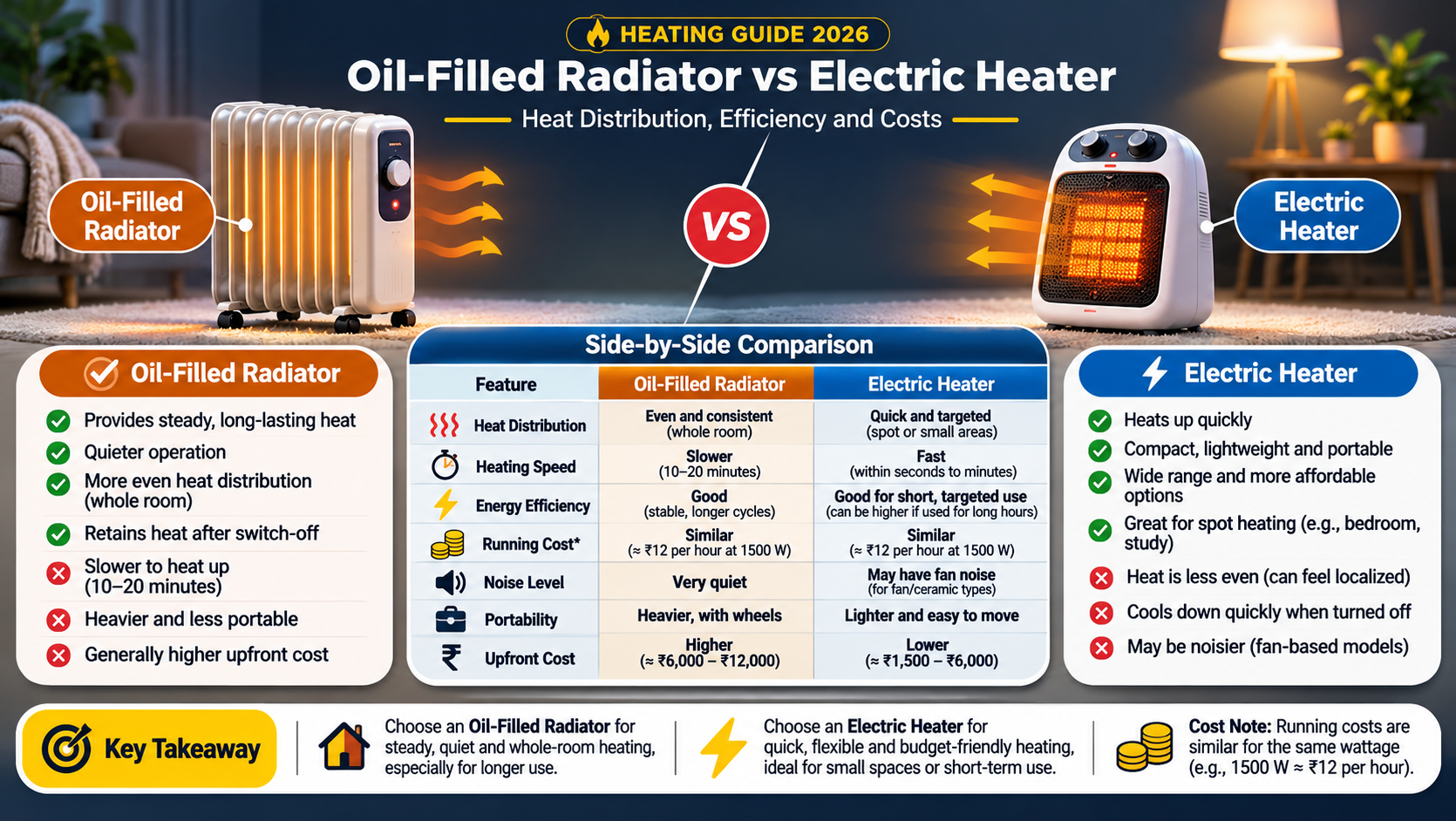
Oil Filled Radiator vs Electric Heater: Side-by-Side Comparison
| Feature | Oil Filled Radiator | Electric Heater (Fan / Ceramic) |
|---|---|---|
| Heat-up speed | Slow, 15 to 30 minutes to feel the difference | Very fast, warm air in about a minute |
| Heat retention | Excellent, stays warm after switching off | Poor, heat stops almost immediately |
| Noise | Almost silent (a gentle tick as it heats) | Fan noise, from soft hum to loud whirr |
| Running cost | Efficient over long periods thanks to thermostat cycling | Efficient for short bursts, costly if left running for hours |
| Safety | Warm surface, no exposed element | Hot grille or element, needs careful placement |
| Air comfort | Does not blow dust or dry the air as much | Circulates dust, air can feel dry |
| Weight and portability | Heavier, usually on castors | Light and easy to carry |
| Upfront price | Moderate | Low to moderate |
| Lifespan | Often 10 years or more | Typically 3 to 7 years |
| Best for | Bedrooms, living rooms, home offices | Quick warm-ups, small spaces, occasional use |
1. Heat-Up Speed and Heat Retention
This is the biggest difference. A fan heater pushes hot air into the room almost instantly, which feels great when you walk into a freezing space. The moment you turn it off, though, the warmth disappears because there is nothing storing the heat.
An oil filled radiator needs time to heat its oil, so it feels slow at first. The reward comes later: the oil keeps releasing heat for a long while, so the room stays comfortable and the thermostat only has to top up the temperature now and then.

2. Energy Use and Running Costs
Here is a fact that surprises many shoppers: almost every electric heater turns close to 100 percent of its electricity into heat. A 1500 watt oil filled radiator and a 1500 watt fan heater both draw 1.5 kWh each hour at full power. So the real cost difference comes from how long the element actually runs, not from some magical efficiency advantage.
Once an oil filled radiator reaches the set temperature, the thermostat cuts power while the hot oil keeps radiating. Over an evening, the element may be on only half to two thirds of the time. A fan heater with a basic thermostat also cycles, but because the room loses heat as soon as the element stops, it tends to switch back on more often.
To estimate your own cost, use this formula: watts divided by 1000, multiplied by hours used, multiplied by your price per kWh. Then multiply by the share of time the heater is likely to be on (about 0.5 to 0.7 for a thermostat-controlled oil filled radiator in a reasonably insulated room).

For a heater you only use 20 to 30 minutes at a time, a fan heater can easily be the cheaper choice, because you do not need to wait for an oil radiator to warm up.
3. Safety
Safety matters more than any other factor if you have children, pets or elderly family members at home. Oil filled radiators have no glowing element and no blades, and the surface temperature is lower than a fan heater grille. They still get hot enough to burn skin on contact, so they should never be covered or used to dry clothes.
Electric fan and ceramic heaters have improved massively, but the outlet grille and element can still be very hot. Look for these features on either type:
- Automatic tip-over shut-off
- Overheat protection (thermal cut-out)
- Adjustable thermostat
- Cool-touch housing or a well-guarded grille
- A safety certification mark from a recognised testing body
4. Noise Level
If you are a light sleeper or work from home on calls, noise is a major factor. Oil filled radiators are nearly silent. Fan and ceramic heaters range from a quiet hum to an obvious blast of sound, which can be tiring during a long evening.
5. Air Quality and Comfort
A fan heater pushes air and dust around the room. People with allergies or dry skin often find this irritating. Oil filled radiators warm the room by gentle radiation and convection, producing a softer, more even feeling that many describe as similar to central heating.
No electric heater actually removes moisture from the air, but fast, hot air blowing directly on you makes dryness easier to notice.
6. Size, Weight and Portability
Fan heaters win here. Most weigh only 1 to 3 kg and can be moved from room to room in seconds. Oil filled radiators weigh from around 5 to 12 kg depending on size, though castors and a carry handle make them manageable. If you need one heater for the whole house, portability may tip the balance toward an electric fan or ceramic model.
7. Price and Lifespan
Basic fan heaters are usually the cheapest to buy. Oil filled radiators cost somewhat more upfront but tend to last much longer, since they have no fan motor to wear out. Over ten winters, the radiator can easily turn out to be the better value.
Quick Scorecard
Here is how the two types compare at a glance across the factors that matter most to buyers.

Pros and Cons
Oil Filled Radiator
| Pros | Cons |
|---|---|
|
|
Electric Heater (Fan / Ceramic)
| Pros | Cons |
|---|---|
|
|
Which One Should You Choose?
Pick an oil filled radiator if:
- You want to warm a bedroom or living room for several hours
- You work from home and need quiet
- You or your family are sensitive to dry air or dust
- You plan to use it every winter for many years
Pick an electric heater if:
- You need fast heat for 15 to 30 minutes at a time
- You move the heater between rooms often
- Your budget is tight
- You live in a mild climate and only need occasional warmth
Pro tip: Many households use both. An oil filled radiator handles the main room all evening, and a small ceramic heater gives quick warmth in the bathroom or at the desk.
Buying Guide: What to Look For
- Power rating: About 10 watts per square foot (or 100 watts per square metre) of floor space is a sensible starting point. Choose higher for poorly insulated rooms.
- Adjustable thermostat: This is the single most useful feature for saving money.
- Multiple heat settings: Three settings (for example 800, 1200 and 1500 watts) give you more control.
- Timer: Switches the heater off automatically, avoiding wasted electricity.
- Safety features: Tip-over protection and overheat cut-off are essential.
- Castors and handle: Make a heavy oil filled radiator easier to move.
- Cord storage and length: Handy for keeping the cable tidy and out of the way.
- Warranty: A longer warranty usually signals better build quality.
Tips to Get More Warmth for Less Money
- Close doors and windows in the room you are heating.
- Use draught excluders and thick curtains.
- Place the heater on a hard floor away from furniture, ideally near a cold wall or window.
- Switch on the heater 30 minutes before you need the room warm if it is an oil filled radiator.
- Use the thermostat rather than leaving the heater on maximum.
- Heat only the rooms you are using.
- Wear warm clothing and use a blanket to lower the temperature you need.
Heater Safety Tips
- Plug directly into a wall socket. Avoid extension cords and power strips.
- Keep at least one metre (three feet) of clear space around the heater.
- Never drape clothes or towels over a heater.
- Switch off and unplug when leaving the house.
- Check the cable and plug regularly for damage.
- Keep children and pets away from hot surfaces.
- Test your smoke alarms regularly during winter.
Frequently Asked Questions
Is an oil filled radiator cheaper to run than an electric heater?
Both convert nearly all the electricity they use into heat, so the same wattage costs the same per hour at full power. The oil filled radiator often costs less over a day because its thermostat switches the element off while the hot oil keeps radiating warmth. For short bursts of heat, a fan heater can use less total energy simply because it runs for less time.
Which is better for a bedroom?
Most people prefer an oil filled radiator for bedrooms. It is silent, does not dry the air as much, and its surface is warm rather than glowing hot. Always choose a model with tip-over protection and overheat cutoff.
Can I leave an oil filled radiator on overnight?
Modern units with a thermostat and safety cutoffs are designed for extended use, but follow the manufacturer instructions, keep fabrics away from the unit, and never cover it. Do not use an extension cord.
How long does an oil filled radiator take to warm a room?
Usually around 15 to 30 minutes to feel the difference, and longer for a large room. A fan heater gives you warm air within a minute or two.
Does an oil filled radiator need refilling?
No. The oil is sealed inside for the life of the product. If it leaks, stop using the unit and replace it.
What size heater do I need?
A common rule of thumb is about 10 watts per square foot of floor area, or roughly 100 watts per square metre in a well-insulated room. Poor insulation, high ceilings or very cold climates need more.
Is a fan heater or oil heater better for a small bathroom or office desk?
A small fan or ceramic heater is better for quick, short-term warmth. Only use heaters rated for bathrooms in damp rooms.
Do oil filled radiators dry the air?
They dry the air far less than fan heaters, because they do not blow air and run at lower surface temperatures. No electric heater removes moisture on its own, but fan models make the dryness easier to notice.
Final Verdict
The choice between an oil filled radiator and an electric heater is not about which one is better in general. It is about which one fits the way you live. If comfort, silence and long hours of steady warmth matter most, the oil filled radiator is the clear winner. If you need fast, affordable, portable heat for short periods, an electric fan or ceramic heater does the job well.
Think about the room size, how many hours a day you will heat it, and who shares your home. Match those answers to the strengths above, and you will stay warm all winter without nasty surprises on your electricity bill.