Fan Heater vs Convection Heater: Which Is Better for Your Home?
When the temperature drops, one question comes up again and again: should you buy a fan heater or a convection heater? Both plug into a wall socket, both turn electricity into heat, and both promise a warmer room. Yet they feel completely different to live with.
A fan heater blasts hot air within seconds, but it can be noisy and the warmth disappears quickly once you switch it off. A convection heater takes longer to get going, but it keeps a room comfortably warm without any noise. Choosing the wrong one can mean wasted money, cold corners or a bedroom you cannot sleep in.
This guide explains how each heater works, compares them side by side, covers running costs and safety, and tells you exactly which one suits your situation.
Quick Verdict
- Choose a fan heater if you need fast heat in a small space for short periods: a bathroom, a home office desk, a garage workbench or a quick warm-up before bed.
- Choose a convection heater if you want steady, quiet, even warmth for hours: a bedroom, nursery, living room or a home office you use all day.
What Is a Fan Heater?
A fan heater is a compact electric heater that pushes air across a hot element using a built-in fan. The element is usually a metal coil or a ceramic plate. Cool room air is drawn in, heated in a fraction of a second and blown straight back out.
Because the fan moves the air for you, you feel warmth almost the moment you switch it on. That makes it the best choice when you need heat right now.
How a Fan Heater Works
Types of Fan Heaters
- Coil fan heaters: the cheapest option, with an exposed metal element. They heat quickly and are often very affordable.
- Ceramic fan heaters: use ceramic plates that heat quickly and tend to be more efficient at holding temperature. Many include oscillation and a thermostat.
- Tower fan heaters: slim, upright designs that suit living rooms and bedrooms where floor space is limited.
- Desktop mini heaters: small units of 500 to 1000 watts for personal warmth at a desk.
Fan Heater Pros and Cons
| Pros | Cons |
|---|---|
| Heats up in seconds Low purchase price Light and easy to carry Many models include a cool-blow summer mode Good for small, enclosed spaces |
Fan noise can be distracting Heat fades fast once switched off Can feel like a dry, drafty blast Stirs up dust in the room Less comfortable for all-night use |
What Is a Convection Heater?
A convection heater warms the air around it without a fan. Air touching the hot surface heats up, becomes lighter and rises. Cooler air then flows in to take its place, creating a slow, natural loop that gradually raises the temperature of the whole room.
How a Convection Heater Works
Types of Convection Heaters
- Panel convection heaters: slim, wall-mountable or freestanding units. They are quiet, simple and popular for bedrooms and offices.
- Oil-filled radiators: sealed fins filled with oil that stays hot after the element switches off, so they release heat steadily for a long time.
- Convector heaters with timers: models with built-in thermostats, digital timers and Wi-Fi control for scheduled heating.
Strictly speaking, oil-filled radiators give off both convection and a little radiant heat, but they are normally grouped with convection heaters because most of their warmth comes from circulating air.
Convection Heater Pros and Cons
| Pros | Cons |
|---|---|
| Completely or nearly silent Even, gentle warmth across the room Does not blow dust around Ideal for long periods and overnight Easy-to-use thermostats and timers |
Slower to warm the room Usually heavier and more expensive Not ideal for quick top-ups Poor in drafty or very large open spaces Takes longer to cool down when moving |
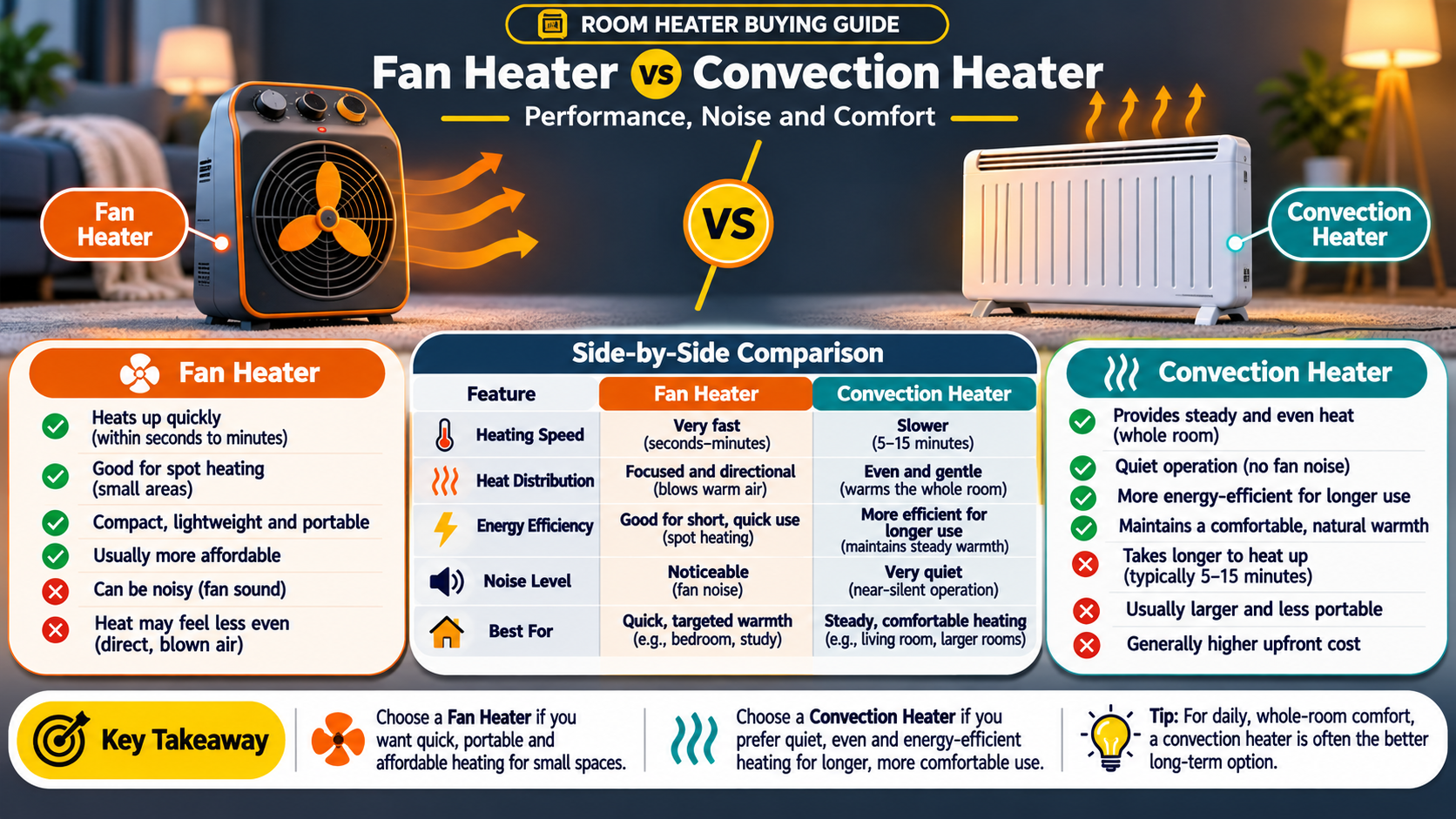
Fan Heater vs Convection Heater: Side-by-Side Comparison
| Feature | Fan Heater | Convection Heater |
|---|---|---|
| Heat-up speed | Very fast | Slow to moderate |
| Noise level | Audible fan hum | Silent |
| Heat distribution | Directional, local | Even across the room |
| Heat retention | Low | Good (best with oil-filled) |
| Best room size | Small to medium | Medium to large (well insulated) |
| Portability | Very light | Moderate to heavy |
| Typical price | Budget-friendly | Mid-range |
| Best use | Short bursts | Long, steady heating |
Which Heater Is Cheaper to Run?
This is the question most buyers care about, and the honest answer surprises people: at the same wattage, both heaters cost the same to run. Almost all the electricity an electric heater uses ends up as heat in your room, so a 2000 W fan heater and a 2000 W convection heater both draw 2 kWh of power per hour at full output.
The real difference is how you use them. Here is the simple formula:
Example: a 2 kW heater at an electricity price of 0.20 per unit costs 2 × 0.20 = 0.40 per hour at full power.
- A fan heater reaches a comfortable temperature faster, so it can be cheaper if you only need heat for 20 to 30 minutes.
- A convection heater with a good thermostat cycles on and off once the room is warm, which can use less energy over several hours.
- Using the wrong heater for the room (for example a small fan heater in a large, drafty space) simply makes you run it for longer.
Whichever you pick, a built-in thermostat and a timer are the two features that save the most money.
How Much Power Do You Need?
A common rule of thumb is about 100 watts per square metre of floor area for a room with normal insulation and standard ceiling height. Poorly insulated rooms, high ceilings or large windows need more.
Safety: Fan Heater vs Convection Heater
Modern heaters from reputable brands are safe when used properly, but there are some differences worth knowing.
- Surface temperature: panel and oil-filled convection heaters often have cooler casings, though oil-filled radiators can still get hot to the touch. Fan heater casings stay cooler, but the air outlet and grille can get very hot.
- Tip-over protection: look for an automatic cut-off that switches the heater off if it is knocked over. This matters most with fan heaters, which are small and light.
- Overheat protection: essential on both types. Never cover a heater or drape clothes over it to dry.
- Distance: keep any heater at least one metre from curtains, bedding and furniture.
- Power supply: plug directly into a wall socket. Avoid extension reels, which can overheat under a heavy load.
- Bathrooms: only use a heater designed and rated for damp or wet areas, and keep it well away from water.
- Children and pets: a convection panel with a cool-touch casing or a heater with a child lock is a safer choice for family homes.
Noise and Air Quality
A fan heater always makes some noise, from a soft whoosh to a noticeable hum on cheaper models. That is fine in a garage but frustrating in a bedroom or while you work on a video call.
Convection heaters are silent. They also do not push air around the room, so they stir up less dust. If anyone in your home has allergies, a convection heater is usually the more comfortable option. Neither type removes humidity from the air in a harmful way, but fan heaters can feel drier because of the direct airflow on your skin.
Which One Should You Choose? Real-Life Scenarios
Bedroom or nursery: convection. Silent operation and steady warmth mean better sleep.
Bathroom: a bathroom-rated fan heater for quick warmth, or a wall-mounted convection panel for continuous use.
Home office: convection if you work all day, or a small ceramic fan heater under the desk for short sessions.
Living room: convection for the main heating, with a fan heater as a boost on very cold evenings.
Garage or workshop: fan heater, because it delivers fast heat and noise is not a concern.
Rented flat or student room: a lightweight ceramic fan heater is cheap and portable, while an oil-filled radiator suits longer stays.
Large open-plan space: neither is ideal as a sole source. A higher-wattage convection unit helps, but consider insulating or using several heaters.
Buying Checklist: Features That Matter
- Adjustable thermostat: keeps the room at a steady temperature and saves energy.
- Multiple heat settings: lets you choose between low, medium and high output.
- Timer: switch on before you wake up or switch off after you fall asleep.
- Tip-over and overheat protection: non-negotiable safety features.
- Oscillation (fan heaters): spreads warmth over a wider area.
- Frost protection mode: helps keep unused rooms above freezing.
- Remote control or app: handy if you want to heat the room before you get there.
- Noise rating: check customer reviews for real-world fan noise.
- Warranty and certifications: look for recognised safety marks and a clear warranty period.
Common Mistakes to Avoid
- Buying on price alone without checking wattage against room size.
- Expecting a convection heater to warm a cold room in five minutes.
- Leaving a fan heater running all night in a bedroom.
- Placing a heater right beside a wall or furniture, which blocks airflow.
- Skipping the thermostat setting and running the heater flat out.
- Ignoring draughts. Sealing gaps around doors and windows can improve any heater’s performance.
Tips to Get More Warmth From Any Heater
- Close doors and windows to keep the warm air in.
- Use thick curtains and draught excluders.
- Heat only the room you are using.
- Place the heater away from cold external walls and large windows.
- Set the thermostat to a comfortable temperature rather than the maximum.
- Clean dust from grilles and vents regularly.
Frequently Asked Questions
Is a fan heater or a convection heater better?
Neither is better in every case. A fan heater is better for fast, short-term heating, while a convection heater is better for quiet, steady warmth over many hours.
Which uses less electricity?
At the same wattage they use the same energy per hour. Savings come from using the right heater, a thermostat and a timer, and from heating only the space you need.
Can I leave a convection heater on overnight?
Many modern convection heaters have thermostats and safety cut-offs designed for extended use, but always follow the manufacturer’s instructions. Keep it clear of bedding and curtains, and never cover it.
Are fan heaters safe to leave unattended?
It is best not to leave any portable heater running while you are out or asleep unless the manufacturer specifically says it is designed for that. Fan heaters in particular are better for supervised, short-term use.
Which heater warms a room faster?
A fan heater. You feel warm air within seconds, whereas a convection heater needs time to raise the temperature of the entire room.
Which is best for a bedroom?
A convection heater, ideally oil-filled or a panel model with a thermostat and timer. It is silent, does not blow air on you and keeps the temperature stable.
What wattage heater do I need?
Aim for roughly 100 watts per square metre of floor area, and go higher for poorly insulated rooms or high ceilings.
Do heaters dry out the air?
Electric heaters do not remove moisture from the air, but warmer air feels drier, and the direct airflow from a fan heater can make your skin and throat feel drier than gentle convection warmth.
Final Verdict
The fan heater vs convection heater decision comes down to how you plan to use it. If you want quick bursts of heat for a small area, a fan heater is affordable, light and effective. If you want a comfortable, quiet and evenly heated room for hours, a convection heater is worth the extra investment.
Many households end up with both: a convection heater for everyday comfort and a compact fan heater for instant warmth on the coldest mornings. Check the wattage, make sure it has a thermostat and proper safety cut-offs, and choose the heater that matches your room and routine.
Match the heater type to your room size and how long you will use it each day, then compare thermostat, timer and safety features before you buy.