







Portable Electric Heater vs Infrared Heater: Which One Is Right for You?
When the temperature drops, a good space heater can turn a freezing room into a cozy retreat within minutes. But once you start shopping, one question comes up again and again: should you buy a portable electric heater or an infrared heater? Both plug into a standard outlet, both are widely available, and both promise fast warmth. Yet they work in very different ways, and choosing the wrong one can leave you cold, frustrated, or paying for heat you never feel.
This complete guide explains how each type works, compares their strengths and weaknesses, looks at running costs and safety, and helps you decide which heater suits your home, office, or workshop.
Quick Answer: Which Is Better?
If you want to warm an entire small or medium room evenly, a portable electric heater (especially a ceramic or oil-filled model) is usually the better pick. If you want instant warmth for yourself in a specific spot, or you are heating a drafty, poorly insulated space like a garage, an infrared heater is often the smarter choice. The details below will help you confirm which category fits your situation.
What Is a Portable Electric Heater?
“Portable electric heater” is a broad term. In most buying guides it refers to convection-style heaters, which heat the air around them and let that warm air spread through the room. Common types include:
- Ceramic fan heaters: A ceramic heating element warms up quickly, and a fan pushes warm air outward. They are compact, affordable, and popular for bedrooms and offices.
- Oil-filled radiator heaters: Electricity heats sealed oil inside metal fins. The fins release heat slowly and steadily, so the heater runs silently and keeps radiating warmth even after it cycles off.
- Coil or fan-forced heaters: Simple, low-cost units that heat quickly but can feel dry and are often louder.
- Tower heaters: Slim, upright designs that often include oscillation, thermostats, timers, and remote controls.
Because these heaters warm the air itself, the whole room gradually reaches a comfortable temperature. That makes them well suited for spaces where you will be sitting or sleeping for several hours.
What Is an Infrared Heater?
An infrared heater produces radiant energy, similar in principle to the warmth you feel from the sun on a cold day. Instead of heating the air, the infrared waves travel in a straight line and warm the first solid objects they reach, such as your skin, clothing, furniture, and floors. Those objects then release some of that heat back into the room.
Infrared heaters come in several forms: quartz tube models, panel heaters, cabinet-style units with a wooden or metal casing, and patio or garage heaters. The key point is that you feel the warmth almost immediately when you are within the heater’s line of sight.

How Each Heater Warms Your Space
The biggest difference between these two options is the heat transfer method.
Convection (portable electric heaters): Warm air rises, cooler air sinks, and a natural circulation pattern forms. This takes time, but once the room reaches temperature, it stays fairly even from corner to corner. The downside is that opening a door or window lets that warm air escape, and the heater must work to rebuild it.
Radiant (infrared heaters): You feel heat without waiting for the air to warm. Since the heater is not trying to raise the temperature of all the air in the room, drafts matter less. You can feel comfortable even if the air itself is still cool. The trade-off is that you only feel the warmth when you are in the path of the rays, and stepping out of that zone means the heat disappears.
Portable Electric Heater vs Infrared Heater: Side-by-Side Comparison
| Feature | Portable Electric Heater (Convection / Ceramic / Oil-Filled) | Infrared Heater |
|---|---|---|
| How it heats | Warms the air, which circulates through the room | Radiates energy that warms people and objects directly |
| Heat-up feel | Gradual; the room warms over time | Almost instant warmth on your skin |
| Best for | Whole-room heating in small to medium spaces | Spot heating, drafty rooms, garages, workshops, desks |
| Noise | Fan models hum; oil-filled models are silent | Usually silent or very quiet |
| Air quality | Fan models can stir up dust | Does not move air, so less dust circulation |
| Temperature evenness | More uniform across the room | Warmest in the direct line of the heater |
| Typical power | Commonly up to 1,500 watts | Commonly up to 1,500 watts |
| Heat retention | Oil-filled models keep radiating after switching off | Heat fades quickly once switched off |

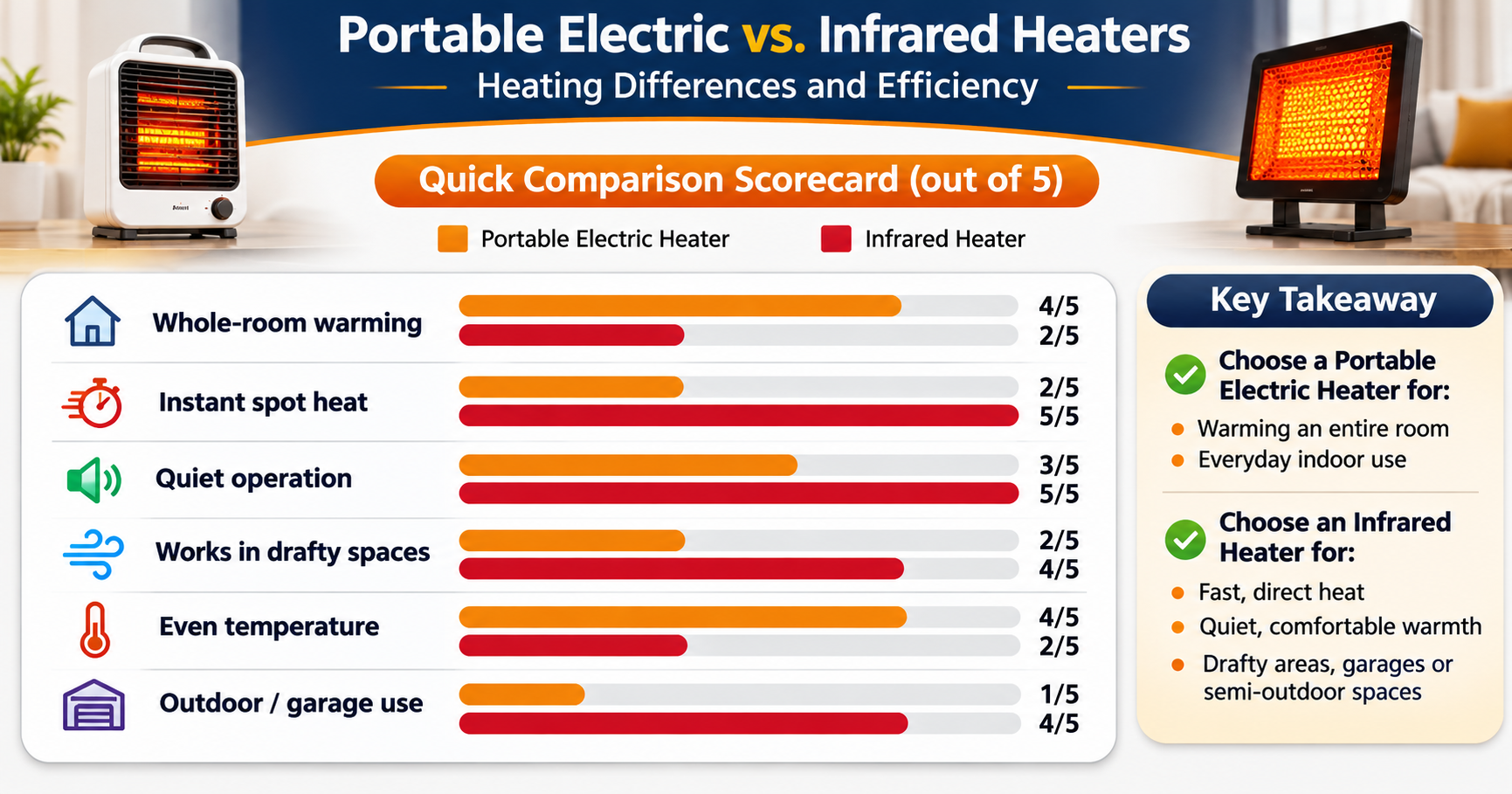
The scorecard above is a general guide. Individual models vary, so always check the features of the specific heater you are considering.
Advantages of Portable Electric Heaters
- Even room heating: Warm air circulates, so you are comfortable anywhere in the room.
- Wide variety of styles: From compact desktop units to oscillating towers and silent oil-filled radiators, there is a design for almost every need.
- Often more affordable upfront: Basic ceramic fan heaters are among the cheapest ways to add warmth to a room.
- Useful features: Many models include adjustable thermostats, timers, remote controls, eco modes, and digital displays.
- Heat retention (oil-filled): Oil-filled radiators continue releasing warmth after the heating element switches off, which suits overnight use.
Disadvantages of Portable Electric Heaters
- Slower to feel warm: You wait for the air temperature to rise before you notice a difference.
- Heat loss in drafty rooms: Warm air escapes through gaps, doors, and windows.
- Fan noise: Fan-driven models can be noisy, which may bother light sleepers.
- Dry air and dust: Fan heaters move air and dust around, which can irritate some people.
Advantages of Infrared Heaters
- Immediate warmth: You feel comfortable within seconds when you sit in front of one.
- Quiet operation: Many infrared models have no fan at all.
- Great for spot heating: Ideal for desks, workbenches, reading chairs, and bathrooms.
- Works well in drafty spaces: Because it heats objects rather than air, heat loss from open doors or leaky windows has less impact on how warm you feel.
- Less air movement: Without a fan stirring things up, dust and allergens are not circulated as much.
- Versatile placement: Wall-mounted, freestanding, and outdoor-rated options are widely available.
Disadvantages of Infrared Heaters
- Line-of-sight heating: If something blocks the rays, you will not feel the warmth.
- Uneven room temperature: The area near the heater feels warm, while distant corners may stay cool.
- Heat stops quickly: Once switched off, the warmth fades fast because there is little stored heat.
- Higher price for quality models: Well-built infrared heaters, especially cabinet-style units, can cost more than basic convection heaters.
Energy Efficiency and Running Costs
Here is something many shoppers do not realize: nearly all electric space heaters convert almost all the electricity they use into heat. A 1,500-watt portable electric heater and a 1,500-watt infrared heater use the same amount of electricity and produce the same amount of heat energy. The difference lies in how that heat reaches you.
To estimate your cost, use this simple formula: watts ÷ 1,000 × hours used × your electricity rate per kilowatt-hour. For example, a 1,500-watt heater running for 8 hours uses 12 kilowatt-hours. Multiply that by your local rate to see your daily cost.
So which one feels cheaper to run? It depends on how you use it:
- If you only need to warm yourself in one spot, an infrared heater can feel more efficient, because you may be able to use a lower setting or run it for shorter periods.
- If you need to warm a whole closed room, a convection heater with a good thermostat can hold the temperature steadily and cycle on and off to save energy.
Remember that no space heater is cheap to run for long periods. Use a thermostat and timer wherever possible, and consider a heater only as a supplement to your main heating system.
Safety: What You Need to Know
Any heater can be dangerous if used carelessly. Whichever type you choose, look for these safety features and follow these habits:
- Tip-over protection: The heater should shut off automatically if knocked over.
- Overheat protection: An internal sensor should cut power if the unit gets too hot.
- Certification marks: Choose models tested by a recognized safety laboratory.
- Cool-touch housing: Especially important if you have children or pets.
- Keep clearance: Place the heater at least three feet away from curtains, bedding, furniture, and anything flammable.
- Plug directly into the wall: Avoid extension cords and power strips, which can overheat with high-wattage appliances.
- Never leave it unattended: Switch the heater off when you leave the room or go to sleep, unless the manual specifically says otherwise.
Infrared heaters have exposed glowing elements in some designs, so keep them well away from anything that can burn and avoid placing them where someone could brush against them. Fan heaters should be kept free of dust, since built-up dust near the heating element can be a hazard.
Which Heater Is Best for Each Situation?
Bedroom
An oil-filled radiator or a quiet ceramic tower heater works best. Silent operation and steady, even heat help you sleep comfortably. Choose a model with a thermostat and timer.
Home Office or Desk
A small infrared heater aimed at your legs or feet delivers instant comfort without heating a whole room. A compact ceramic heater is also a good option if you want to raise the room temperature slightly.
Living Room
For larger open spaces, a ceramic tower with oscillation or an infrared cabinet heater can both work. If the room is drafty, infrared may feel more comfortable. If the room is well sealed, convection will spread heat more evenly.
Bathroom
Choose a heater specifically rated for bathroom or damp-area use. Wall-mounted infrared panels and bathroom-rated ceramic heaters are common choices. Never use a standard heater near water.
Garage or Workshop
Infrared heaters are generally the better fit. Large, drafty spaces are hard to warm by heating the air, but radiant heat warms you and your tools directly while you work.
Kids’ Rooms and Homes With Pets
Prioritize cool-touch housing, tip-over protection, and a stable base. Oil-filled radiators with protective surfaces and enclosed ceramic heaters are popular here.
How to Choose: Buying Checklist
- Measure your room. A common rule of thumb is about 10 watts of heating power per square foot. A 1,500-watt heater suits a room of roughly 150 square feet.
- Decide between whole-room and spot heating. This one decision usually settles the portable electric vs infrared debate.
- Check noise level. If it will run while you sleep or work, silence matters.
- Look for a thermostat and timer. They keep the temperature steady and help control energy use.
- Verify safety features. Tip-over and overheat protection should be standard.
- Consider portability. Handles, wheels, and weight matter if you plan to move the heater between rooms.
- Read the warranty. A longer warranty often signals better build quality.
Common Myths About Space Heaters
Myth: Infrared heaters use far less electricity. A 1,500-watt infrared heater draws the same power as a 1,500-watt convection heater. The perceived savings come from using it for targeted heating.
Myth: Infrared heaters are unsafe because of radiation. The infrared waves from a space heater are the same kind of warmth you feel from the sun or a campfire. They are not the harmful kind of radiation associated with X-rays or ultraviolet light.
Myth: A higher-wattage heater is always better. Standard household outlets limit practical wattage, and an oversized heater in a small room will simply cycle on and off. Match the heater to your space.
Frequently Asked Questions
Is an infrared heater better than an electric heater?
Neither is universally better. Infrared heaters excel at instant, targeted warmth, while convection electric heaters excel at heating a whole room evenly. The right choice depends on how and where you will use it.
Which is cheaper to run, an infrared heater or a portable electric heater?
At the same wattage, both use the same electricity. Real-world costs depend on how well each fits your use: spot heating often favors infrared, while whole-room heating often favors convection with a thermostat.
Can I leave a portable electric heater on overnight?
Most manufacturers advise against leaving any space heater running unattended. If you use one at night, choose a model with a thermostat, timer, tip-over switch, and overheat protection, and follow the manual closely.
Do infrared heaters work in large rooms?
They can warm people and objects in a large room, but they do not raise the overall air temperature much. For very large spaces, you may need several units or a different heating solution.
Are oil-filled heaters considered portable electric heaters?
Yes. Oil-filled radiators are a popular type of portable electric heater. They heat slowly but retain warmth well and run silently.
Which heater is best for allergies?
Models without a fan, such as oil-filled radiators and many infrared heaters, move less air and may stir up less dust. Keeping any heater clean also helps.
Final Verdict
The portable electric heater vs infrared heater decision comes down to one question: do you want to heat the room, or heat yourself?
- Choose a portable electric heater (ceramic or oil-filled) if you want steady, even warmth in a small to medium room, such as a bedroom, nursery, or living space.
- Choose an infrared heater if you want instant, quiet warmth in a specific spot, or you are heating a drafty area like a garage, workshop, or patio.
Whichever you pick, choose a model with reliable safety features, size it to your space, and use a thermostat and timer to keep comfort high and energy use under control. With the right heater in the right place, you can stay warm all winter without wasting power.