




Finding the “perfect” home decor style is often misunderstood as a search for a single label—like “Modern” or “Boho.” In reality, the most successful rooms in 2026 are those that move away from rigid catalogues and toward Personal Narrative Design. This guide provides a deep dive into identifying your aesthetic, understanding the psychology of your space, and applying the professional “editing” techniques used by top designers.
1. The Psychology of Space: Why Style Matters
Before picking a color or a couch, you must define the emotional objective of the room. In 2026, interior design has shifted from “status-driven” to “well-being-driven.”
The “Nervous System” Check
How do you want your nervous system to respond when you walk into the room?
- The Decompressor (High Comfort, Low Stimulation): Best for bedrooms and reading nooks. Focuses on soft textures, low contrast, and curved lines.
- The Energizer (High Stimulation, High Creativity): Best for home offices or kitchens. Focuses on “dopamine decor,” bold accents, and high-contrast colors.
- The Social Grounder (Medium Stimulation, High Warmth): Best for living and dining rooms. Focuses on tactile materials (wood, stone) and “conversation circles” in furniture layout.
2. Defining the 2026 Design Movements
If you are looking for a foundational style to build upon, these four movements are currently defining the interior landscape:
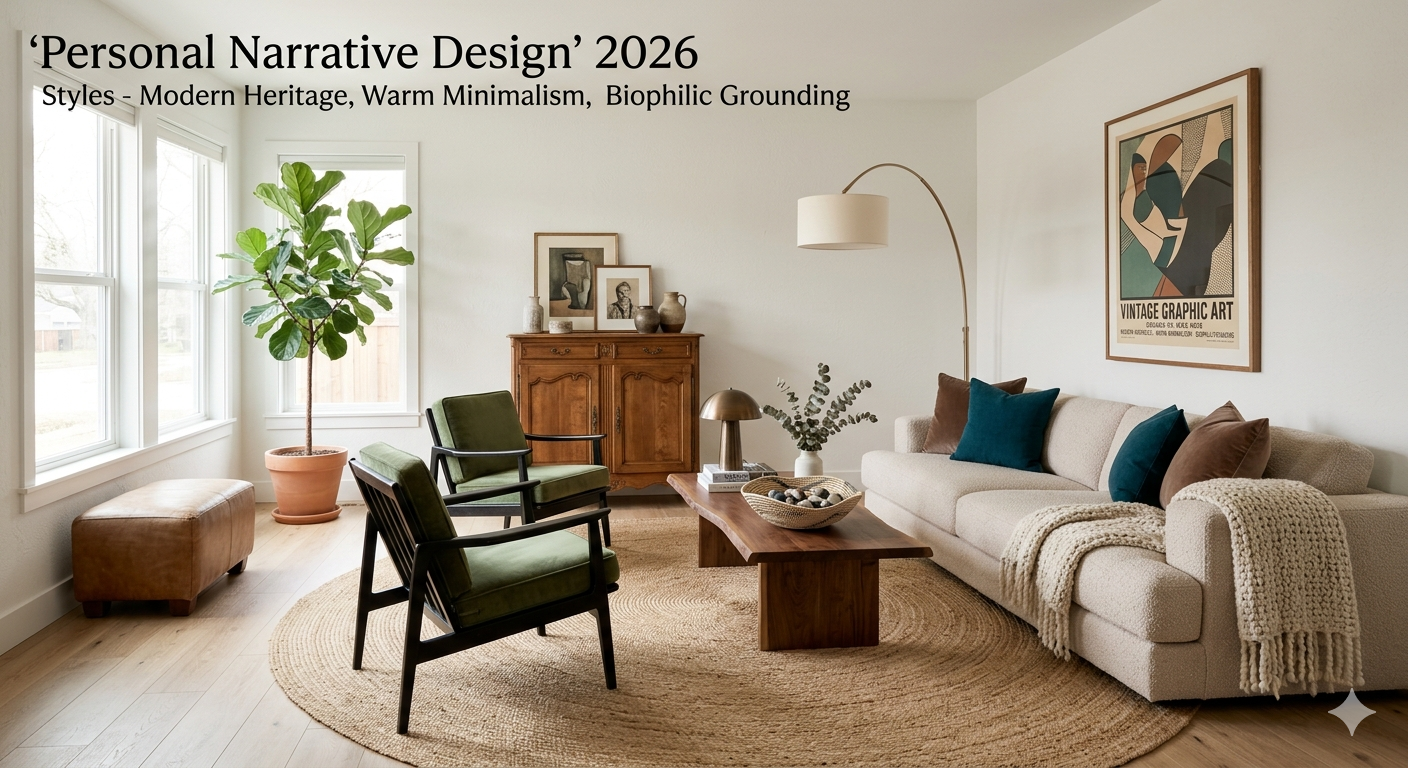
A. Modern Heritage (The “Old Soul” Style)
This style bridges the gap between past and present. It’s for those who love the sleekness of modern furniture but don’t want their home to feel like a sterile hotel.
- Key Elements: Classic moldings, dark lacquered woods paired with contemporary lighting, and “collected” vintage art.
- The Goal: A space that feels like it has been curated over decades, not bought in one weekend.
B. Japandi & Warm Minimalism
Minimalism hasn’t died; it just got warmer. The “Cold Gray” era is officially over.
- Key Elements: “Cloud Dancer” (Pantone’s 2026 off-white), light oak, bamboo, and stone.
- The Goal: To reduce “visual noise” and cognitive load. It’s about having fewer things, but making sure those things are high-quality and functional.
C. Biophilic Grounding
This isn’t just about “adding a plant.” It’s a design philosophy that integrates the natural world into the structural bones of the room.
- Key Elements: Sage greens, terracotta, cork walls, and maximizing natural light.
- The Goal: To lower cortisol. Studies show that rooms with natural textures and “fractal patterns” (like wood grain) significantly improve mental health.
D. Expressive Maximalism
For the storyteller. This style rejects the “less is more” mantra in favor of “more of what you love.”
- Key Elements: Gallery walls, mixed patterns (stripes with florals), and bold “jewel-tone” accents like deep teal or berry red.
- The Goal: Intentional self-expression. It’s about displaying books, travel souvenirs, and collectibles in a way that feels curated rather than cluttered.
3. The “Design DNA” Discovery Process
How do you know which one is yours? Use these three professional diagnostic tools:
Step 1: The Material Preference Test
Close your eyes and imagine running your hand across a surface. Which feels most “like home”?
- Cold & Smooth (Glass, Marble, Polished Metal) $\rightarrow$ Contemporary / Industrial
- Warm & Rough (Raw Wood, Linen, Jute) $\rightarrow$ Biophilic / Rustic
- Soft & Plush (Velvet, Bouclé, Sheepskin) $\rightarrow$ Glam / Traditional
Step 2: The Color Anchoring
Look at your current environment. Do you prefer High Contrast (Black vs. White) or Low Contrast (Beige vs. Cream)?
- High Contrast creates focus and energy.
- Low Contrast creates a sense of “unending space” and calm.
Step 3: The “Hero Object” Method
Pick one item in your room that you absolutely love. Is it a vintage lamp? A sleek tech gadget? A handmade ceramic bowl? Build the rest of the room to “talk” to that object. If the object is a handmade bowl, your style leans toward Organic/Wabi-Sabi. If it’s a sleek gadget, you lean toward High-Tech Modern.
4. Professional Execution: The 60-30-10 Rule
Once you have your style, use the 60-30-10 ratio to ensure the room stays balanced:
- 60% Primary Color/Style: This is your “Base.” Usually your walls, rugs, and large furniture. (e.g., Warm Neutrals).
- 30% Secondary Color/Style: This adds “Depth.” Usually your curtains, side chairs, or shelving. (e.g., Natural Wood/Mid-tones).
- 10% Accent Color/Style: This is your “Soul.” Your pillows, art, and small decor. This is where you can take risks with bold colors like Mocha Mousse or Deep Teal.
5. Avoiding the “Museum” Trap
A common mistake is making a room look so perfect that it becomes unlivable. To avoid this, apply the “Tactile Rule”: No matter how modern or sleek your style is, you must have at least two items that show “human touch”—something slightly asymmetrical, hand-woven, or weathered.
Final Checklist for Your Room
- [ ] Lighting: Do you have three sources? (Overhead, Task, and Ambient/Accent).
- [ ] Flow: Can you walk through the room without “thinking” about it? (Aim for 60cm of clearance around major paths).
- [ ] Editing: Have you removed one item that no longer fits the “narrative”?
Your perfect home decor style isn’t something you find in a magazine; it’s the intersection of your daily habits and your emotional needs. Start with one “hero” piece, and let the rest of the room follow its lead.