



Disclosure: This site may earn a commission if you buy through links elsewhere on the site, at no extra cost to you. Our comparisons are written to help you choose the right product, not to push a particular one.
When the temperature drops, two kinds of plug-in heaters keep coming up: the portable electric heater and the infrared heater. They look similar on a shop shelf and they use the same electricity from the same wall socket, so it is easy to assume they do the same job. They do not. One warms the air around you, the other warms you directly, and that single difference changes how comfortable you feel, how much you spend and where each one works best.
In this guide, we compare a portable electric heater with an infrared heater in plain language. You will learn how each one works, where each one wins, what they cost to run, how to use them safely and what to check before you buy.
Quick Answer: Which One Should You Choose?
- Choose a portable electric heater if you want to warm an entire small, closed room and stay there for hours.
- Choose an infrared heater if you want fast, targeted warmth for yourself or one spot, or if the space is drafty, open or poorly insulated.
Neither one is cheaper to run in a simple like-for-like sense, because both turn almost all of the electricity they use into heat. The real question is which one delivers that heat where you need it.
What Is a Portable Electric Heater?
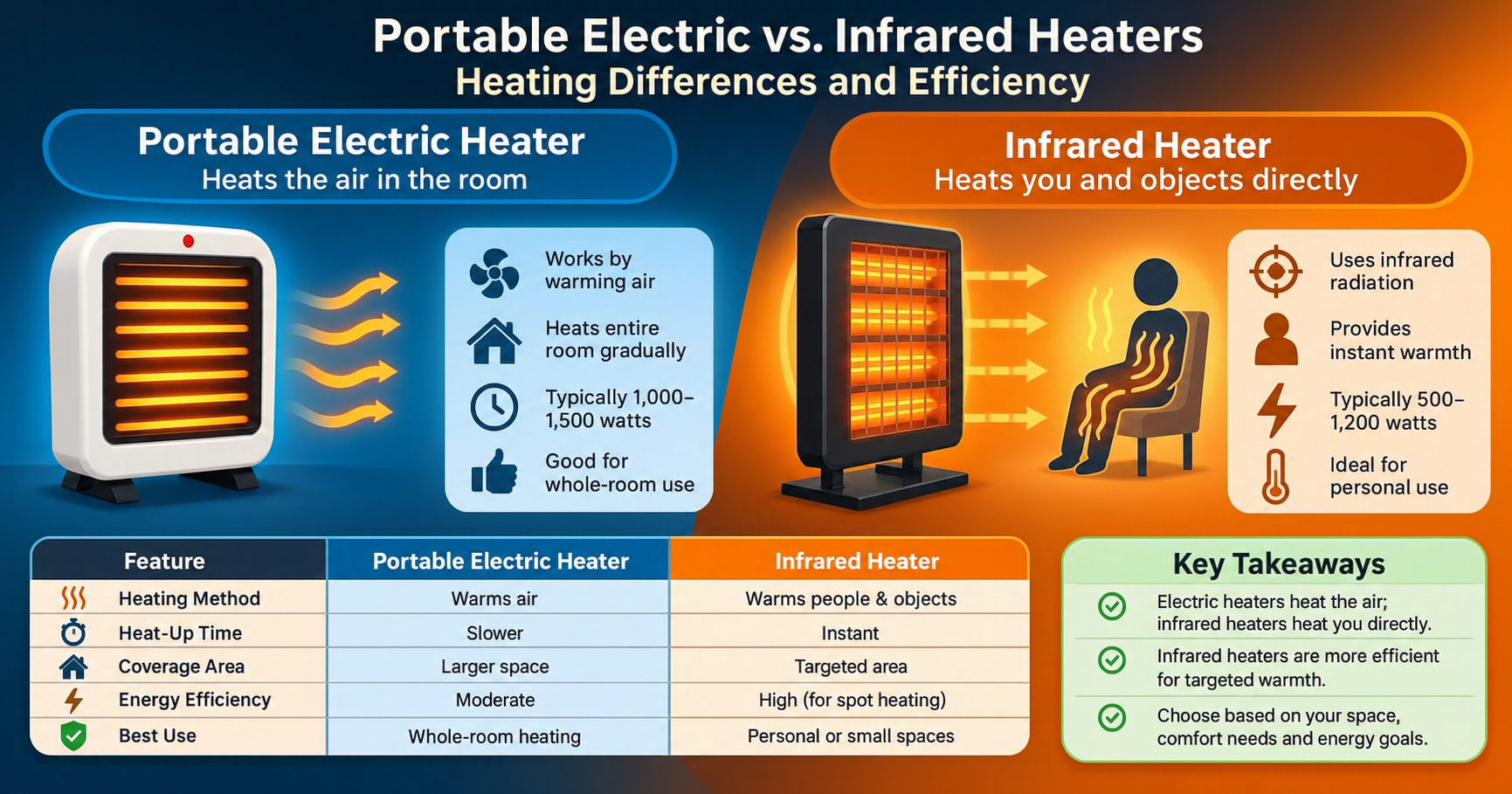
In everyday shopping, “portable electric heater” usually means a convection heater. Inside is a heating element, often ceramic, metal coil or an oil-filled column. The element heats the air that touches it. That warm air rises, cooler air moves in to replace it and, over time, the whole room warms up. This is called convection.
Common types include:
- Ceramic fan heaters: compact and quick. A fan pushes air across a hot ceramic element, which spreads warmth faster.
- Oil-filled radiators: a sealed column of oil is heated and releases warmth slowly. They are quiet and keep giving off heat for a while after you switch them off.
- Panel and baseboard-style convection heaters: slim units that warm the air gently without a fan.
Strengths of portable electric heaters
- Good at raising the temperature of a whole small room.
- Most models include a thermostat, so they can hold a steady temperature.
- Widely available in many sizes and price ranges.
- Oil-filled and fanless models are quiet, which suits bedrooms and study rooms.
Weaknesses of portable electric heaters
- They need a little time to warm the air before you feel the difference.
- Warm air escapes through open doors and drafty windows, so they struggle in large or leaky spaces.
- Fan models can be noisy, and they can stir up dust.
What Is an Infrared Heater?
An infrared heater works more like the sun than like a stove. Instead of warming the air first, it gives off infrared radiation, a form of energy that travels in straight lines and heats the first solid thing it meets: your skin, your clothes, the floor, a desk. You feel warm almost at once, even if the air in the room is still cool.
Common types include quartz or halogen tube heaters, carbon heaters and flat infrared panels. Some glow bright orange, while others, especially panels, give off heat without much visible light.
Strengths of infrared heaters
- You feel warmth within seconds, with no waiting for the room to heat up.
- Radiant heat is far less affected by drafts, which makes it handy for garages, workshops, covered patios and rooms with poor insulation.
- Most models run quietly because they do not need a fan.
- They are good for warming one person or one work area instead of an entire space.
Weaknesses of infrared heaters
- You only feel the warmth where the heat reaches. Step out of its path and the effect fades.
- They are not ideal for evenly warming a whole room.
- Warmth stops quickly after you switch the heater off.
- Glowing elements can be a distraction at night, and they need extra care around curtains and furniture.
Portable Electric Heater vs Infrared Heater: Side-by-Side Comparison
The table below puts the main differences next to each other.
| Feature | Portable electric heater | Infrared heater |
|---|---|---|
| Heating method | Heats the air, which then circulates (convection) | Radiates energy that warms people and objects directly |
| How fast you feel it | A few minutes in a small room | Often within seconds when you are in its path |
| Best for | Closed bedrooms, small offices, bathrooms with a safe model | Spot heating, garages, workshops, patios, drafty corners |
| Whole-room heating | Better, especially in an enclosed room | Limited, because it warms what it points at |
| Drafts and open doors | Warm air escapes and mixes with cold air | Less affected, since radiant heat does not depend on the air |
| Noise | Fan models hum; oil-filled and fanless models are quiet | Usually silent or nearly silent |
| Warmth after switch-off | Some warmth lingers in the room | Fades quickly once it is off |
| Light output | None on most ceramic and oil-filled models | Many models glow orange or red |
| Electricity use | Nearly all power becomes heat | Nearly all power becomes heat |
Which One Costs Less to Run?
This is the question most buyers ask, and the honest answer surprises people: for the same wattage, they cost almost the same. An electric resistance heater converts nearly all the electricity it draws into heat, whichever type it is. A 1,500-watt convection heater and a 1,500-watt infrared heater use the same amount of electricity per hour.
The difference lies in how much heater time you actually need:
- If you only need to feel warm at your desk or on the sofa, an infrared heater at a lower wattage can feel comfortable sooner, so you may not need to run it long or at full power.
- If you need the whole room to reach a comfortable temperature, a convection heater with a thermostat can cycle on and off to hold the temperature, which can be the more sensible way to heat a closed space.
To estimate the real cost for your own situation, use this formula.
Practical tip
A heater with a thermostat and a timer will not use less power while it is running, but it can stop running once the room is warm enough. That is where much of the real saving comes from.
Safety: What You Should Know Before Using Either Heater
Electric heaters are safe when used correctly, and most home heater fires come from misuse, such as placing a heater too close to something flammable. These habits apply to both types:
- Keep clear space. Leave at least three feet (about one meter) around the heater, free of curtains, bedding, paper and furniture.
- Plug directly into a wall socket. Avoid extension cords and power strips, since heaters draw a lot of current and can overheat thin cables.
- Look for a tip-over switch. This cuts power automatically if the heater is knocked over.
- Look for overheat protection. It shuts the heater off if internal temperatures rise too high.
- Never leave it running unattended or while you sleep unless the manufacturer says it is designed for that and you are comfortable with the risk.
- Keep it on a flat, hard surface and never place it on a bed, sofa or carpet pile that could block airflow.
- Check smoke alarms in the rooms where you use heaters.
- Take extra care around children and pets. Infrared elements and some metal casings can get very hot to the touch. Oil-filled radiators and models with cool-touch housing are usually more forgiving.
- Do not use a heater in wet areas unless it is clearly rated for that location.
Good to know
Because these heaters run on electricity, they do not burn fuel and do not produce carbon monoxide. That is a major difference from gas, kerosene or wood-burning heaters.
Which Heater Is Best for Each Space?
Bedroom
A quiet convection heater, such as an oil-filled radiator or a fanless panel model, is usually the better choice. It warms the room gently, a thermostat keeps the temperature steady, and there is no fan noise to disturb sleep.
Home office or study desk
An infrared heater aimed at your legs or torso is a good fit. You feel the warmth quickly and you do not need to heat the whole room for one person at a desk.
Living room
It depends on the room. A convection heater suits a smaller, well-sealed room. In a large or open-plan space, an infrared heater can give you a warm zone around where you sit.
Bathroom
Only use a heater that is specifically rated for bathroom use and installed according to its instructions. A standard portable heater should not be used near water.
Garage, workshop or covered patio
Infrared heaters usually perform better here. Warm air is hard to hold in these spaces, but radiant heat warms you and your work area directly.
Baby’s room or elderly relative’s room
Choose a model with cool-touch housing, a thermostat and automatic shut-off, and place it well away from the cot or bed. Check the room temperature with a thermometer instead of relying on the heater alone.
Common Myths About Electric Heaters
Myth 1: Infrared heaters are far cheaper to run
Marketing sometimes suggests they are. In reality, watt for watt, the electricity use is almost identical. Infrared can feel more efficient when you only need to warm yourself, because you are not heating the whole room.
Myth 2: Portable electric heaters dry out the air
A heater does not remove moisture. But when air warms up, its relative humidity drops, which can make the room feel drier. This can happen with any heater, and a small humidifier or a bowl of water can help if it bothers you.
Myth 3: Infrared radiation is dangerous
The infrared radiation from a household heater is the same kind of warmth you feel from the sun or a fire. It is not the same as ultraviolet light. The practical concern is touching hot surfaces or placing the heater too close to flammable items, not the radiation itself.
Myth 4: A higher wattage is always better
More watts means more heat output, but also higher running cost and a heavier load on your wiring. Match the wattage to your room size and use it with a thermostat instead of simply buying the biggest heater.
What to Check Before You Buy
- Room size. As a rough starting point, many heaters aim for around 10 watts per square foot of floor area in a room with average insulation. Poorly insulated rooms need more. Always check the manufacturer’s recommended room size.
- Wattage settings. Multiple heat settings let you lower the output once the room is comfortable.
- Thermostat and timer. These help control running cost and keep temperatures steady.
- Safety features. Tip-over protection, overheat protection and a cool-touch exterior matter more than any extra feature.
- Noise level. If you will use it in a bedroom or while working, check for a quiet or fanless design.
- Portability. Handles, wheels and a reasonable weight make it easier to move from room to room.
- Remote control and display. Handy extras if you want to adjust settings without getting up.
- Certification and warranty. Look for recognized safety marks for your country and a clear warranty.
- Cord length. Choose a model whose cord reaches the wall socket comfortably so you are not tempted to use an extension cord.
Frequently Asked Questions
Is an infrared heater better than a portable electric heater?
Neither is better in every situation. An infrared heater is better for fast, targeted warmth and for drafty or open spaces. A portable electric heater is better at raising the temperature of a whole small, closed room.
Do infrared heaters use less electricity?
Not at the same wattage. Both types turn nearly all their electricity into heat. An infrared heater can feel more economical when you only need to warm yourself, because you may run it for less time or at a lower setting.
Can an infrared heater heat a whole room?
It can warm objects and people across a room, but it does not heat the air as evenly as a convection heater. In a small, well-insulated room it may be enough. In a larger room, you will mainly feel warm in its path.
Which heater is best for a bedroom?
Most people prefer a quiet convection heater, such as an oil-filled radiator or a fanless panel heater, with a thermostat and automatic shut-off.
Is it safe to leave a portable heater on overnight?
Many manufacturers advise against leaving heaters running unattended or while you sleep. If you choose to use one overnight, pick a model with tip-over and overheat protection, give it plenty of clear space and plug it straight into the wall. Following the manufacturer’s instructions is the safest approach.
Which heater warms up faster?
An infrared heater. You feel its warmth almost immediately, while a convection heater needs time to warm the air in the room.
Can I use these heaters in a bathroom?
Only if the heater is specifically rated for bathroom use. A standard portable heater should be kept away from water and damp areas.
Which one is better for a large or drafty room?
Infrared usually works better in drafty or large spaces, because radiant heat warms you directly instead of relying on the air staying warm.
Final Verdict
The portable electric heater vs infrared heater decision comes down to one idea: do you want to heat the room or heat yourself?
If you want a comfortable, evenly warm bedroom, study or small living space where you will stay for hours, a portable electric heater with a thermostat is the sensible choice. If you want instant warmth at a desk, in a garage or in a space that never holds heat well, an infrared heater will feel better, faster.
For many homes, the best answer is to match the heater to the space: a quiet convection heater for bedrooms and an infrared heater for the spot where you work or relax. Whichever you pick, choose a model with proper safety features, size it to your room and use it with a thermostat or timer so you stay warm without wasting power.