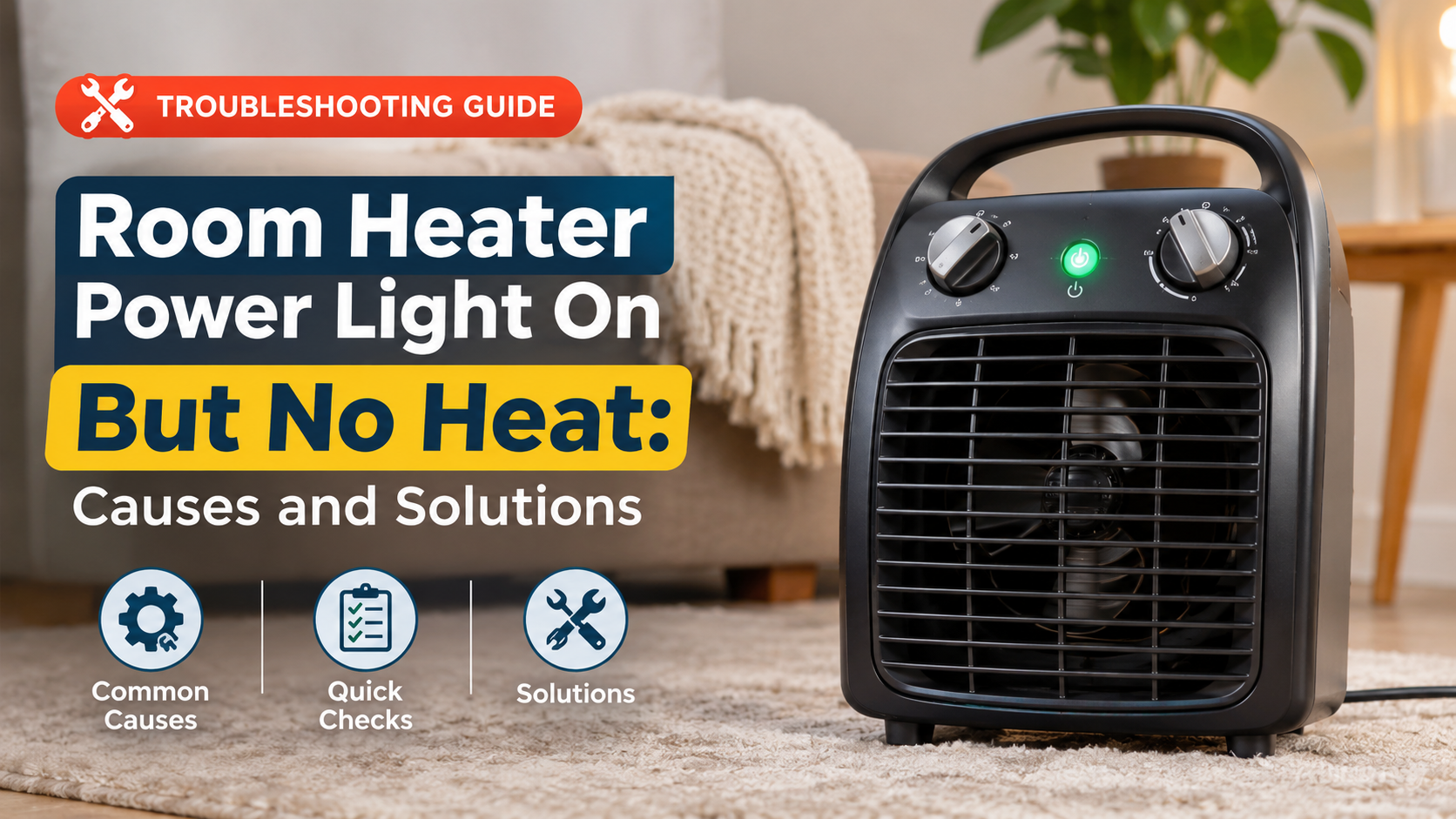



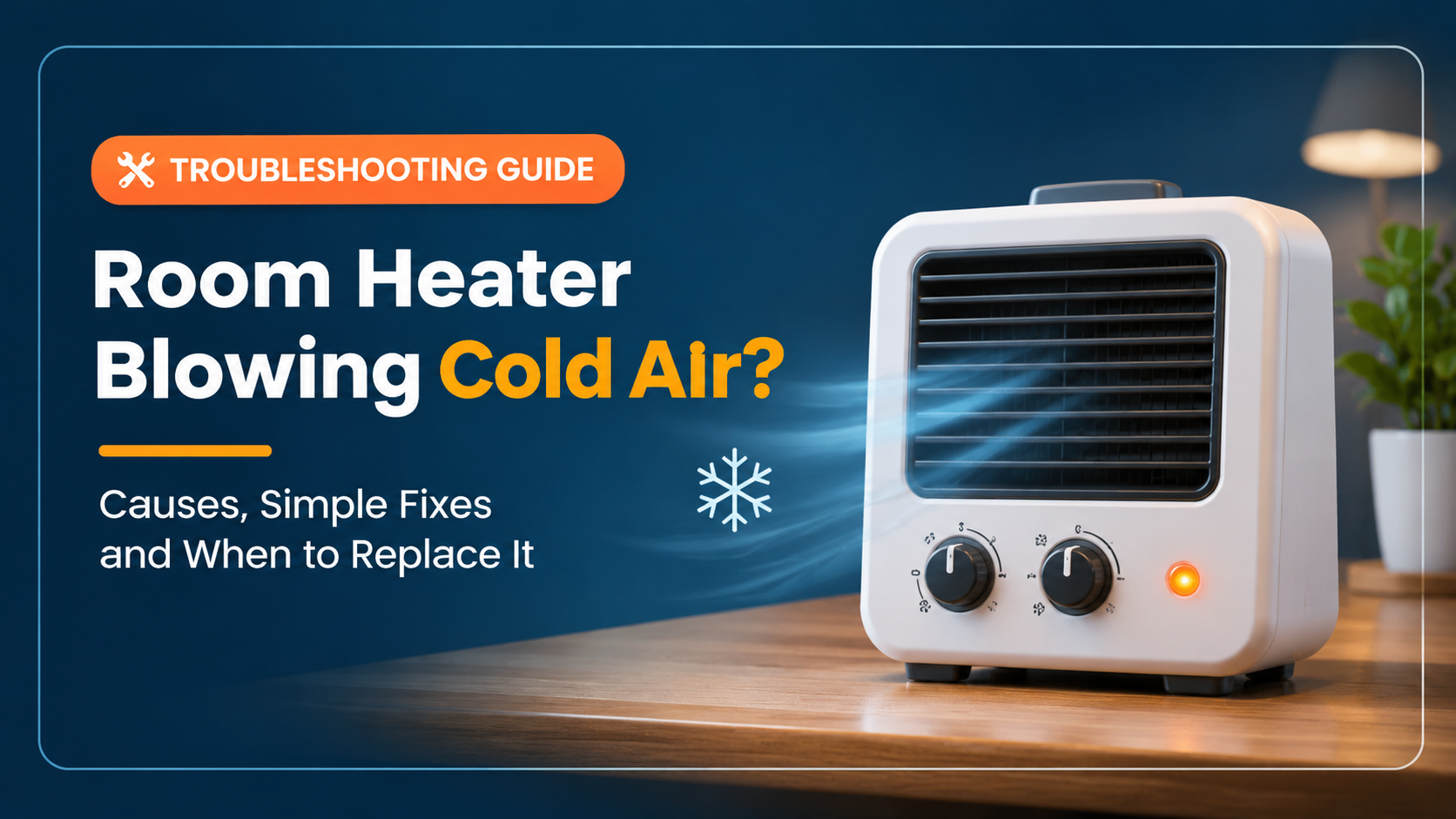

You switch on your room heater on a chilly evening, hold your hands up to the grille, and feel… cool air. The fan is running and the power light is on, but the warmth you were counting on is missing. If that sounds familiar, you are far from alone. A room heater blowing cold air is one of the most common heater complaints, and in many cases the cause is simple and can be fixed in a few minutes without any tools.
In this guide you will learn how a room heater actually produces warm air, the 9 most common reasons it blows cold air, a clear step-by-step troubleshooting routine, how to clean it safely, when it makes sense to repair or replace it, and what to look for if you decide to buy a better heater.
Quick answer: A room heater usually blows cold air because of the wrong mode or a low thermostat setting, a clogged filter or blocked vent, tripped overheat protection, a weak power supply (such as an extension cord), or a failed heating element or thermostat. Start with the free fixes (settings, cleaning and power) before assuming the heater is broken.
How a Room Heater Makes Warm Air
Understanding the basics makes troubleshooting much easier. Most electric fan heaters and ceramic heaters work in the same five stages: the heater pulls in cool room air through an intake, a fan moves that air across a heating element, a thermostat decides when the element should be on, safety switches cut the power if anything gets too hot, and the warmed air leaves through the outlet grille.

Because the warm air depends on every stage working together, a problem in any one of them can leave you with a fan that keeps blowing but no heat. That is exactly why a heater can sound perfectly normal and still feel cold.
9 Common Reasons Your Room Heater Is Blowing Cold Air
1. The Heater Is in the Wrong Mode
Many heaters have a fan-only or “cool” setting, and some have an eco or low setting that heats only slightly. If someone changed the mode, or a knob was bumped when the heater was moved, you may simply be blowing room-temperature air.
How to fix it: Set the mode to heat (usually marked with a flame or wavy-line symbol) and start with the highest heat setting. Lower it once the room is comfortable. If your heater has a remote control, replace the batteries and check which mode the display shows.
2. The Thermostat Is Set Too Low or the Room Has Already Reached the Target
Heaters with a built-in thermostat switch the heating element off as soon as the room reaches the set temperature. On many models the fan keeps running, so the air coming out is cool. If the dial is set below the current room temperature, the element will never switch on at all.
How to fix it: Turn the thermostat to maximum as a test. If warm air appears within a few seconds, the heater is fine and the setting was the problem. Also keep the heater away from direct sunlight and other heat sources, because the built-in sensor can read a falsely high temperature and shut the element off too early.
3. A Clogged Filter, Dusty Vent or Blocked Airflow
Dust, pet hair and lint collect on the air intake and around the heating element. Restricted airflow makes the heater run hotter inside, so the safety system reduces or cuts the heat, and the little air that gets through feels lukewarm. A heater pushed against a wall, curtains, bedding or furniture suffers from the same problem.
How to fix it: Unplug the heater, let it cool, and clean the intake, grille and any filter (see the cleaning steps below). Then leave at least 3 feet (about 1 metre) of clear space around it.
4. Overheat Protection or the Tip-Over Switch Has Tripped
Almost every modern heater has a thermal cut-off that switches the element off when the internal temperature gets too high, plus a tip-over switch that cuts power if the heater is knocked or placed on an uneven surface. On some models the fan keeps running after the element shuts off, which is why you get cold air.
How to fix it: Switch off and unplug the heater and let it cool for 15 to 30 minutes. Clean the vents, place it upright on a flat, hard surface, plug it back in and test again. If it keeps tripping, there is an underlying airflow or internal problem, so do not keep resetting it and hoping for the best.
5. Weak or Unstable Power Supply
Room heaters are among the most power-hungry appliances in a home, often drawing 1,000 to 2,000 watts or more. Thin extension cords, multi-plug adapters, worn sockets and overloaded circuits can cause a voltage drop, so the element does not get enough power to heat properly while the fan, which needs very little, keeps running. A loose plug or damaged socket can also interrupt power to the element.
Safety warning: Plug a heater directly into a wall socket. Avoid extension cords and power strips. If the plug, cord or socket feels hot, smells like burning or shows discoloration, stop using it immediately and have it checked.
How to fix it: Plug the heater into a different wall socket on a different circuit, and make sure the plug sits firmly. Check that no breaker or fuse has tripped.
6. Burnt-Out or Damaged Heating Element
The heating element is the part that actually creates the heat. Over time, repeated heating and cooling cycles, power surges and dust build-up can cause a coil to break or a ceramic plate to crack. When that happens, the fan still runs but the air stays cold. Typical signs include a burning smell followed by a sudden loss of heat, or a heater that produced weaker and weaker heat over several weeks before failing completely.
How to fix it: This is not a do-it-yourself job for most people, because the part carries mains electricity. If the heater is under warranty, contact the seller or manufacturer. Otherwise, ask a qualified appliance technician for a quote and compare it with the price of a new heater.
7. Faulty Thermostat or Temperature Sensor
If the thermostat or sensor is damaged, it may think the room is already hot and never allow the element to switch on. Signs include a heater that turns on and off every few seconds, shuts off almost immediately, or ignores the dial completely.
How to fix it: Test the heater on its maximum setting. If the fan runs but there is still no heat, the thermostat or sensor is a likely culprit. Replacement needs a technician or a manufacturer-approved part.
8. A Blown Thermal Fuse or Failed Control Board
Some heaters contain a one-time thermal fuse that permanently cuts power to the element after a serious overheating event. Others use a small circuit board to control the fan, element and display. When either part fails, the heater may switch on but never produce heat, or behave strangely with flashing lights or error codes.
How to fix it: Check the manual to see what any error code or flashing light means. Because these are internal electrical parts, replacement should be done by an authorized service center. For lower-priced portable heaters, replacing the whole unit is often more practical.
9. It May Not Be a Fault at All
Sometimes the heater works exactly as designed, but the room still feels cold because of how that type of heater works or the space it is used in:
- Warm-up time: Oil-filled radiators can need 15 to 30 minutes to reach full heat, and even fan heaters can blow slightly cool air for the first few seconds.
- Heater type: Oil-filled and infrared (radiant) heaters do not blow air by design. Infrared heaters warm people and objects in their line of sight rather than the air in the room.
- An undersized heater: A 1,000-watt heater in a large, cold living room will deliver warm air that disappears into the space long before the room feels comfortable.
- Drafts and poor insulation: Gaps under doors, single-pane windows and high ceilings pull heat away faster than the heater can supply it.
How to fix it: Close doors, block drafts, give the heater time to warm up, and use a heater rated for your room size (see the wattage guide later in this article).
Step-by-Step Troubleshooting Guide
Follow these steps in order. They move from the easiest, free checks to the ones that point to a real fault.

- Check the mode and temperature. Make sure the heater is on a heat setting and the thermostat is turned up. If it has a remote, check the batteries and the mode on the display.
- Test the output. Run the heater on its highest setting for two minutes, then carefully hold your hand about 6 inches (15 cm) in front of the grille. Do not touch the grille.
- Inspect for blockages. Look for dust on the intake and grille, a dirty filter, or objects such as curtains and furniture blocking the airflow.
- Reset the heater. Unplug it for 15 to 30 minutes to let the overheat protection reset, then plug it back in.
- Check the power source. Use a wall socket, not an extension cord, and try a different socket if possible. Make sure the breaker has not tripped.
- Listen and smell. A soft click when the thermostat switches on and off is normal. A strong burning smell, crackling or sparks is not: unplug the heater at once.
- Know when to stop. If the heater still blows cold air after all of these steps, stop using it and contact the manufacturer, seller or a qualified technician.
Does Your Heater Type Change the Fix?
Different heaters make heat in different ways, so the “cold air” complaint has different causes depending on what you own.
| Heater type | How it heats | Blows air? | Typical warm-up | Common “cold air” cause |
|---|---|---|---|---|
| Fan heater (coil) | Electric coil heats, fan pushes air across it | Yes | A few seconds | Fan-only mode, thermostat reached target, burnt coil |
| Ceramic (PTC) heater | Self-regulating ceramic plates heat the air | Yes | Seconds to 1 minute | Overheat cut-off, blocked airflow, low thermostat setting |
| Oil-filled radiator | Heated oil warms metal fins that radiate heat | No | 15 to 30 minutes | Not given enough time, or too small for the room |
| Infrared / radiant | Warms people and objects directly | Usually no | Almost instant | Standing outside its line of sight; it does not heat the air |
| Convection panel | Warm air rises and circulates naturally | Sometimes | 5 to 15 minutes | Room too large, drafts, thermostat set too low |
Heat Pump or Wall-Mounted Unit Blowing Cold Air?
If your “room heater” is actually a mini-split heat pump or an air conditioner running in heat mode, there are a few extra harmless causes. In cold weather these units run a defrost cycle, during which they may blow cool air for several minutes while the outdoor unit melts frost. Many also hold the indoor fan back for the first minute or two until the coil is warm enough to heat the air.
If the cold air continues for more than 10 to 15 minutes, check that the mode is set to heat, the temperature is set above the room temperature, and the filters are clean. If the problem remains, call a qualified HVAC technician.
How to Clean Your Room Heater Safely
Regular cleaning prevents many cold-air problems and is one of the best safety habits you can build. Clean your heater at the start of the heating season, and every few weeks if you use it daily or have pets.
- Unplug and cool down. Wait at least 30 minutes after use so every part is completely cool.
- Remove loose dust. Use a soft brush or a vacuum with a brush attachment on the grille, intake and vents.
- Clean the filter. If your heater has a removable filter, wash it as the manual says and let it dry completely before refitting it.
- Wipe the outer body. Use a dry or slightly damp microfiber cloth. Never spray liquids into the vents and never submerge the heater in water.
- Check the cord and plug. Look for cracks, fraying, discoloration or heat marks. Replace the heater if you see damage.
- Test it. Place the heater on a flat, hard surface and run it on high for a few minutes. A light dusty smell at first is normal and should fade quickly.
Repair or Replace? How to Decide
Once you have ruled out settings, dust and power problems, the question becomes whether a repair is worth it. Use these simple guidelines.
Repair makes sense when:
- The heater is still under warranty.
- It is a high-quality, premium or fixed (wall-mounted) heater that is expensive to replace.
- A technician has found a simple, inexpensive problem such as a switch, cord or fuse.
- The repair quote is well below half the price of a comparable new heater.
Replacement makes sense when:
- It is a budget portable heater and the repair cost is close to the price of a new one.
- The overheat protection trips again and again, even after cleaning.
- You notice burn marks, a melted plug or cord, or a persistent burning smell.
- The heater is many seasons old and has more than one fault.
Newer heaters also tend to offer better safety and comfort features, such as tip-over protection, overheat protection, adjustable thermostats, timers and energy-saving modes.
How to Choose a Room Heater That Will Not Let You Down
If your current heater is beyond saving, choosing the right replacement can prevent the same problem from happening again. The first step is getting the power right. A heater that is too small for the room will run constantly and still feel weak.

For most rooms with standard insulation and 8-foot ceilings, plan on about 10 watts per square foot. A 150-square-foot bedroom needs roughly 1,500 watts, while a 300-square-foot living room needs about 3,000 watts, which usually means a more powerful heater or two heaters sharing the load. Add 20 to 25 percent if the room has poor insulation, high ceilings or large windows.
Features worth paying for
- Adjustable thermostat: Keeps the temperature steady and saves energy.
- Overheat protection and tip-over switch: Essential safety features, especially around children and pets.
- Several heat settings: Lets you match the power to the room instead of running full blast.
- PTC ceramic element: Heats quickly and regulates its own temperature.
- Removable or easy-to-clean filter and grille: Makes regular cleaning quick.
- Timer, remote and automatic shut-off: Convenient and helpful for safe use.
- Quiet operation: Important for bedrooms and home offices.
- Heavy-duty cord and sturdy plug: Better build quality where the most power is drawn.
The best heater type for each situation
- Bedroom: A quiet ceramic heater with a thermostat, or an oil-filled radiator for silent, steady warmth.
- Home office or desk: A small ceramic or infrared heater for fast, personal warmth.
- Large living area: A higher-wattage ceramic or convection heater, or two heaters placed in different areas.
- Bathroom: Only a heater specifically rated for damp areas, installed according to the manual.
- Garage or workshop: A heavy-duty or fixed heater designed for the space.
Heater Safety Rules You Should Never Skip
Remember: A heater that overheats, trips or smells of burning is warning you about a problem. Switch it off and unplug it instead of forcing it to keep running.
- Keep at least 3 feet (1 metre) of clear space around the heater, away from curtains, bedding, furniture and paper.
- Plug it directly into a wall socket and avoid extension cords and power strips.
- Never cover the heater or use it to dry clothes.
- Do not leave it running unattended or while you sleep unless it is designed for it and has automatic shut-off.
- Place it on a flat, stable, hard surface, never on a bed or a sofa.
- Keep it away from water and damp areas unless it is rated for them.
- Keep children and pets away from the grille and hot surfaces.
- Test your smoke alarms regularly, and fit a carbon monoxide alarm if you use any fuel-burning heater.
Frequently Asked Questions
Why is my room heater blowing cold air but the fan is working?
A working fan only proves the heater is getting some power. The heating element itself is not switching on. The most common reasons are a low thermostat setting, the wrong mode, tripped overheat protection, or a failed element or thermostat.
Why does my heater blow cold air after a few minutes?
Most often the overheat protection is switching the element off because airflow is blocked by dust, or the thermostat has simply reached its target temperature. Clean the heater, give it more space and check the thermostat setting.
Can a dirty filter make a heater blow cold air?
Yes. A clogged filter or dusty intake restricts airflow, causes the heater to overheat and triggers the safety cut-off, which leads to weak or cool air.
How long should a room heater take to warm up?
Fan and ceramic heaters usually produce warm air within seconds to a minute. Oil-filled radiators can take 15 to 30 minutes, and convection panels often take several minutes.
Is it safe to keep using a heater that blows cold air?
If the cause is a simple setting or a dusty filter, yes, once you fix it. If the heater repeatedly trips, smells of burning or has a hot plug or cord, stop using it and have it checked or replaced.
Can I replace a heater element myself?
It is not recommended. Heater parts carry mains electricity, and a wrong repair can create a fire or shock risk and void your warranty. Leave internal repairs to a qualified technician or an authorized service center.
Why does my heater blow hot air and then cold air?
That can be normal thermostat cycling: the element switches off when the room reaches the set temperature and on again when it cools. If it switches on and off every few seconds, the thermostat may be faulty or the heater may be overheating from blocked airflow.
Why does my heater smell when I turn it on for the first time each season?
Dust that settled on the element over the months of storage burns off when the heater heats up. A light smell that disappears within a few minutes is normal. A strong or lasting burning smell is not, so unplug the heater and inspect it.
Final Thoughts
A room heater blowing cold air is frustrating, but it is rarely a mystery. Work through the checks in order: confirm the mode and thermostat, clean the filter and vents, let overheat protection reset, and make sure the heater has a solid power supply. In most cases that is all it takes to bring the warmth back.
If the heater still blows cold air after those steps, the heating element, thermostat or thermal fuse has probably failed. At that point, weigh the repair cost against a new heater, and choose a model with the right wattage and safety features for your room. Stay warm and stay safe.