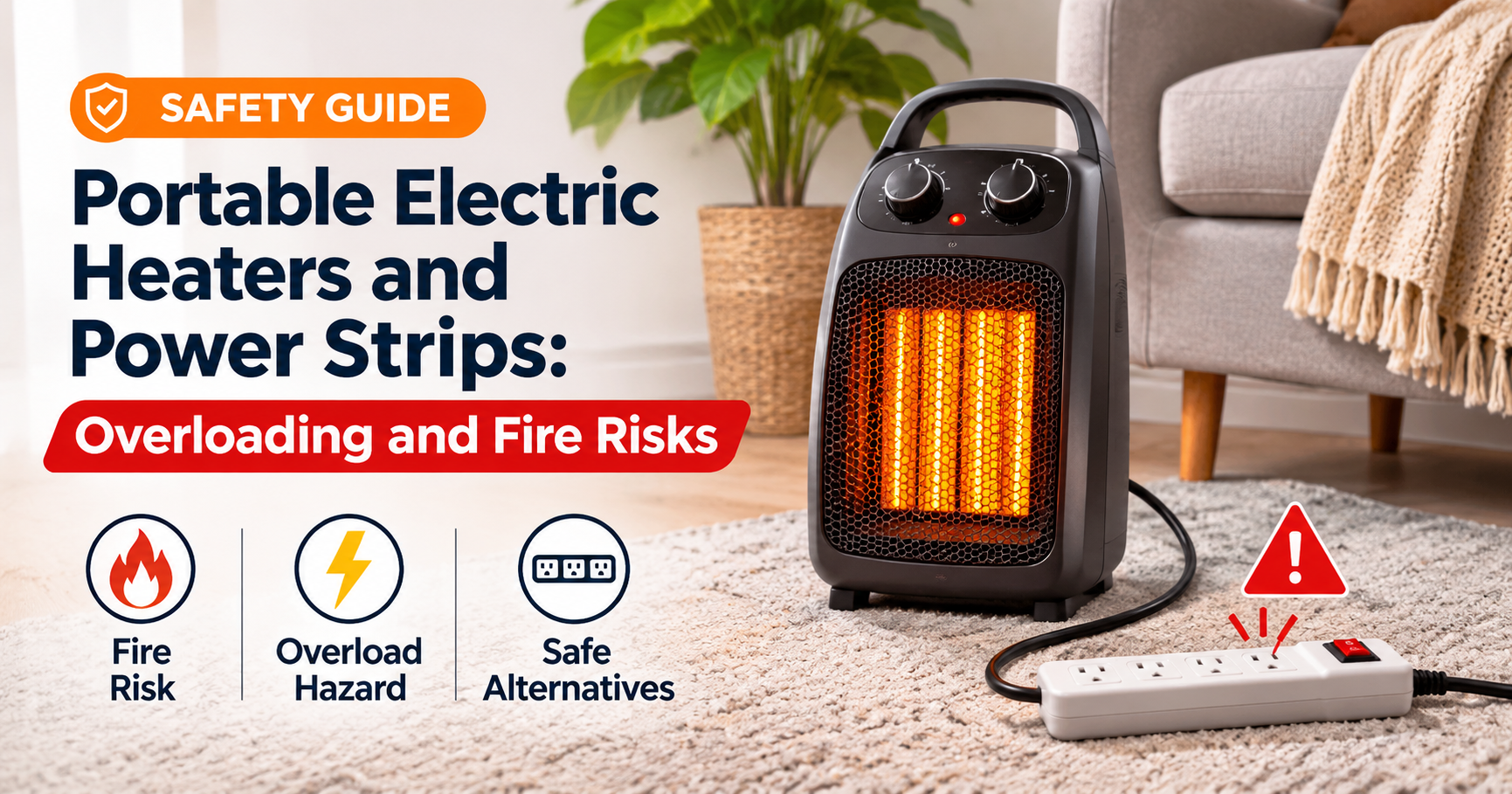

Every winter, millions of people switch on a portable electric heater and plug it into whatever outlet is closest. Very often that “outlet” is a power strip that is already crowded with a TV, a phone charger and a lamp. It feels harmless, but it is one of the most common ways an ordinary cold evening turns into an electrical fire.
So, can you plug a portable electric heater into a power strip? The short answer is no. In this guide you will learn why heaters and power strips are a dangerous pair, how to work out the electrical load yourself, which warning signs to watch for, and exactly what to do instead so you can stay warm without taking risks.
Key Takeaways
- Plug a portable electric heater directly into a wall outlet, every time.
- A 1500 W heater draws about 12.5 amps at 120 V, close to the entire limit of a standard 15 A circuit.
- Power strips and surge protectors are built for low-power electronics, not for heating elements that run for hours.
- A warm plug, a burning smell or a tripping breaker means: unplug the heater and stop using that outlet.
- Keep the heater at least 3 feet (1 meter) away from anything that can burn, and never leave it running unattended.
Why Portable Heaters Are Different From Other Appliances
Most things we plug into a power strip are gentle on the wiring. A phone charger uses a few watts, a laptop charger around 60 watts, and a television roughly 100 to 150 watts. A portable electric heater works in a completely different category. Its only job is to turn electricity into heat, and it needs a lot of power to do that.
- High wattage: most portable heaters are rated between 750 W and 1500 W, and some go up to 2000 W or more.
- Long running time: a laptop charger idles along, but a heater can run for hours at full power. Heat builds up in every part of the circuit during that time, including the plug, the cord and the outlet.
- Constant load: a heater does not “sip” power. When it is on, it pulls its full rated current almost without a break.
This is why safety organizations and heater manufacturers repeat the same advice: heaters should be plugged straight into the wall. Space heaters are consistently linked to a large share of home heating fires and to most of the deaths caused by heating equipment, and overloaded cords and outlets are a major reason.
The Simple Math: Watts, Volts and Amps
You do not need to be an electrician to understand the risk. One formula is enough:
Amps = Watts ÷ Volts
A 1500 W heater on a 120 V supply draws 1500 ÷ 120 = 12.5 amps. The table below shows what that looks like for common heater sizes, both on 120 V systems (such as the United States and Canada) and on 230 V systems (such as the UK, Europe, Asia and many other regions).
| Heater power | Current at 120 V | Current at 230 V |
|---|---|---|
| 500 W | 4.2 A | 2.2 A |
| 750 W | 6.3 A | 3.3 A |
| 1000 W | 8.3 A | 4.3 A |
| 1500 W | 12.5 A | 6.5 A |
| 2000 W | 16.7 A | 8.7 A |

Why 12.5 amps is already a problem
In many homes, a typical outlet circuit is protected by a 15 amp breaker. A widely used electrical guideline says that a load running for three hours or more should stay at or below 80% of the breaker rating. For a 15 A circuit, that is 12 amps. A 1500 W heater on high already slightly exceeds this level by itself. Add a TV, a lamp or a phone charger on the same circuit, and you are asking the wiring to carry more than it was designed to carry for long periods.
On a 230 V system the current is lower, so the numbers look friendlier, but the heat generated in a small plug, a thin cord or a worn socket is still the same problem. The advice does not change: connect the heater directly to a good wall socket.
What Actually Goes Wrong When You Use a Power Strip
A power strip looks sturdy, but it adds several extra links between the wall and the heater. Each link can become a hot spot.
- Thin internal wiring and cord: many budget strips use thin conductors that are fine for electronics but heat up quickly under a heavy, continuous load.
- Small internal contacts: the metal clips inside each socket are small. A heater plug never grips perfectly, and any loose connection creates resistance and heat.
- A rating that is a limit, not a target: many strips are marked 15 A or 1875 W. That is the absolute maximum, not a comfortable level for hours of non-stop use.
- Overload and switch parts: built-in breakers and switches can wear out, stick or fail, and cannot be relied on as your only protection.
- Surge protectors are not heater-safe: they are designed to absorb voltage spikes for electronics. They do not make a high-wattage heater any safer, and the extra components can overheat.
- Daisy-chaining: plugging one strip into another multiplies every one of the problems above.
- Hidden hazards: strips are often pushed behind furniture or under rugs, where heat cannot escape and you cannot see the damage.

Warning Signs Your Outlet, Cord or Plug Is Overloaded
Overheating usually announces itself before a fire starts. Learn these signs, and act the moment you notice any of them.
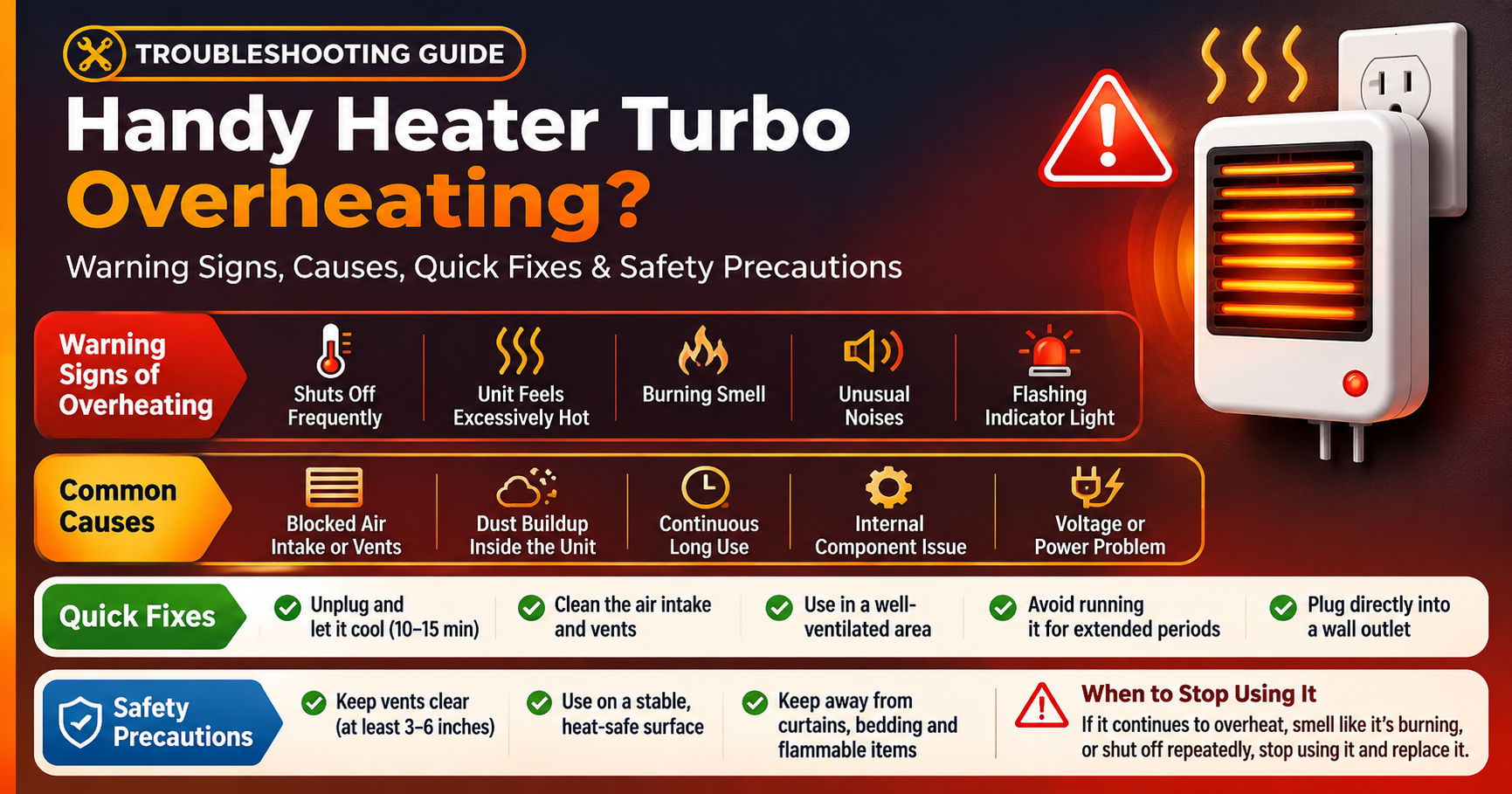
- The plug or outlet feels hot or even warm to the touch. A plug that is warmer than the room is not normal for a heater.
- A burning or hot plastic smell near the outlet, the strip or the heater.
- Discoloration, scorch marks or melted plastic on the plug, outlet plate or strip.
- Buzzing, crackling or sizzling sounds from the outlet.
- Flickering lights when the heater turns on.
- The breaker trips repeatedly. This is the system telling you the circuit cannot carry the load. Do not “fix” it by installing a bigger breaker, because the wires behind the wall were sized for the original one.
- A loose plug that slides out of the outlet or does not stay snug.
What to do: turn the heater off, unplug it carefully, let everything cool down and stop using that outlet or strip. Have the heater, the cord and the outlet checked before you use them again. If you see smoke or flames, leave the room and call your local emergency number.
What to Do Instead: A Safe Way to Power Your Heater
1. Plug directly into a wall outlet
This is the single most important rule. Choose an outlet that is in good condition: the face is not cracked or discolored, the plug fits firmly, and the plate stays cool during use.
2. Give the heater its own circuit when possible
Do not run other high-power devices on the same circuit at the same time. Things like hair dryers, microwaves, toasters, air conditioners and a second heater should be kept on a different circuit. If your breaker keeps tripping, ask a licensed electrician to review the wiring rather than guessing.
3. Avoid extension cords whenever you can
Most heater manufacturers say not to use them at all, so check your manual first. If you truly have no alternative and the manual allows it, take these precautions:
- Use a heavy-duty cord clearly rated for the heater’s wattage. Look for a thick wire (14 AWG at minimum, 12 AWG even better; a lower gauge number means thicker wire).
- Keep it as short as possible and fully uncoiled, because coiled cords trap heat.
- Use a cord with a single outlet, not a multi-outlet strip.
- Never run it under rugs, carpets or furniture, and check it often for warmth.
- Treat it as a temporary fix, then arrange a permanent solution such as moving the heater or asking an electrician to add an outlet.
4. Be careful with smart plugs and timers
Many smart plugs and plug-in timers are built for lamps and small electronics. Only use one if it is clearly rated for the full wattage of your heater as a continuous heating load, and prefer a heater with its own built-in thermostat and timer instead.
Heater Placement and Everyday Safety Rules
Good electrical habits are only half of the story. Where and how you use the heater matters just as much.
- Keep a 3-foot (1-meter) clear zone on all sides. Curtains, bedding, clothes, sofas, paper and rugs should stay well outside it.
- Place it on a flat, hard, stable floor. Never put it on a bed, a sofa, a thick carpet or a table that can wobble.
- Never leave it running unattended, and switch it off before you go to sleep or leave the house.
- Do not dry clothes or towels on it or cover it for any reason.
- Keep it away from water, including bathrooms, unless it is specifically designed and rated for that space.
- Protect children and pets. Pick a spot where nobody can bump it, touch the hot surface or pull the cord.
- Do not run the cord through high-traffic areas where it can be stepped on, pinched or chewed.
- Test your smoke alarms regularly and keep one in the room or hallway near where you use the heater.

How to Choose a Safer Portable Electric Heater
If you are shopping for a new heater, the right features reduce risk even when something goes wrong. Look for these:
- Tip-over protection: an automatic switch that cuts the power if the heater is knocked over.
- Overheat protection: a sensor that shuts the heater off if internal temperatures get too high.
- Adjustable thermostat: keeps the heater from running at full power non-stop and helps save electricity.
- A recognized safety certification mark from an independent testing laboratory (for example UL or ETL in North America, or CE and similar marks in other regions). Avoid unbranded heaters with no markings at all.
- A plug with built-in leakage protection (the kind with test and reset buttons), where available.
- Multiple power settings: a 750 W low setting lets you heat a small space with a much lighter electrical load.
- A cool-touch or well-guarded housing, and a cord that is long enough to reach the wall without any extension.
- A built-in timer to turn the heater off automatically.
Match the heater to the room
A common rule of thumb is about 10 watts of heating power for each square foot of floor space in a room with standard ceilings. A 150 square foot bedroom is therefore well served by a 1500 W heater, while a small 70 square foot room may only need 750 W. Buying a heater that is too powerful for the room wastes electricity and increases the electrical load for no benefit.
Common heater types at a glance
- Ceramic fan heaters warm up quickly and suit small rooms and short use.
- Oil-filled radiators heat more slowly but stay warm longer and give steadier, quieter heat. They still need a direct wall outlet.
- Convection heaters warm the air gently and are useful for general background heating.
- Infrared or radiant heaters warm people and objects directly, so clearance from combustibles matters even more.
No matter which type you choose, the power-strip rule is exactly the same.
Quick Safety Checklist Before You Switch It On
- Is the heater plugged directly into a wall outlet in good condition?
- Is it the only high-power device on that circuit?
- Is the cord undamaged, uncoiled and not under any rug or furniture?
- Is the plug firmly seated and cool to the touch after the first 10 to 15 minutes of use?
- Is the 3-foot clear zone really clear on every side?
- Is the heater standing on a flat, hard surface?
- Will someone be in the room, and will it be switched off when you sleep or leave?
- Do you have working smoke alarms nearby?
Regular Maintenance Tips
- Before each heating season, inspect the cord and plug for cracks, fraying, bent pins or discoloration.
- Gently remove dust from vents and grilles with a dry cloth or soft brush while the heater is unplugged and cool.
- Test the tip-over switch occasionally, following your manual.
- Store the heater in a dry place with the cord loosely wrapped, never tightly kinked.
- Replace the heater immediately if it has a damaged cord, a cracked housing, exposed wires, or if it has been dropped and now behaves strangely. Do not try to repair a heating element yourself.
Frequently Asked Questions
Can I plug a space heater into a surge protector?
No. A surge protector is designed to guard electronics against voltage spikes, not to carry a heavy heating load for hours. Plug the heater straight into the wall.
What if my power strip says it is rated for 15 amps or 1875 watts?
That rating is a maximum, and a 1500 W heater would use most of it continuously. Combined with thin internal parts and loose contacts, this still creates an unnecessary risk. The heater manual’s instructions always come first.
Is it safe to use an oil-filled radiator on a power strip?
No. Oil-filled radiators are still high-wattage appliances, and they often run for many hours. Use a wall outlet.
The heater plug gets warm. Is that normal?
A slightly warm plug can happen on a heavy load, but a plug that is hot or noticeably warmer than the heater body is a warning sign. Unplug the heater, let it cool, and check the plug, the outlet and the heater. If the problem returns, stop using that outlet and have an electrician inspect it.
Can I leave a heater on overnight?
Most safety guidance says to switch heaters off when you sleep or leave the room. Use a thicker blanket, warmer clothing or a safer heating arrangement for the night instead of a running heater.
My breaker keeps tripping when the heater is on. What should I do?
Turn the heater off and move it to a circuit with less load, or use its lower power setting. If tripping continues, ask a licensed electrician to inspect your wiring. Never replace the breaker with a larger one to stop the tripping.
Final Thoughts
Staying warm should never come at the cost of your safety. The safest approach to portable electric heater safety is also the simplest: plug the heater directly into a good wall outlet, keep it on its own circuit if you can, give it plenty of space, and never leave it running unattended. A power strip may be perfect for your computer and chargers, but it is simply the wrong tool for a heating appliance.
Take two minutes today to check your outlets, your cords and your heater’s position. Those small checks are the difference between a cozy winter and a dangerous one.
Disclaimer: This article provides general safety information and does not replace the manufacturer’s instructions for your heater or the advice of a licensed electrician. Electrical codes, voltage and outlet standards differ between countries, so always follow your local regulations.