
Quick answer: For most small rooms (up to about 150 square feet), a 1500-watt ceramic or oil-filled portable electric heater with a thermostat, tip-over protection and overheat shut-off is the safest and most practical choice. Choose ceramic for fast heat, oil-filled for silent all-night warmth, and infrared if you only need to warm yourself at a desk.
When winter arrives, heating an entire house just to stay warm in one bedroom, nursery or home office is wasteful. That is exactly why a portable electric heater for small rooms is one of the most popular seasonal purchases. It plugs into a standard outlet, warms a compact space in minutes, and can be moved from room to room.
But not every heater is a good match for a small space. Too little power and the room never feels warm; too much and you waste electricity and risk overheating. In this guide you will learn how to pick the right wattage, which type suits your room, which safety features matter most, what it really costs to run a heater, and how to use it safely.
Table of Contents
- Why a portable heater is ideal for small rooms
- How much wattage do you need?
- Types of portable electric heaters compared
- Essential safety features
- Features worth paying for
- How much does it cost to run?
- Best heater for each situation
- Safe placement and usage tips
- Common buying mistakes
- Frequently asked questions
- Final verdict
1. Why a Portable Heater Is Ideal for Small Rooms
Central heating warms every room whether you are using it or not. A portable electric heater lets you heat only the space you occupy, which can noticeably cut your heating bill during cold months. Here is why they work so well in compact rooms:
- Targeted warmth: Heat the room you are actually in instead of the whole home.
- Fast results: Small spaces warm up quickly, so even a modest heater feels effective.
- No installation: Plug it in and switch it on. There are no vents, pipes or fuel to manage.
- Easy to move: Carry it from bedroom to bathroom to office as needed.
- Clean operation: Electric heaters produce no fumes or combustion gases in the room, unlike fuel-burning units.
- Affordable upfront: Good models cost far less than installing a new heating system.
2. How Much Wattage Do You Need?
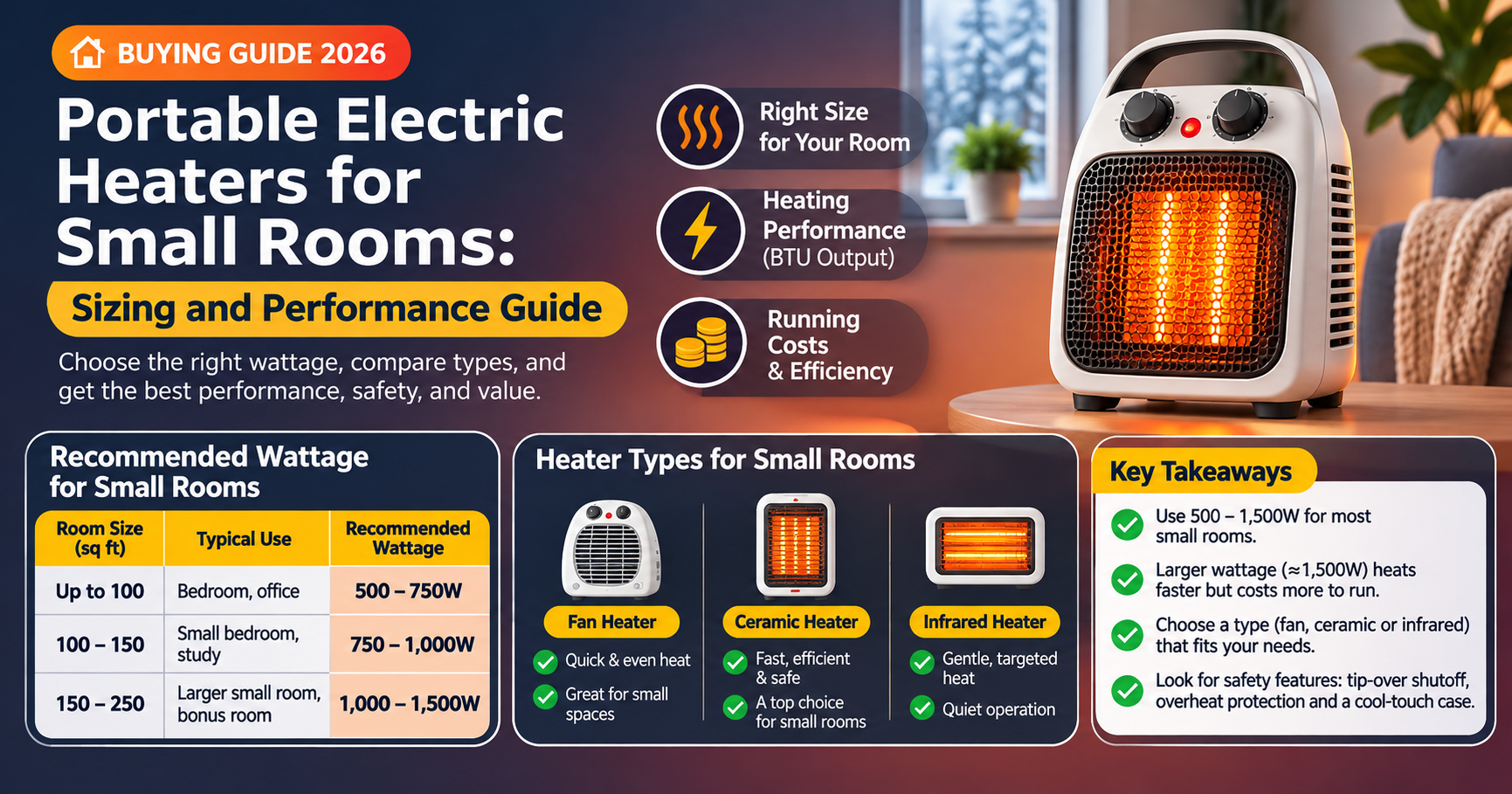
Wattage is the single most important number when buying a heater. A simple rule of thumb is to allow roughly 10 watts of heating power per square foot of floor space. Measure the length and width of your room in feet, multiply them, then use the result to estimate the wattage.

| Room Size | Typical Space | Recommended Wattage |
|---|---|---|
| Up to 50 sq ft | Small bathroom, closet, entryway | 500–750 W |
| 50–100 sq ft | Nursery, small office, dorm room | 750–1000 W |
| 100–150 sq ft | Standard bedroom, guest room | 1000–1500 W |
| 150+ sq ft | Larger bedroom or living area | 1500 W (may need longer to warm) |
Important: Most household outlets in North America are designed for a maximum of 1500 watts on a standard circuit, which is why nearly all portable heaters top out at that figure. Poor insulation, high ceilings, large windows or a very cold climate can make a room feel colder than its size suggests, so consider a thermostat model that can run a little longer when needed.
3. Types of Portable Electric Heaters Compared
All electric heaters convert nearly 100% of the electricity they use into heat. The real difference is how they deliver that heat, and that changes how they feel in a small room.

Ceramic Heaters
Ceramic heaters pass electricity through ceramic plates that heat up quickly, then a fan pushes warm air into the room. They are compact, light and usually the best all-rounder for bedrooms and offices.
Pros: Heats fast, small footprint, often includes oscillation and a thermostat, surfaces tend to stay cooler than coil heaters.
Cons: The fan produces some noise and can dry the air slightly.
Oil-Filled Radiator Heaters
These look like slim radiators. Electricity heats sealed oil inside, which keeps radiating warmth even after the heater cycles off. They are quiet and well suited to long periods of use.
Pros: Silent, steady and gentle heat, retains warmth, good for overnight comfort.
Cons: Slower to warm up, heavier and bulkier, and the metal surface can get hot.
Infrared (Radiant) Heaters
Infrared heaters warm people and objects directly instead of heating the air. This makes them useful when you sit in one spot, such as at a desk or reading chair.
Pros: Instant, directed warmth, quiet, works even in drafty spaces.
Cons: Warms only what is in its line of sight, so it is less effective at heating a whole room evenly.
Fan Heaters (Coil Fan Heaters)
A basic fan blows air across a hot metal coil. They are among the cheapest options and offer a quick burst of heat.
Pros: Low price, lightweight, rapid warm-up.
Cons: Often noisier, and the heat stops almost immediately when switched off.
Panel (Convection) Heaters
Slim, flat heaters that warm air by convection and can often be placed against a wall or stood upright. They suit tight spaces where floor room is limited.
Pros: Slim profile, quiet, safe low-profile design.
Cons: Slower warm-up, best for continuous low-level heating.
Quick Comparison Table
| Type | Heat-Up Speed | Noise | Best For |
|---|---|---|---|
| Ceramic | Very fast | Low–medium | Bedrooms and home offices |
| Oil-filled | Slow | Silent | Overnight and long sessions |
| Infrared | Instant (direct) | Silent | Desks and personal warmth |
| Fan heater | Fast | Medium–high | Bathrooms and quick boosts |
| Panel | Medium | Silent | Tight spaces and wall placement |
4. Essential Safety Features
Space heaters are a leading cause of home heating fires when used incorrectly, so safety features are not optional. Treat the following as a minimum checklist before you buy.

- Tip-over shut-off: Automatically cuts power if the heater is knocked over. Essential in homes with children or pets.
- Overheat protection: A sensor switches the unit off if internal temperatures rise too high.
- Cool-touch housing: A cooler exterior reduces burn risk.
- Adjustable thermostat: Maintains a steady temperature and prevents constant full-power running.
- Recognized safety certification: Look for a mark from an accredited testing laboratory, such as UL or ETL, on the product or packaging.
- Timer or auto-off: Helpful if you tend to forget to switch it off.
5. Features Worth Paying For
Once safety is covered, these extras make a heater far more pleasant to live with:
- Multiple heat settings: Low, medium and high modes (for example 750 W and 1500 W) let you adapt to the temperature.
- Digital thermostat: Offers more precise control than a basic dial.
- Oscillation: Spreads heat across the room rather than in one direction.
- Remote control: Convenient when you are in bed or at your desk.
- Eco or energy-saving mode: Adjusts power automatically to hold the temperature.
- Quiet operation: Important for bedrooms, nurseries and home offices where you take calls.
- Carry handle and compact size: Makes moving between rooms easier.
- Washable or removable filter: Keeps dust from burning off and reduces odors.
6. How Much Does It Cost to Run a Portable Heater?
Running cost depends on wattage and your local electricity rate. The formula is simple:
Cost per hour = (Watts ÷ 1000) × Electricity price per kWh
For example, a 1500 W heater running at full power uses 1.5 kWh each hour. At an electricity rate of $0.16 per kWh, that is about $0.24 per hour. Eight hours of continuous full-power use would cost around $1.92.
In practice, a thermostat-controlled heater cycles on and off, so real usage is often much lower than the maximum figure. Your own rate may be higher or lower, so check your electricity bill for the exact price per kWh.
Ways to Lower Your Heating Costs
- Close the door and heat only the room you are using.
- Seal drafts around windows and doors with weatherstripping.
- Use heavy curtains to keep warmth in at night.
- Set the thermostat to a comfortable but modest temperature rather than the maximum.
- Use a timer so the heater does not run when you are away.
- Wear warm layers and use blankets alongside the heater.
7. Best Heater for Each Situation
Instead of one winner, the right answer depends on how you will use the heater. Use this as a quick matching guide, then compare current models that fit each description.
Best Overall for Small Bedrooms: Ceramic Heater with Thermostat
Look for a 1500 W ceramic model with adjustable thermostat, oscillation, tip-over protection and a remote. It heats a typical bedroom quickly and is easy to store when spring arrives.
Best for Quiet Overnight Warmth: Oil-Filled Radiator
Choose a unit with a digital thermostat and timer. It heats slowly but stays comfortable without fan noise, which makes it ideal for light sleepers and nurseries (with safe placement well away from the cot).
Best for Home Offices and Desks: Infrared Heater
If you sit in one spot all day, an infrared model warms you directly and silently, so you can leave the rest of the room cooler and save energy.
Best on a Budget: Compact Fan Heater
For occasional use in a small space, a basic fan heater delivers quick warmth at a low price. Just make sure it still has tip-over and overheat protection.
Best for Tight Spaces: Slim Panel Heater
If floor space is limited, a slim convection panel heater can sit near a wall and deliver quiet, steady heat without getting in the way.
8. Safe Placement and Usage Tips
Even the best heater becomes a hazard if placed or used badly. Follow these rules every time:

- Keep a 3-foot clear zone around the heater. Bedding, curtains, furniture, paper and clothing must stay well away.
- Place it on a flat, hard, level surface. Never put it on a bed, sofa or thick carpet, and do not place it on a table where it could fall.
- Plug directly into the wall. Avoid extension cords and power strips.
- Never cover the heater or use it to dry clothes.
- Turn it off when you sleep or leave the room unless the model is specifically designed and rated for unattended operation, and even then follow the manufacturer instructions carefully.
- Keep children and pets away from the unit, and supervise their time in the room.
- Do not use in wet areas unless the heater is rated for bathrooms, and keep it away from water.
- Inspect the cord and plug regularly. If either feels very hot or looks damaged, stop using the heater.
- Test your smoke alarms and keep a working alarm in rooms where you use a heater.
- Clean the heater at the start of each season. Dust buildup can cause odors and reduce safety.
9. Common Buying Mistakes to Avoid
- Buying on price alone: The cheapest heaters often skip important safety protections.
- Ignoring room size: An underpowered heater runs constantly; an oversized one can overheat a tiny room.
- Skipping the thermostat: Without one, the heater runs at full power and wastes electricity.
- Overlooking noise: A loud fan can be very annoying in a bedroom or office.
- Forgetting certification: Always look for a recognized testing mark.
- Choosing the wrong type: Infrared will not evenly warm a whole room, while oil-filled radiators are too slow when you need heat right now.
- Not reading the manual: Manufacturer guidelines cover placement, cleaning and limitations specific to your model.
10. Buying Checklist
- Measure your room and choose the right wattage.
- Pick the heater type that matches how you use the space.
- Confirm tip-over and overheat protection.
- Check for a recognized safety certification mark.
- Choose an adjustable thermostat and, ideally, a timer.
- Check the noise level if it is for a bedroom or office.
- Read recent customer reviews for durability and real-world heating performance.
- Check the warranty and return policy.
11. Frequently Asked Questions
What size heater do I need for a small room?
Allow roughly 10 watts per square foot. A 1500 W heater is generally suitable for rooms up to about 150 square feet, while smaller spaces such as bathrooms or closets often only need 500 to 1000 W.
Are portable electric heaters safe to leave on overnight?
Fire safety organizations generally advise turning space heaters off when you go to sleep or leave the room. If you must use heat overnight, consider a model with strong safety features and follow the manufacturer instructions, or use a safer alternative such as an electric blanket or heated mattress pad.
Which type of heater is best for a small bedroom?
Ceramic heaters suit most people because they heat quickly and are compact. Oil-filled radiators are better if you want completely silent, steady warmth.
Do electric heaters use a lot of electricity?
A 1500 W heater uses 1.5 kWh per hour at full power. With a thermostat it cycles on and off, so actual use is typically lower. Heating only the room you are in is usually cheaper than heating the whole house.
Is an infrared heater more efficient than a ceramic heater?
Both convert nearly all electricity to heat. Infrared can feel more efficient when you sit near it because it warms you directly, but a ceramic heater is better at warming the air in the whole room.
Can I use a portable heater in a bathroom?
Only if the product is specifically rated for bathroom use. Keep any electrical heater away from water, sinks, showers and tubs.
Why does my heater smell when I first turn it on?
A slight odor is common when a heater is new or has been stored, caused by dust or manufacturing residue burning off. It should fade after a short time. If the smell is strong, smells like burning plastic or persists, switch it off and unplug it.
Should I plug a heater into an extension cord?
No. Plug heaters directly into a wall outlet. Most extension cords and power strips are not designed for the high current that heaters draw.
Final Verdict
The best portable electric heater for small rooms is the one that fits your room size, matches your daily routine, and puts safety first. For most people, a 1500 W ceramic heater with a thermostat gives the best balance of fast heat, compact size and affordability. If you value silence and steady warmth, an oil-filled radiator is a great alternative, and an infrared heater is perfect for warming just yourself at a desk.
Whichever type you choose, check the certification mark, use a thermostat, keep a clear three-foot zone around the heater, and never leave it running unattended. Do that, and you will enjoy a warm, comfortable small room all winter without the worry.
Disclosure: This article is for general information only and does not replace the manufacturer’s instructions or professional safety advice. Costs and recommendations are estimates and will vary by product and location.