
Handy Heater Turbo Safety Features: What They Do and How to Use Them Safely
A small plug-in heater feels like a simple gadget, but any appliance that turns electricity into heat deserves a close look at its safety design. If you own a Handy Heater Turbo, or you are thinking of buying one, understanding the Handy Heater Turbo safety features will help you use it with confidence and avoid the mistakes that cause most heater accidents.
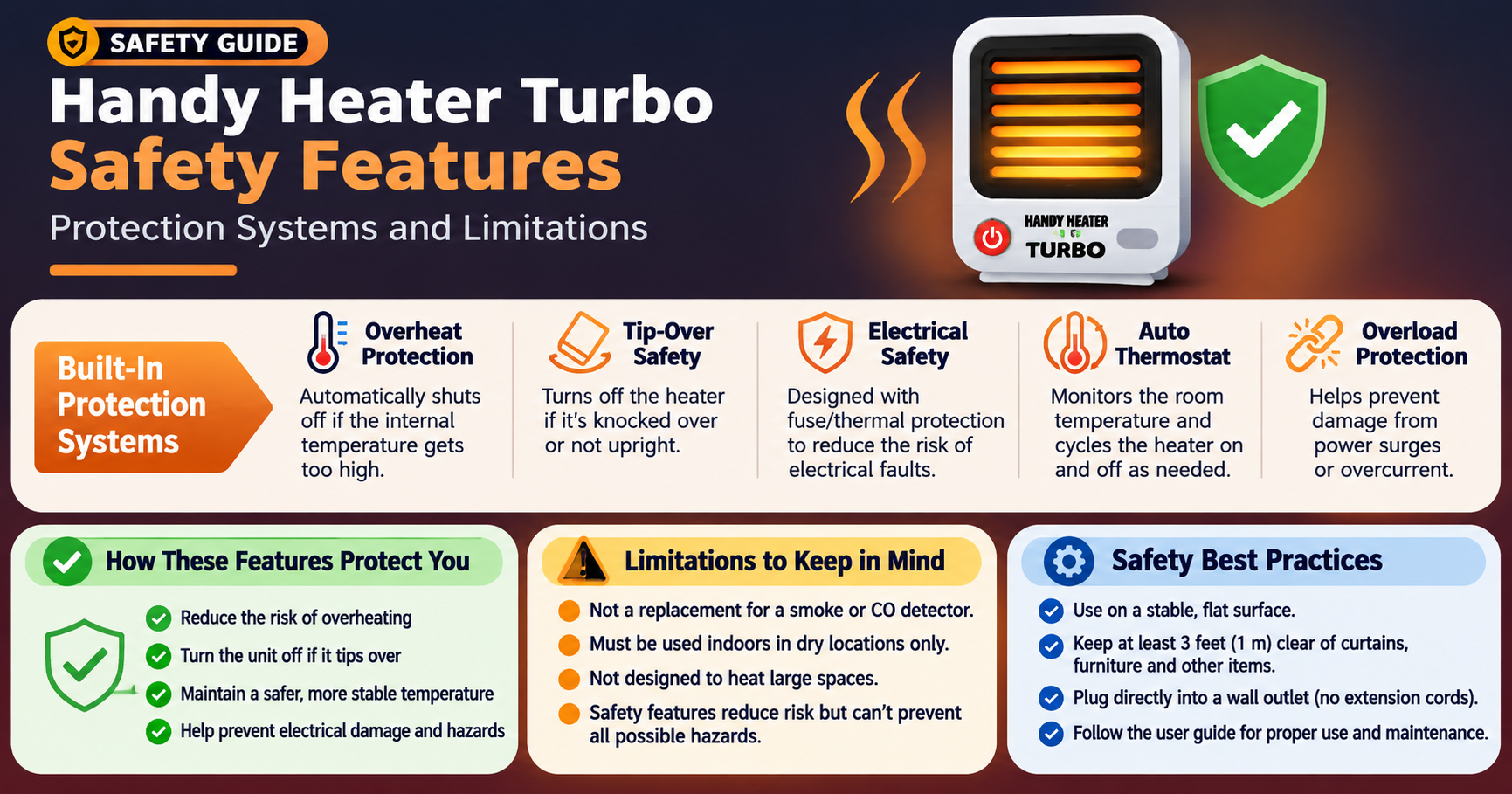
In this guide, we explain the protective features that compact ceramic-style heaters like this one are generally built with, how each feature protects your home, the habits that matter even more than any built-in feature, and what to check before you buy. Because designs and specifications can vary between batches, sellers and versions, always confirm the exact features listed on your own unit’s packaging and manual.
Table of Contents
- Why heater safety features matter
- Overheat protection
- Tip-over protection
- Stable base and compact design
- Housing, grille and heat-resistant materials
- Power cord, plug and electrical safety
- Thermostat and heat control
- Safety features that depend on you
- Safe placement guide
- Pre-use safety checklist
- Maintenance that keeps safety features working
- Warning signs to stop using the heater
- What to check before buying
- Frequently asked questions
- Final thoughts
1. Why Heater Safety Features Matter
Portable heaters are among the most common causes of home heating fires, and the usual reasons are not mysterious: a heater placed too close to bedding or curtains, a heater left running while no one is home, a damaged cord, or a unit that has been knocked over. Built-in safety features exist to reduce the damage when something goes wrong, but they are a backup, not a replacement for careful use.
Think of the safety features of a heater like the seat belt in a car. They greatly improve your odds in a bad situation, yet nobody would argue they make careless driving acceptable. The goal is to use both the hardware and good habits together.
2. Overheat Protection
Overheat protection is the single most important safety feature on a small electric heater. Inside the unit, a temperature-sensing part, often a thermal fuse or a thermal cut-off switch, monitors how hot the internal components are getting. If the temperature rises beyond a safe limit, the part interrupts the electrical circuit and the heater stops producing heat.
What can trigger it?
- Blocked airflow: A dusty grille, a rug pressed against the front, or a towel draped over the heater traps heat inside.
- Dust buildup inside the unit: Over time, lint and pet hair reduce airflow and make the unit run hotter.
- Very long run times: Running a small heater non-stop in a poorly insulated room makes it work harder than intended.
- A failing fan or component: A weak fan cannot move heat away from the element.
If your heater shuts off by itself
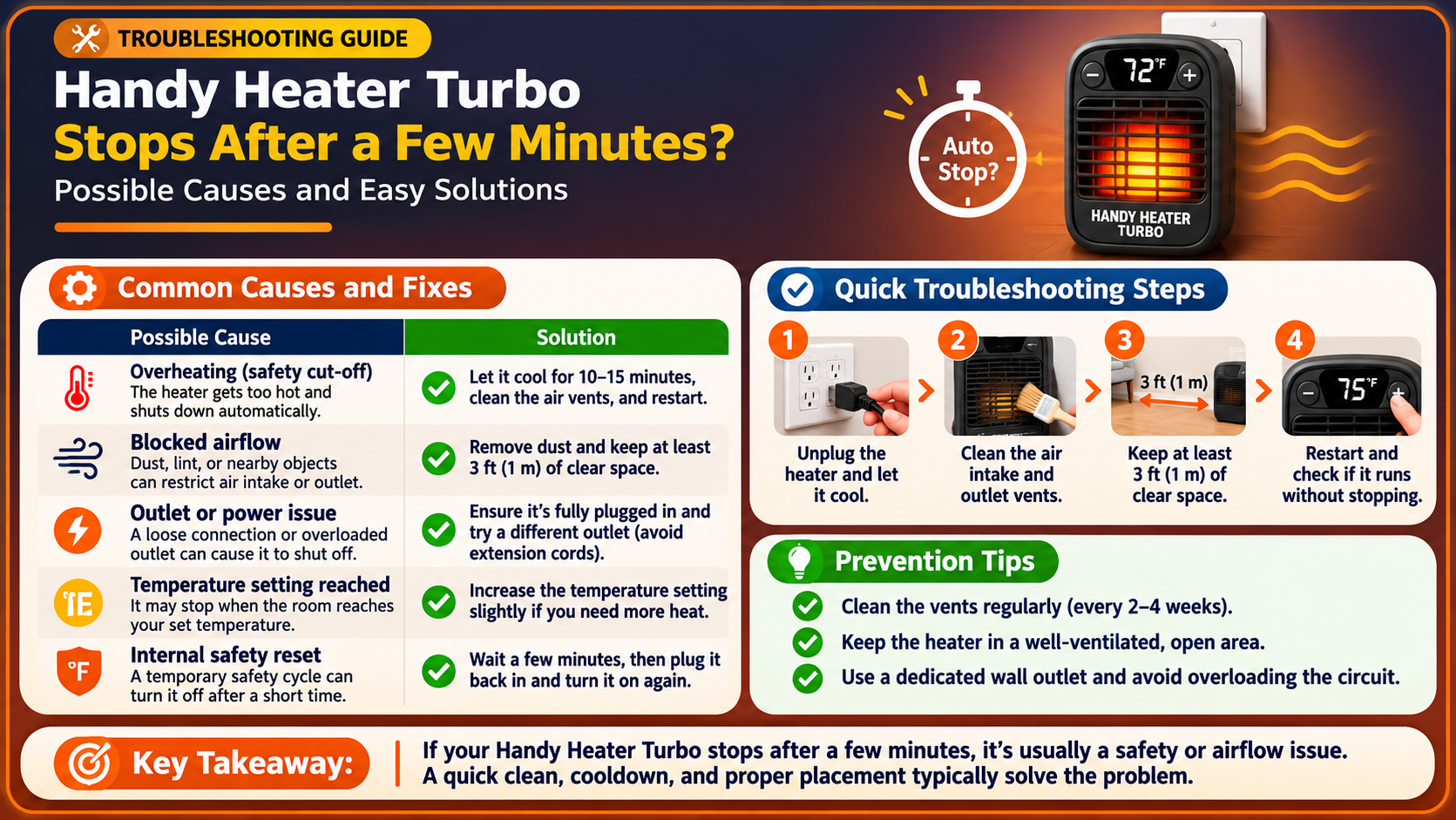
If the heater switches off, do not try to defeat the protection. Unplug it, let it cool completely, check that the vents are clear, clean the grille gently, and restart it in a better location. If it keeps shutting off, that is a signal that something is wrong, and the unit should be inspected or replaced rather than forced to keep running.
3. Tip-Over Protection
Small heaters get bumped by pets, children and passing feet. A tip-over switch is designed to sense when the unit leaves its upright position and to cut the power right away. This is meant to stop a hot element from lying against carpet, fabric or a floor surface.
Do not rely on this feature to excuse a poor location. A heater should still sit on a flat, stable, hard surface, away from walkways where it can be struck. If your unit does not clearly list tip-over protection, treat that as a red flag and be extra cautious about where it sits, or choose a model that clearly lists it.
4. Stable Base and Compact Design
A compact heater has the advantage of being easy to move, but a small footprint can also mean a smaller margin for stability. A well-designed base, a low centre of gravity and a firm connection to the plug all reduce the chance of the unit tipping or being pulled around.
- Place it on a hard, level surface such as tile, wood or laminate.
- Avoid soft surfaces like beds, sofas and thick rugs, which can tilt the unit and block air intake.
- Do not stand it on a stack of items, a shelf edge or an unstable table.
5. Housing, Grille and Heat-Resistant Materials
The outer housing of a good heater is made from heat-resistant, flame-retardant plastic or similar materials. The front grille is designed so that fingers and small objects cannot easily reach the hot element. These design details matter most in homes with children and pets.
Even so, the front of any heater will get hot. Surfaces can cause burns with short contact, so teach children and guests not to touch the unit and keep it out of reach of toddlers. A heater that is warm to the touch on top is normal, while a housing that smells like burning plastic or looks discoloured is not.
6. Power Cord, Plug and Electrical Safety
Many heater fires begin at the plug, not at the heater itself. Heaters draw a lot of current compared with lamps or phone chargers, and loose or damaged connections create heat at the wrong place.
- Plug directly into a wall socket. Avoid extension cords and multi-socket power strips unless the heater’s manual explicitly allows it and the cord is rated for the load.
- Check that the plug fits snugly. A loose fit can cause arcing and heat build-up.
- Feel the plug after the first 15 to 20 minutes. It may be slightly warm, but if it is hot, unplug it and stop using that socket or heater until it is checked.
- Do not run the cord under rugs or furniture, where damage and heat can go unnoticed.
- Replace any heater with a cracked, frayed or kinked cord.
Be mindful of your home’s wiring, too. In older buildings, a socket that sparks, feels warm or has discoloured faceplates should be checked by a qualified electrician before a high-wattage appliance is plugged into it.
7. Thermostat and Heat Control
A thermostat or adjustable heat setting lets the heater cycle on and off or lower its output once a room reaches a comfortable temperature. This reduces unnecessary heating, lowers energy use and puts less stress on the internal parts. If your Handy Heater Turbo offers heat settings or a temperature control, use the lower setting whenever the room is already warm enough.
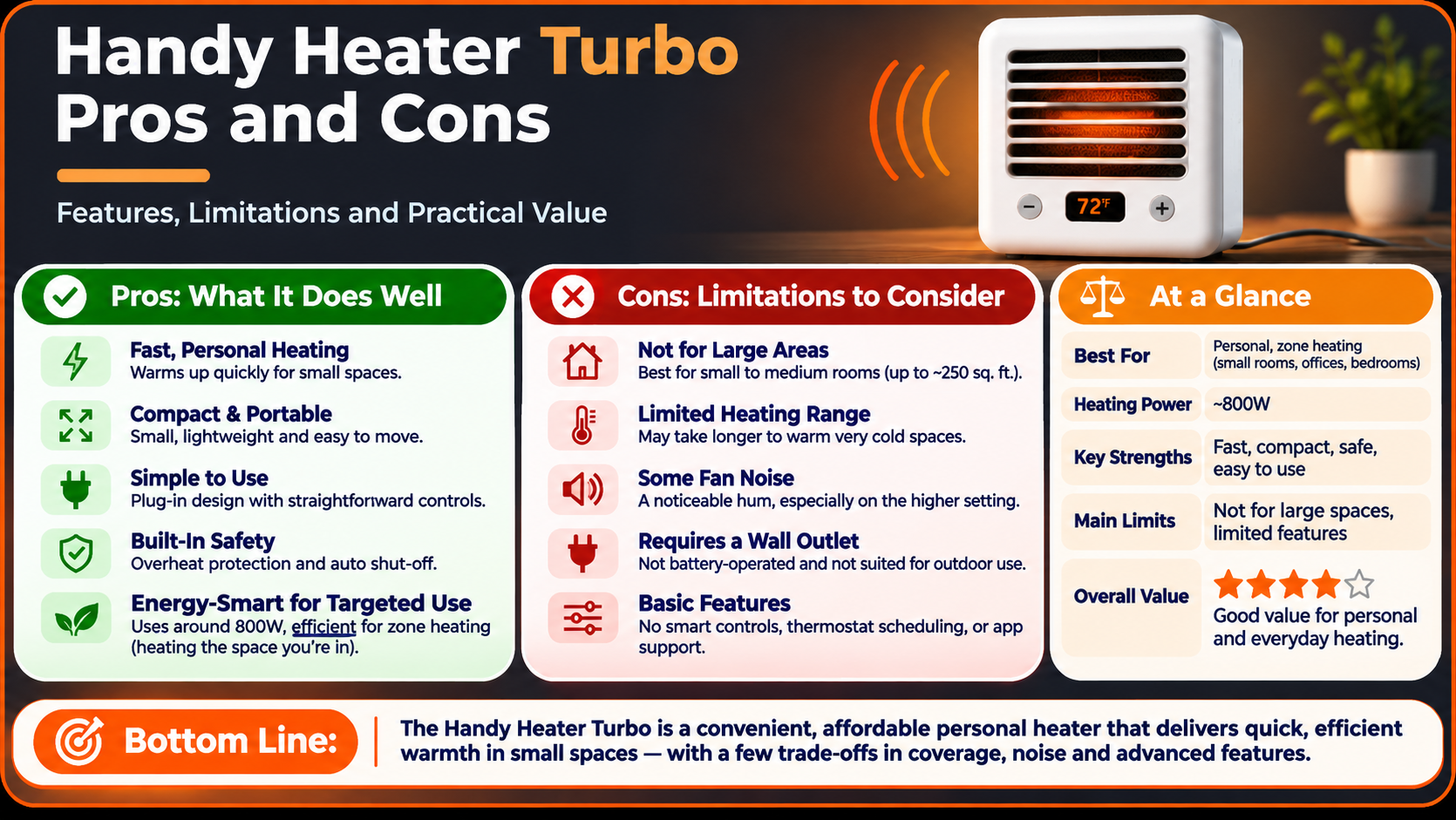
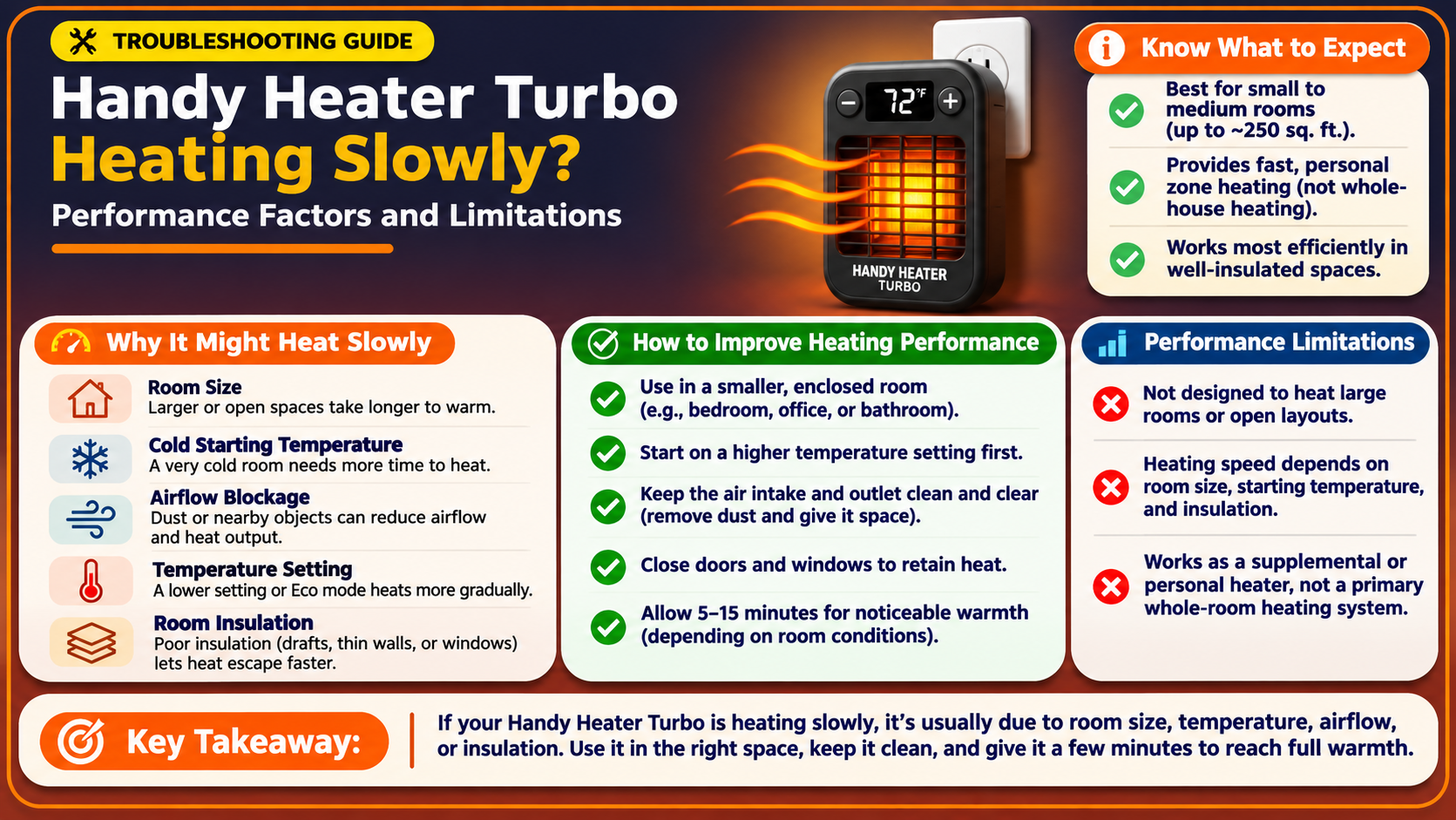
It also helps to understand the limits of a small heater. A compact unit is best suited to a small room or a personal space, and it is not a replacement for central heating. Using it in a very large or draughty room makes it run continuously and wear faster.
8. Safety Features That Depend on You
Some of the most important safety features are not built into the machine. They are habits.
Keep a clear zone
Fire safety guidance for portable heaters commonly recommends keeping at least about three feet (around one metre) of clear space on all sides. That means no curtains, bedding, clothes, paper, sofas or cardboard boxes nearby.
Never leave it unattended
Turn the heater off and unplug it when you leave the room, leave the house or go to sleep. Safety features reduce risk but cannot catch everything, and a heater running in an empty room has no one to notice the first sign of trouble.
Never cover it
Do not dry clothes, towels or shoes on a heater. Covering the unit blocks airflow and is a leading cause of overheating.
Keep it away from water
Do not use a standard room heater in a bathroom, near a sink or in a damp area, and never touch it with wet hands. Water and electricity are a dangerous combination unless a product is specifically designed and rated for wet locations.
Supervise children and pets
Even a heater with a protective grille should be placed where children and pets cannot reach it or knock it over.
9. Safe Placement Guide
Where you place the heater often matters as much as which heater you own. The ideal spot is on a flat hard floor, near a working socket, away from foot traffic, and with open space on every side.
- Choose a spot where the cord does not stretch or cross a walkway.
- Point the heater into the room, not at a wall, furniture or bedding.
- Avoid placing it directly beneath a curtain, a shelf or a table edge.
10. Pre-Use Safety Checklist
A 30-second check before switching on the heater can catch most problems. Use this checklist every time, especially at the start of the cold season when the heater has been stored for months.
11. Maintenance That Keeps Safety Features Working
Safety features only work when the heater is in good condition. Dust and lint are the enemies of both airflow and sensors.
- Unplug and let it cool completely before cleaning.
- Wipe the exterior with a dry or slightly damp cloth. Do not let liquid get into the vents.
- Clear the grille and vents with a soft brush or the brush attachment of a vacuum cleaner.
- Inspect the cord and plug for cracks, bent pins, discolouration or melted spots.
- Store it dry in a clean place at the end of the season, ideally in its original box.
Do not open the casing to repair a heater yourself. Internal parts carry mains voltage and the safety components are easy to damage or bypass by mistake.
12. Warning Signs to Stop Using the Heater
Stop using the heater immediately, unplug it and have it inspected or replace it if you notice any of the following:
- A burning smell that does not fade after the first few minutes of a new unit or a seasonal restart
- Smoke, sparks or crackling sounds
- A plug, cord or socket that is hot to touch
- Discolouration or melting on the casing or plug
- The heater repeatedly shutting off or tripping the circuit breaker
- A fan that grinds, rattles or stops while the heater is on
- Flickering power or an intermittent connection when the cord is moved
A faint, brief smell when a heater is first used after storage is usually dust burning off the element. A strong or persistent smell is different, and should be treated as a warning.
13. What to Check Before Buying
If you are comparing the Handy Heater Turbo with other portable heaters, here are the points worth checking on the product page, packaging and manual. Do not assume that every similar-looking heater has the same protections.
| Feature to check | Why it matters |
|---|---|
| Overheat protection | Cuts power if internal temperatures get too high |
| Tip-over protection | Shuts the unit off if it is knocked over |
| Safety certification marks | Shows testing against recognised electrical safety standards in your region |
| Wattage and plug rating | Should match your socket and circuit capacity |
| Cord quality | Thick, flexible, undamaged cord with a firm plug |
| Protective grille | Keeps fingers and objects away from the heating element |
| Manual and warranty | Clear instructions and support if something goes wrong |
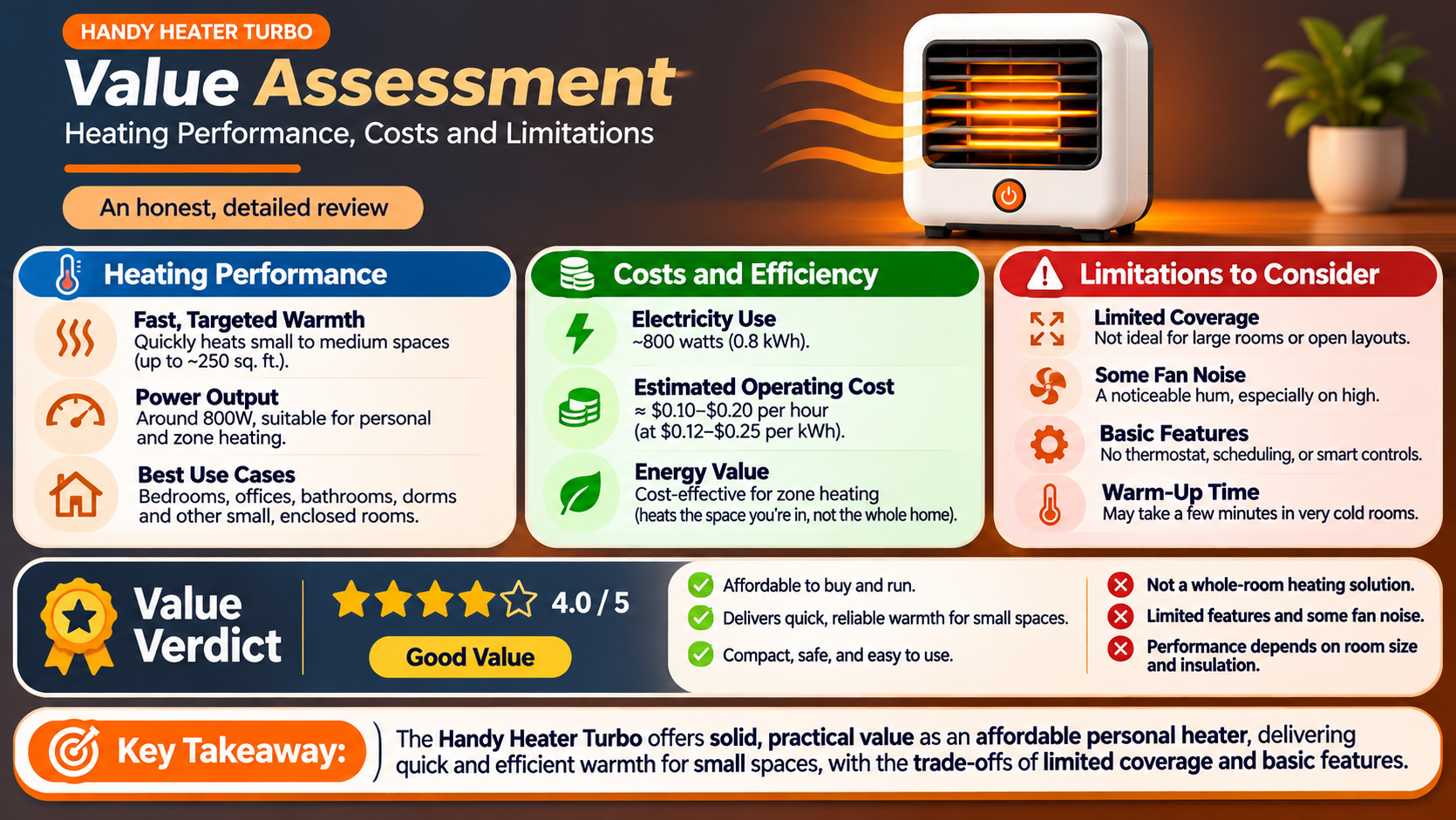
Be cautious with exaggerated marketing claims such as promises of heating a whole house cheaply or instant results in any room. Real-world heating depends on room size, insulation and wattage. Buy from a reputable seller, and keep your purchase record in case you need warranty support.
14. Frequently Asked Questions
Is the Handy Heater Turbo safe to leave on overnight?
It is best not to. Even with overheat and tip-over protection, fire safety guidance generally advises turning off and unplugging portable heaters when you sleep or leave the room. If you need overnight warmth, consider safer options such as warmer bedding, a safe pre-heating session before bed, or a heating system designed for continuous use.
Does it have overheat protection?
Overheat protection is a standard feature on most reputable portable electric heaters, but you should confirm it on your own unit’s packaging, listing or manual. If it is not clearly stated, treat that as a reason for extra caution or consider a model that lists it clearly.
Can I use it with an extension cord or power strip?
Plug it straight into a wall socket whenever possible. Heaters draw a high load, and thin extension cords or crowded power strips can overheat. Only use an extension cord if the manufacturer allows it and the cord is rated for the heater’s wattage.
Is it safe to use in the bathroom?
No, unless the product is specifically rated for bathroom use. A standard room heater should be kept away from water, damp areas and wet hands.
Is it safe around kids and pets?
Place it out of reach, keep a clear zone around it and supervise. The grille and housing reduce risks, but the front can still become hot enough to burn skin.
Why does my heater smell when I first turn it on?
A light, short-lived smell can come from dust or manufacturing residue burning off. If the smell is strong, smells like melting plastic, or does not fade quickly, switch it off, unplug it and have it checked.
What should I do if the heater keeps turning itself off?
Unplug it, let it cool, clear dust from the vents, make sure nothing blocks the airflow and try again in a better position. If it continues to shut off, stop using it and replace or service it.
How often should I clean it?
A quick vent check once a week during heavy use and a thorough clean at the start and end of the season is a good routine, more often if you have pets or a dusty home.
15. Final Thoughts
The Handy Heater Turbo safety features that matter most are overheat protection, tip-over protection, a stable and well-built housing, and a sound cord and plug. Together they make a compact heater a reasonable choice for warming a small space, provided it is used the right way.
But no feature can replace sensible habits. Give the heater space, plug it into the wall, keep it clean, never leave it running unattended, and stop using it at the first sign of trouble. If you follow those rules, you get the comfort of a warm room without taking on unnecessary risk.