Handy Heater Turbo Electricity Consumption: How Much Power It Really Uses

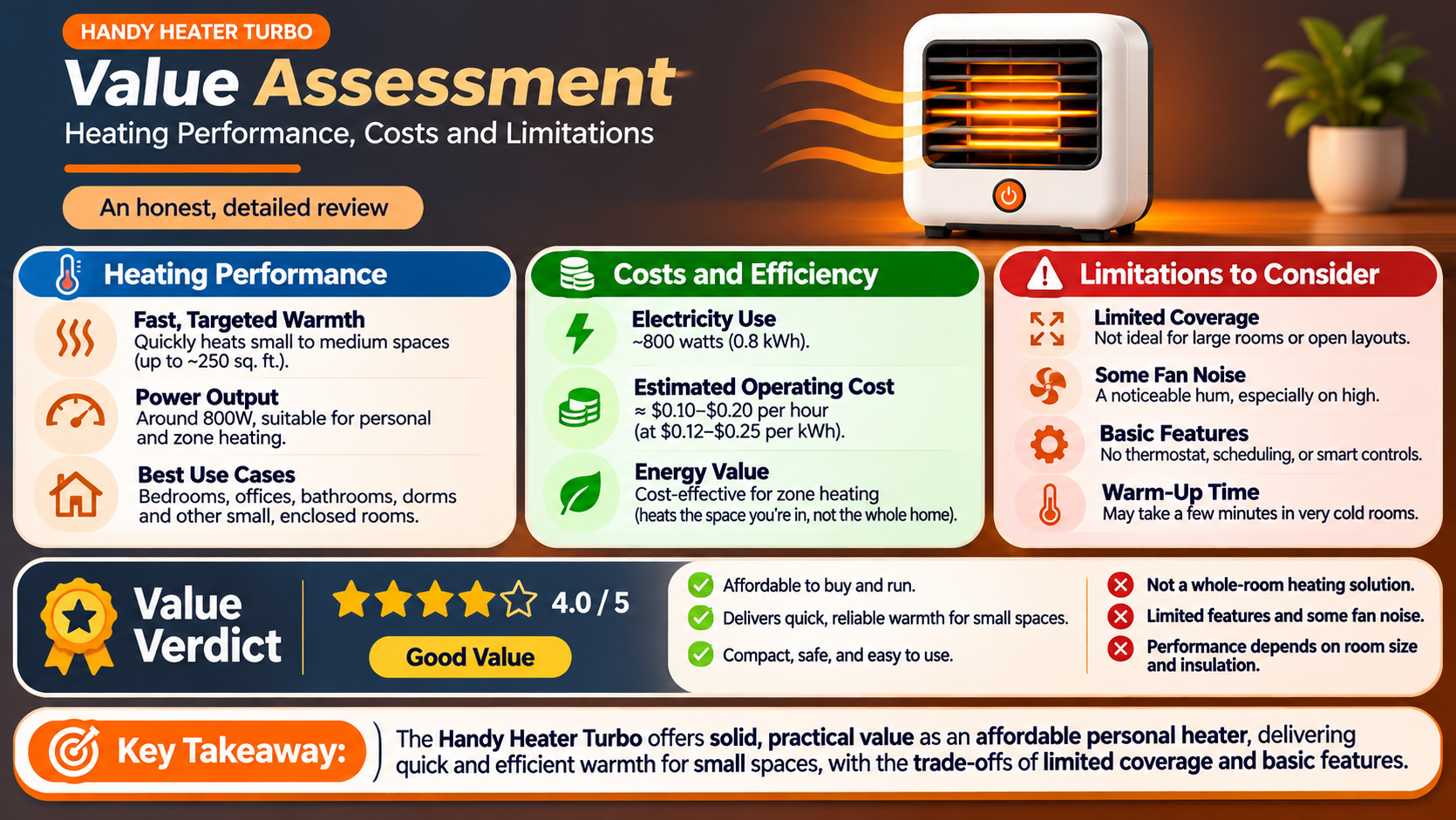
Compact heaters like the Handy Heater Turbo are popular because they are small, quick to warm up and easy to move from room to room. But before you plug one in for the whole winter, one question always comes up: how much electricity does it actually use, and what will it add to your bill?
The honest answer depends on three things: the heater’s wattage, how many hours you run it, and what you pay per unit of electricity. The good news is that the maths is simple. In this guide you will learn exactly how to calculate the Handy Heater Turbo’s electricity consumption, see realistic monthly cost examples, understand why your real usage is often lower than the label suggests, and pick up practical ways to keep the bill down.
- A heater’s electricity use is set by its wattage. You will find it printed on the rating label of your unit.
- Formula: (Watts ÷ 1,000) × hours × your rate per kWh = cost.
- Example: a 500 W heater running 8 hours a day at $0.15 per kWh costs about $0.60 a day, or roughly $18 a month, if it ran at full power the entire time.
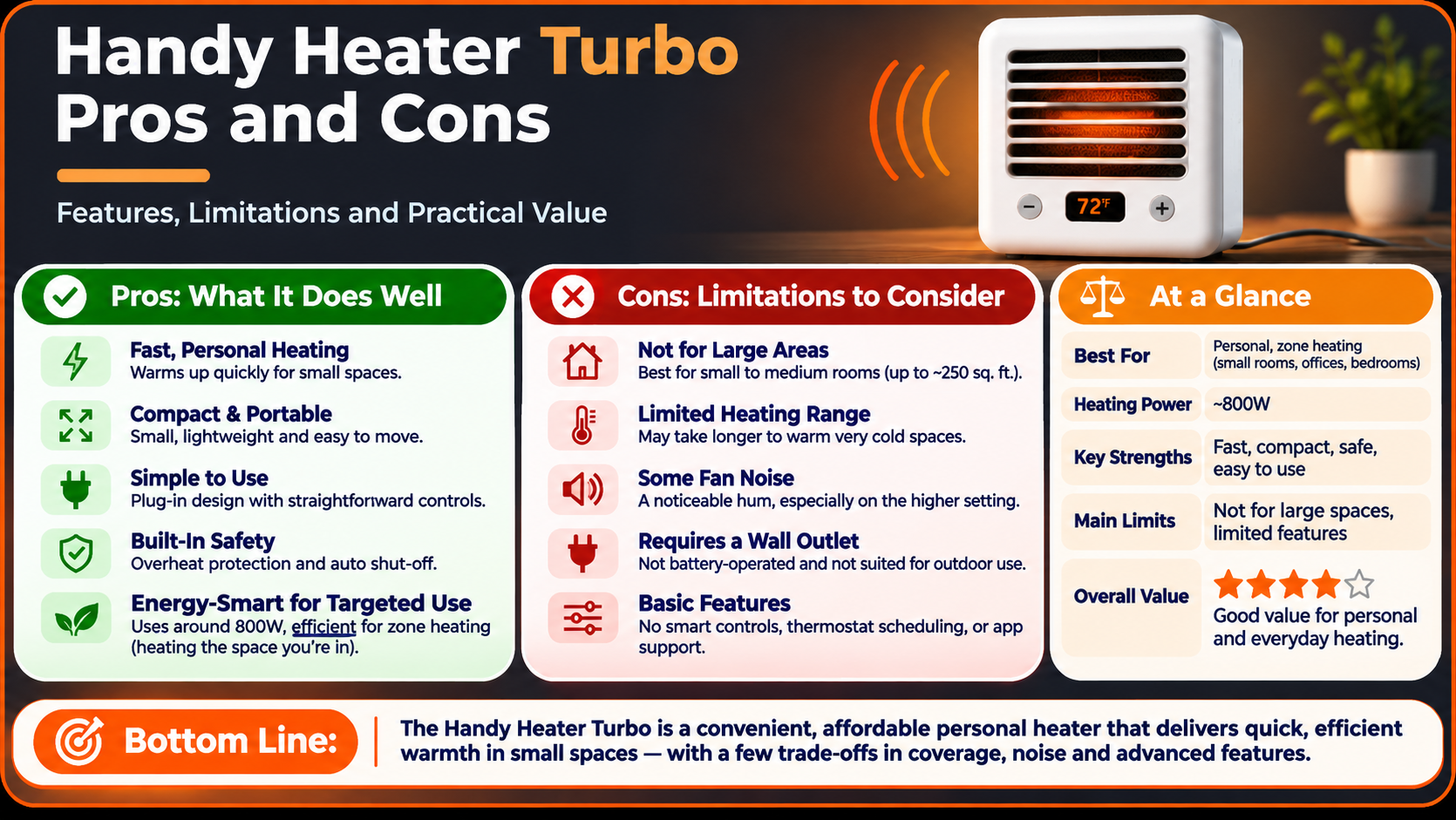
- Compact heaters usually cost far less to run than a 1,500 W space heater, but they also heat a much smaller area.
What Determines the Handy Heater Turbo’s Electricity Consumption?
Every electric heater turns almost all of the electricity it draws into heat. That means there is no “efficient” or “inefficient” resistance heater in the way people talk about cars or air conditioners. A 500 W heater and a 1,500 W heater both convert nearly 100% of their power into heat. The difference is simply how much heat they produce each hour and how much electricity they draw to do it.
So the Handy Heater Turbo’s consumption comes down to:
- Rated wattage: the higher the number, the more electricity per hour.
- Running time: a heater used for 2 hours uses a quarter of the energy of one used for 8 hours.
- Thermostat behaviour: a heater that switches off once the room is warm uses less than its label power over time.
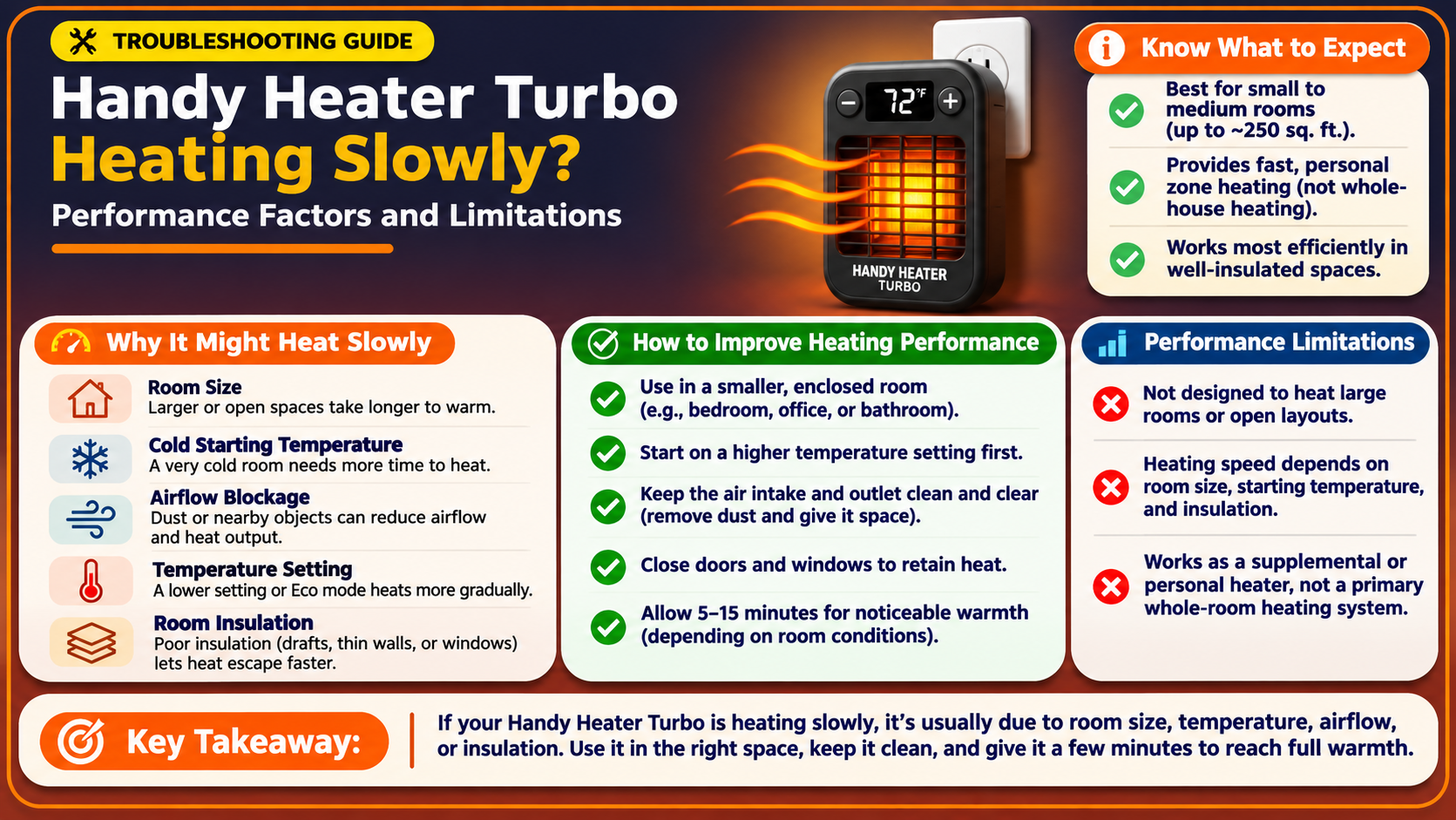
- Room conditions: a draughty, cold room makes the heater work longer to reach the set temperature.
- Your electricity rate: the price per kilowatt-hour (kWh) differs by country, provider and even time of day.
Watts, Kilowatts and kWh Explained Simply
Electricity bills are not measured in watts. They are measured in kilowatt-hours (kWh), which is the amount of energy used when a 1,000 watt device runs for one hour. Here is the easy way to think about it:
- Watt (W): how fast a device uses power at any moment.
- Kilowatt (kW): 1,000 watts.
- Kilowatt-hour (kWh): power in kW multiplied by the hours it runs. This is what your electricity company charges for.
Step-by-Step Example
- Find the wattage on the label, for example 500 W.
- Divide by 1,000 to get kilowatts: 500 ÷ 1,000 = 0.5 kW.
- Multiply by the hours of use: 0.5 × 8 = 4 kWh per day.
- Multiply by your rate. At $0.15 per kWh: 4 × 0.15 = $0.60 per day.
- Multiply by the days in the month: $0.60 × 30 = $18.00.
Handy Heater Turbo Running Cost: Worked Examples
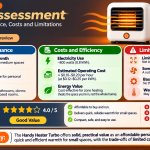
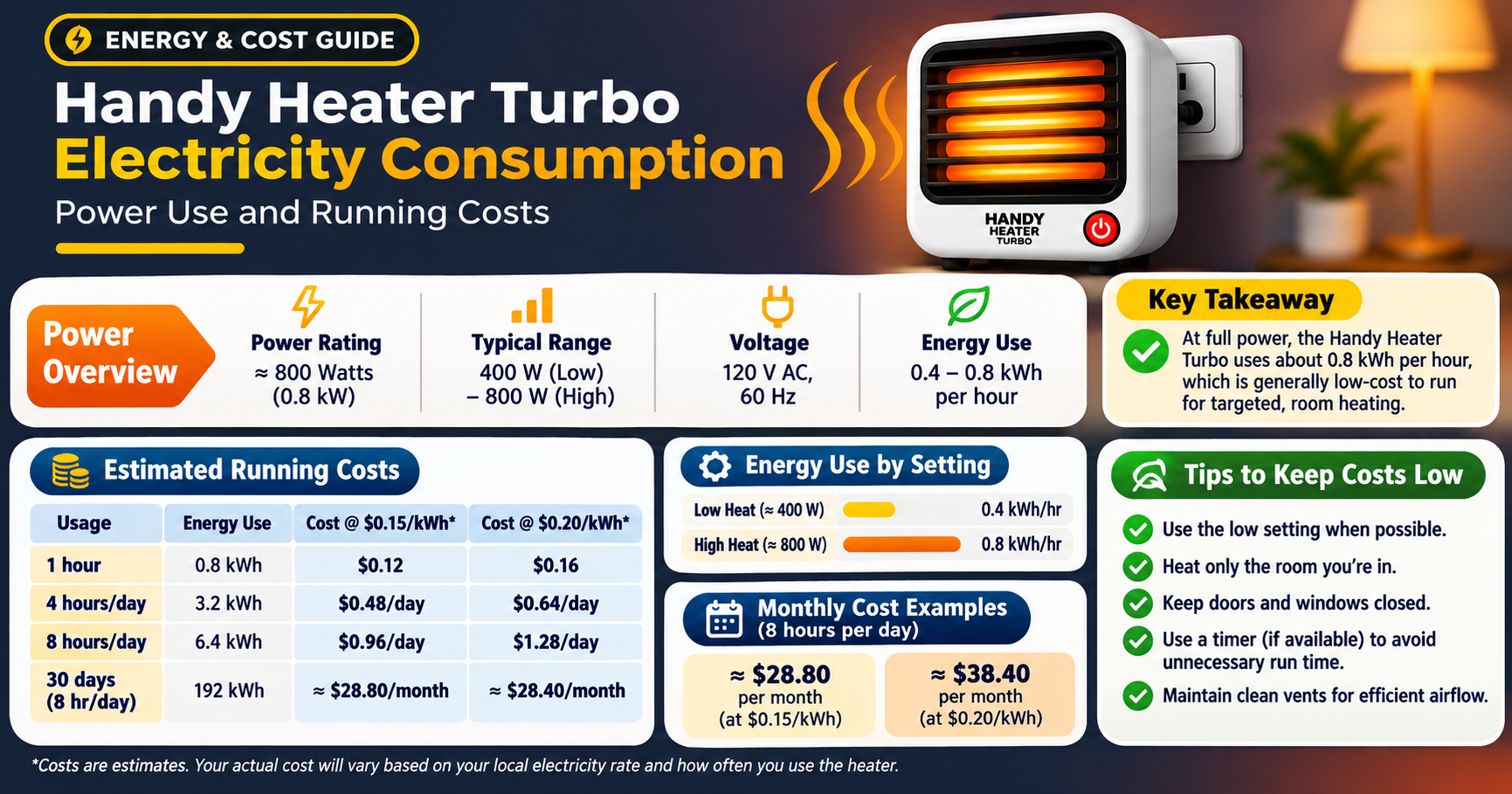
The table below shows what different wattage levels cost at an example rate of $0.15 per kWh when run for 8 hours a day over 30 days. A 1,500 W space heater is included so you can see how a compact heater compares.
| Heater Rating | Energy per Hour | Cost per Hour | Cost per 8-Hour Day | Cost per 30 Days |
|---|---|---|---|---|
| 400 W compact heater | 0.4 kWh | $0.06 | $0.48 | $14.40 |
| 500 W compact heater | 0.5 kWh | $0.075 | $0.60 | $18.00 |
| 1,500 W space heater | 1.5 kWh | $0.225 | $1.80 | $54.00 |
Your own result will differ because electricity rates vary widely. If you pay $0.10 per kWh, multiply the kWh figure by 0.10 instead. If you pay $0.30, multiply by 0.30. The kWh numbers (0.4, 0.5 and 1.5 per hour) stay the same everywhere.
Cost for Shorter Daily Use
Most people do not run a heater for eight hours straight. For a 500 W unit at $0.15 per kWh, here is a quick guide:
- 2 hours a day: 1 kWh, about $0.15 per day, or $4.50 per month.
- 4 hours a day: 2 kWh, about $0.30 per day, or $9.00 per month.
- 12 hours a day: 6 kWh, about $0.90 per day, or $27.00 per month.
Why Your Real Consumption Is Often Lower Than the Label
The wattage on the label is the maximum power the heater draws while its heating element is on. Most heaters with a thermostat do not keep the element on all the time. Once the room reaches the temperature you set, the heater switches off, then back on when the room cools slightly. Over an hour, the “on” time may be only part of the hour.
This is why a small heater in a small, well-closed room can cost noticeably less than the “full power” numbers above. On the other hand, in a large or draughty space the heater may stay on almost continuously and your cost will be close to the maximum. If your model has no thermostat, it will draw its rated power the entire time it is switched on.
How Many Amps Does a Handy Heater Turbo Draw?
Electricity use is also about current. You can estimate the amps with this formula: Amps = Watts ÷ Volts.
- A 500 W heater on a 120 V supply draws about 4.2 A.
- A 500 W heater on a 230 V supply draws about 2.2 A.
- A 1,500 W heater on a 120 V supply draws about 12.5 A, which is close to the limit of a typical 15 A household circuit.
Lower current is one reason compact heaters are easier on household wiring than large space heaters. Even so, a heater is a continuous, heavy load, so it should be plugged into a suitable wall socket that is in good condition.
Handy Heater Turbo vs Other Heating Options
It helps to put the running cost in perspective. Here is how a compact heater compares with other common ways to stay warm.
Compact Heater vs 1,500 W Space Heater
A 1,500 W space heater produces about three times the heat of a 500 W unit, and uses about three times the electricity. If you only need to warm a desk, a bed corner or a small bathroom, the smaller heater is the more sensible choice. If you need to take the chill off a large living room, a small heater may run constantly and still struggle to keep up.
Compact Heater vs Central Heating
Heating your whole home for a single cold room is expensive. Using a compact heater in the one room you occupy, while lowering the thermostat elsewhere, is a common way to cut a heating bill. This is called zone heating, and it works best when the room door is kept closed.
Compact Heater vs Heat Pump or Efficient Air Conditioner
A heat pump moves heat instead of creating it, so it can deliver two to four times more heat per unit of electricity than any resistance heater. If you already have a heat pump or an inverter air conditioner with a heating mode, it will usually be cheaper to run for long periods than any plug-in heater. A small heater earns its place for short, targeted use.
How to Measure the Real Electricity Use of Your Heater
You do not have to guess. There are two reliable ways to find out what your Handy Heater Turbo really consumes:
- Use a plug-in energy monitor. This inexpensive device sits between the wall socket and the heater and shows watts, kWh used and often the estimated cost. Run the heater for a normal day and read the total.
- Use the electricity meter. Switch off other big appliances, note the meter reading, run the heater for exactly one hour, and note the reading again. The difference is the heater’s real consumption for that hour.
Whichever method you use, test it in the room where you actually plan to use the heater, because room size and temperature change how often the thermostat switches the element on and off.
6 Ways to Lower the Handy Heater Turbo’s Running Cost
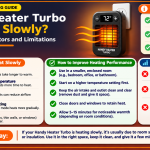
- Heat only the room you are using. Close the door and avoid trying to warm open hallways or connected spaces.
- Let the thermostat do its job. Choose a comfortable setting rather than the maximum, so the heater can switch off when the room is warm.
- Seal the draughts. Door gaps, window edges and open letterbox flaps let warm air escape. A draught excluder or weather strip pays for itself quickly.
- Heat people, not rooms. Point the heater toward your desk, chair or bed area at a safe distance, and wear a warm layer so you can use a lower setting.
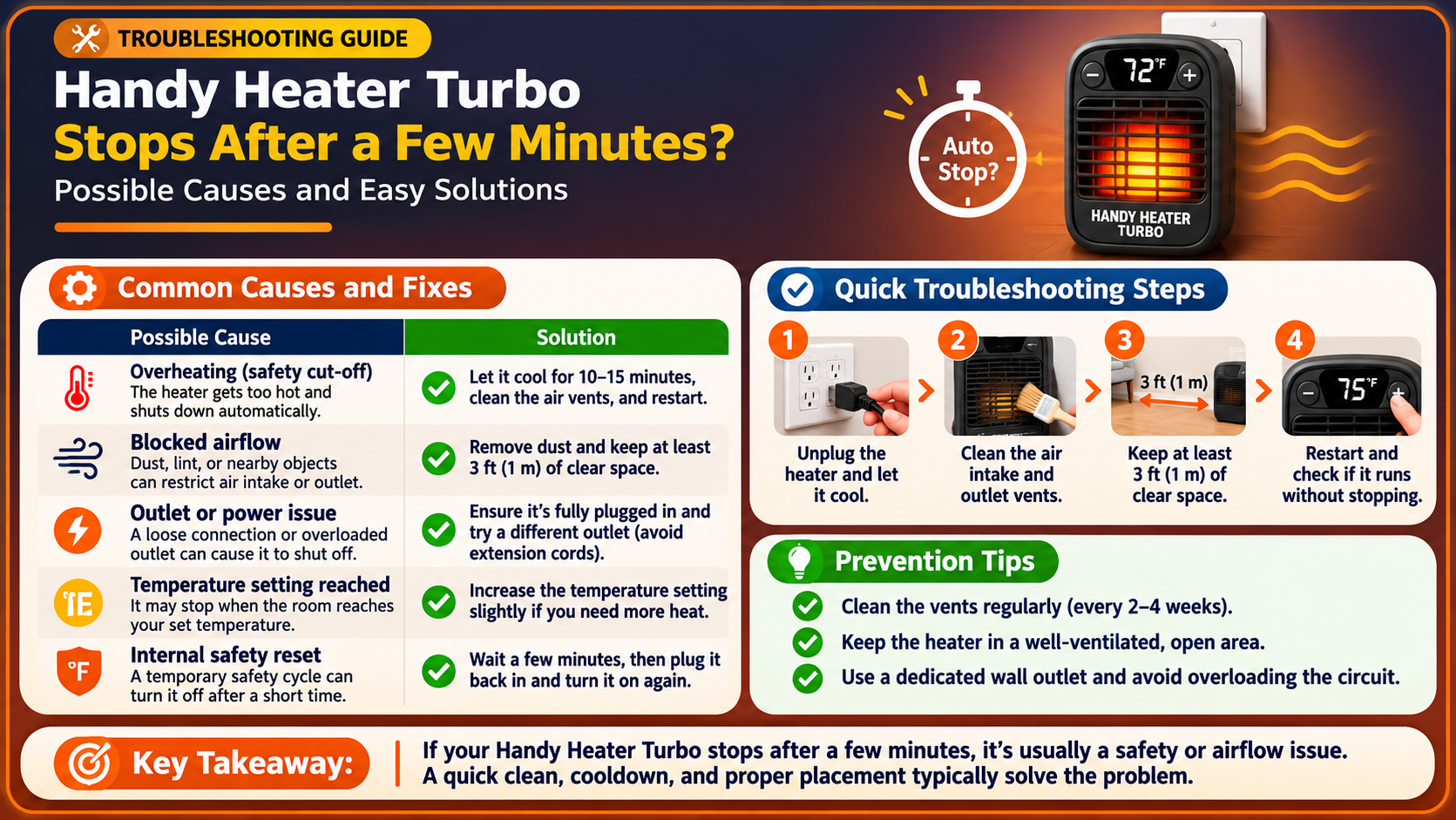
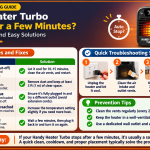
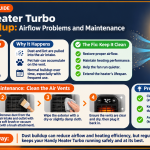
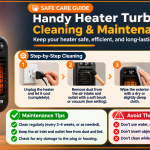
- Keep the vents clean. Dust buildup restricts airflow and can make the heater work harder and warm up more slowly. Unplug and let it cool before cleaning.
- Use a timer. A plug-in timer or a built-in timer prevents the heater from running for hours after you have left the room.
Is the Handy Heater Turbo Worth It for Your Electricity Bill?
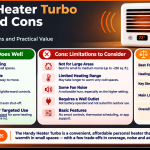
A compact heater is a good fit if you want personal, short-term or spot heating: a home office, a small bedroom, a bathroom before a shower, or a chilly corner. In those situations its low wattage keeps the cost per hour small, and you avoid heating the entire home.
It is a poor fit if you hope to heat a large, open or badly insulated space for many hours a day. In that case a low-wattage heater will run flat out without ever reaching a comfortable temperature, and a different heating method will be both cheaper and more comfortable.
Things to Check Before You Buy
- The rated wattage and the voltage for your country.
- Whether the unit has an adjustable thermostat and a timer.
- Safety features such as tip-over protection and overheat protection.
- The size of the room you want to heat compared with the heater’s output.
- The length and quality of the power cable and plug.
Safety Tips While You Keep the Bill Low
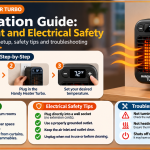
- Plug the heater directly into a wall socket. Avoid extension cords and power strips for heating appliances unless the manufacturer says it is safe.
- Keep curtains, bedding, clothing, paper and furniture well away from the heater.
- Never cover the heater or dry clothes on it.
- Place it on a flat, stable, hard surface.
- Do not leave it running unattended or while you sleep unless the manual explicitly allows it and the unit has working safety protection.
- Stop using it and have it checked if you notice a burning smell, a hot or discoloured plug, a damaged cable or repeated tripping of the circuit breaker.
Frequently Asked Questions
How much electricity does a Handy Heater Turbo use per hour?
It uses its rated wattage divided by 1,000 in kWh for every hour the heating element is on. For example, a 500 W unit uses 0.5 kWh per hour at full power. Check your own unit’s label for the exact figure.
How much does it cost to run a Handy Heater Turbo all night?
Multiply the kWh per hour by the hours and by your rate. A 500 W heater running 8 hours at $0.15 per kWh would cost up to $0.60 at full power. Keep in mind the safety advice above about running heaters unattended or overnight.
Does a Handy Heater Turbo use less electricity than a normal space heater?
Typically yes, because compact heaters usually have a lower wattage than a full-size space heater. However, it also produces less heat, so it suits smaller spaces and shorter use.
Is a low-wattage heater cheaper to run than a high-wattage one?
Per hour, yes. But if the low-wattage heater has to run much longer to reach the same warmth, the saving shrinks. Matching the heater to the size of the room is what keeps the cost low.
Does the thermostat really save electricity?
Yes. When the room reaches the set temperature, the heater switches off and stops drawing power until it cools down again, so the total energy used over an hour is lower than at constant full power.
Will using a heater a lot increase my electricity bill noticeably?
It can. A heater is a high-power appliance, so heavy daily use adds up over a month. Using the calculation in this guide before winter lets you plan for it, and an energy monitor shows you the real number.
Can I use a Handy Heater Turbo with an extension cord?
It is best to plug any heater straight into a wall socket. Extension cords and power strips can overheat under the continuous load of a heating appliance.
Final Thoughts
The Handy Heater Turbo’s electricity consumption is easy to work out once you know its wattage. Divide the watts by 1,000, multiply by the hours you use it, then multiply by your rate per kWh. For a typical few-hundred-watt compact heater, the cost for a few hours a day is small, and the thermostat can make your real usage lower still.
Use it where it makes sense: small rooms, short sessions, and personal warmth. Seal draughts, use a timer, keep the vents clean, and measure with an energy monitor if you want precise numbers. Do that, and you can stay warm without any unpleasant surprises on your next electricity bill.
Note: All cost figures in this article are estimates based on example rates and wattages. Your actual consumption and cost depend on your model’s rating, your local tariff, the room and how you use the heater.