
Plug-in heaters like the Handy Heater Turbo look like a bargain: a small price tag, no installation, and warmth on demand. But the purchase price is only half the story. The real question most buyers ask is simple: how much does the Handy Heater Turbo cost to run?
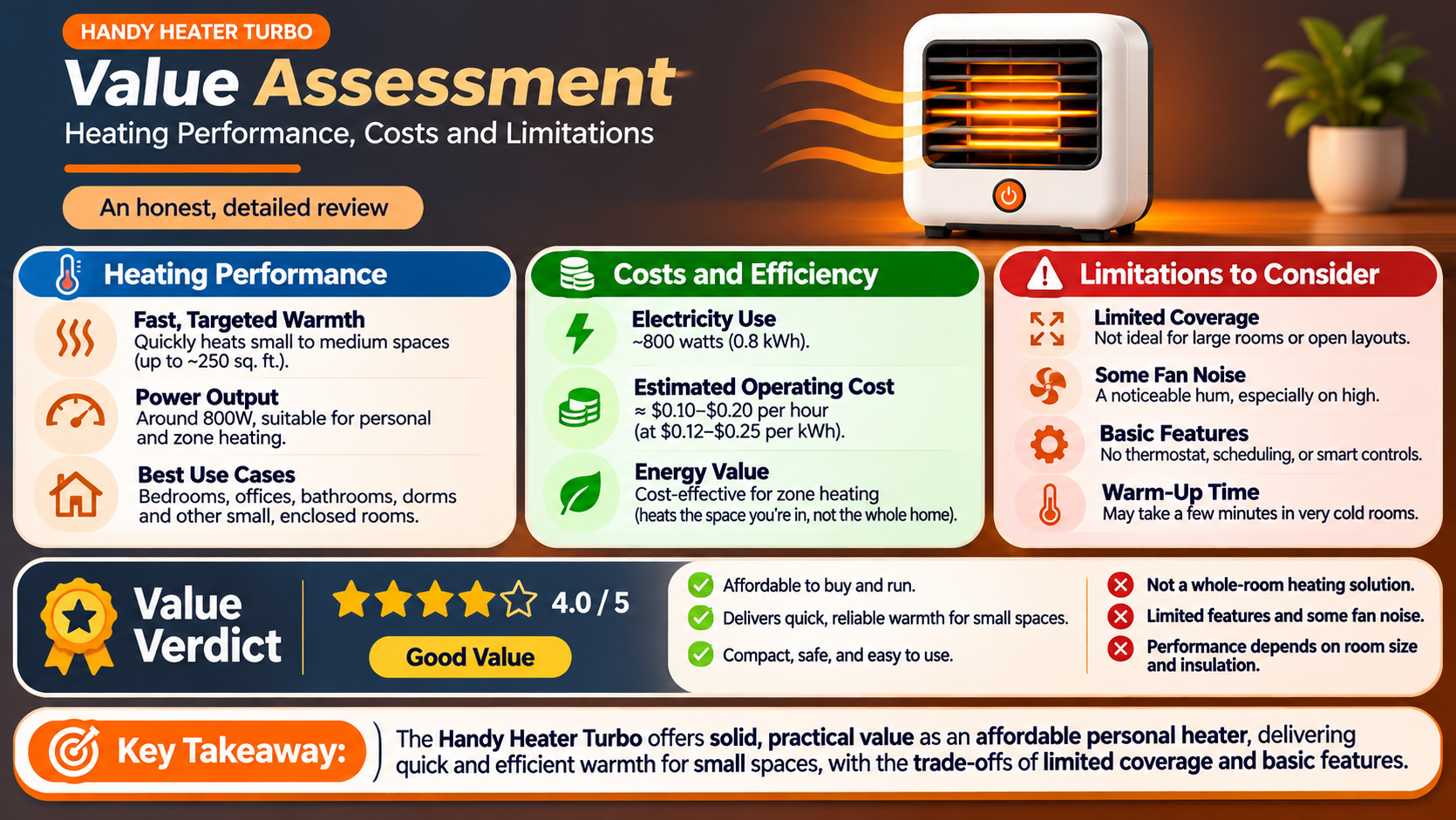
The short answer is that the Handy Heater Turbo 800 draws 800 watts, which works out to roughly 15 cents per hour at the current average U.S. residential electricity price of about 19 cents per kilowatt-hour. In this guide you will find the exact hourly, daily and monthly numbers, a simple formula to calculate your own cost, and practical ways to keep your electricity bill under control.
Quick Answer: Handy Heater Turbo Running Cost at a Glance
- Power rating: 800 watts (0.8 kilowatts) at 120 volts
- Electricity used: 0.8 kWh for every hour at full power
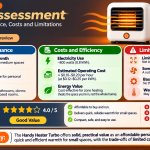
- Cost per hour: about 9.6 cents at 12¢/kWh, 15.2 cents at 19¢/kWh, and 25.6 cents at 32¢/kWh
- Cost per month (8 hours a day, full power): roughly $23 to $61 depending on where you live, about $36 at the national average
- Real-world cost: often lower, because the built-in thermostat cycles the heater on and off once the room is warm
What Is the Handy Heater Turbo?
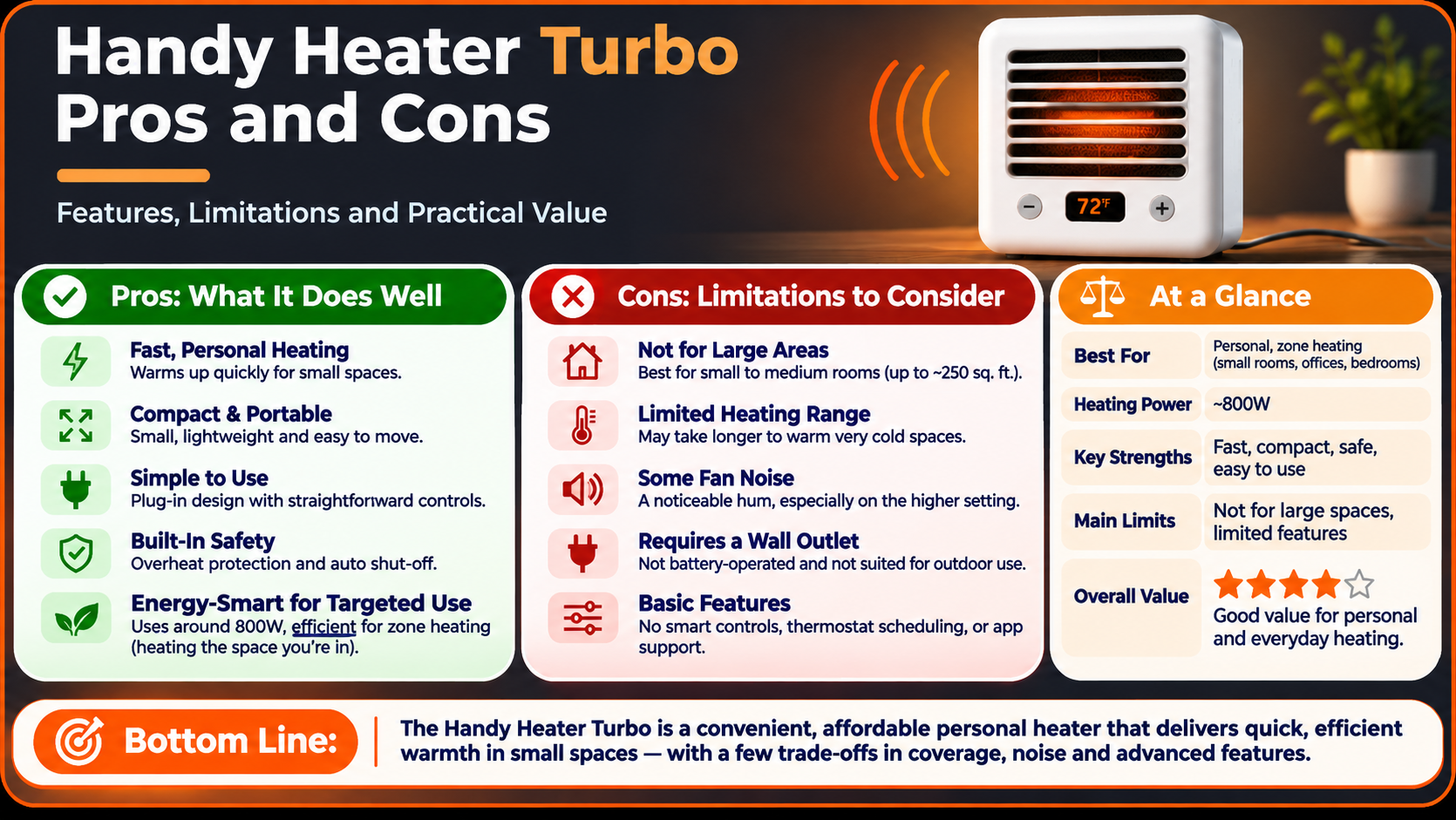
The Handy Heater Turbo 800 is a compact ceramic space heater that plugs directly into a standard wall outlet. There is no stand, no long cord and no floor space taken up, which is why it is popular in bedrooms, home offices, bathrooms and small living areas. Retail listings commonly show it priced somewhere between about $20 and $35.
Key features reported by retailers and the manufacturer include:
- 800-watt ceramic heating element
- Digital LED display with an adjustable thermostat (roughly 60°F to 90°F)
- 12-hour programmable timer
- Stay-cool housing and automatic shut-off protection
- ETL safety listing
- Quiet operation suitable for bedrooms
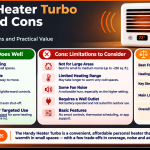
Because it is a wall-mounted plug-in unit rated at 800 watts, it is designed for small spaces and personal warmth rather than for heating an entire house.
How Much Electricity Does the Handy Heater Turbo Use?
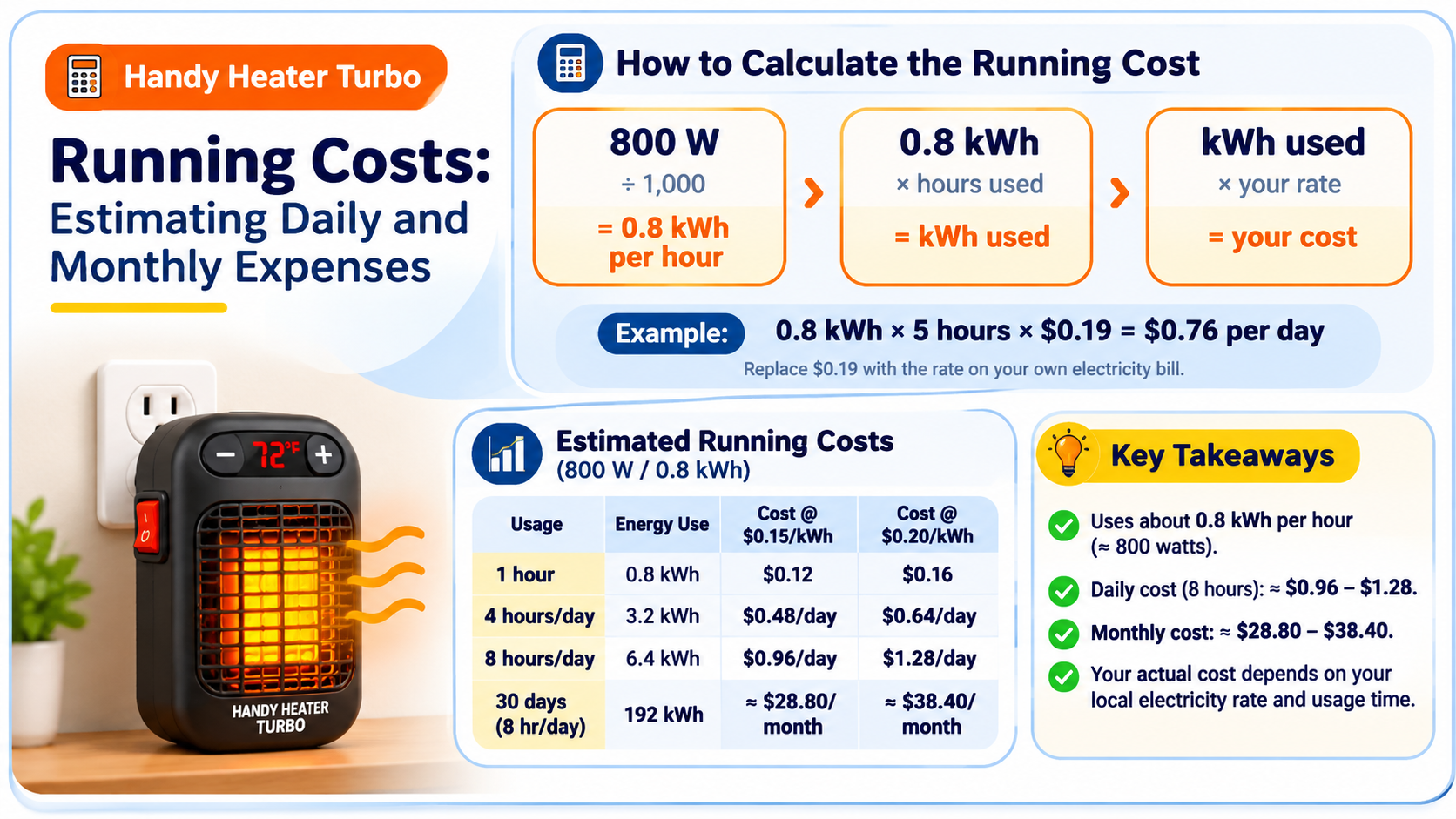
Electricity is billed in kilowatt-hours (kWh). One kilowatt-hour is the energy used by a 1,000-watt device running for one hour. Since the Handy Heater Turbo is rated at 800 watts, the math is straightforward:
- 800 watts ÷ 1,000 = 0.8 kW
- 0.8 kW × 1 hour = 0.8 kWh per hour
At 120 volts, an 800-watt heater pulls about 6.7 amps. That is a significant load for a household outlet, which is why it is important to follow the safety guidance later in this article.
How to Calculate the Cost to Run the Handy Heater Turbo
You can work out your exact cost in three steps using the rate printed on your latest electricity bill.

Formula: 0.8 kWh × hours of use × your price per kWh = your running cost.
Example: If you run the heater for 5 hours and pay 19 cents per kWh, the cost is 0.8 × 5 × $0.19 = $0.76.
Cost per Hour: What Does 800 Watts Cost?
Electricity prices vary widely across the country. As of 2026, the U.S. residential average sits at roughly 18 to 19 cents per kWh, with low-cost states closer to 12 cents and high-cost states such as California, Connecticut, Massachusetts and Hawaii often paying 30 cents or more. The chart and table below show how that range changes the hourly cost of the Handy Heater Turbo.

| Electricity rate | Cost per hour | Cost for 8 hours | Cost for 24 hours |
|---|---|---|---|
| 12¢ per kWh (low) | 9.6¢ | $0.77 | $2.30 |
| 19¢ per kWh (U.S. average) | 15.2¢ | $1.22 | $3.65 |
| 32¢ per kWh (high) | 25.6¢ | $2.05 | $6.14 |
Daily and Monthly Cost of Running the Handy Heater Turbo
Most people do not run a small heater around the clock. The next table uses the U.S. average rate of 19 cents per kWh and assumes the heater runs continuously at full power during the hours listed, for 30 days.
| Daily use | Energy per day | Cost per day | Cost per month (30 days) |
|---|---|---|---|
| 2 hours | 1.6 kWh | $0.30 | $9.12 |
| 4 hours | 3.2 kWh | $0.61 | $18.24 |
| 8 hours | 6.4 kWh | $1.22 | $36.48 |
| 12 hours | 9.6 kWh | $1.82 | $54.72 |
| 24 hours | 19.2 kWh | $3.65 | $109.44 |

If you live in a low-cost state, subtract roughly 37 percent from those figures. If you live in a high-cost state, expect to pay about 70 percent more.
Will the Thermostat Lower Your Real Cost?
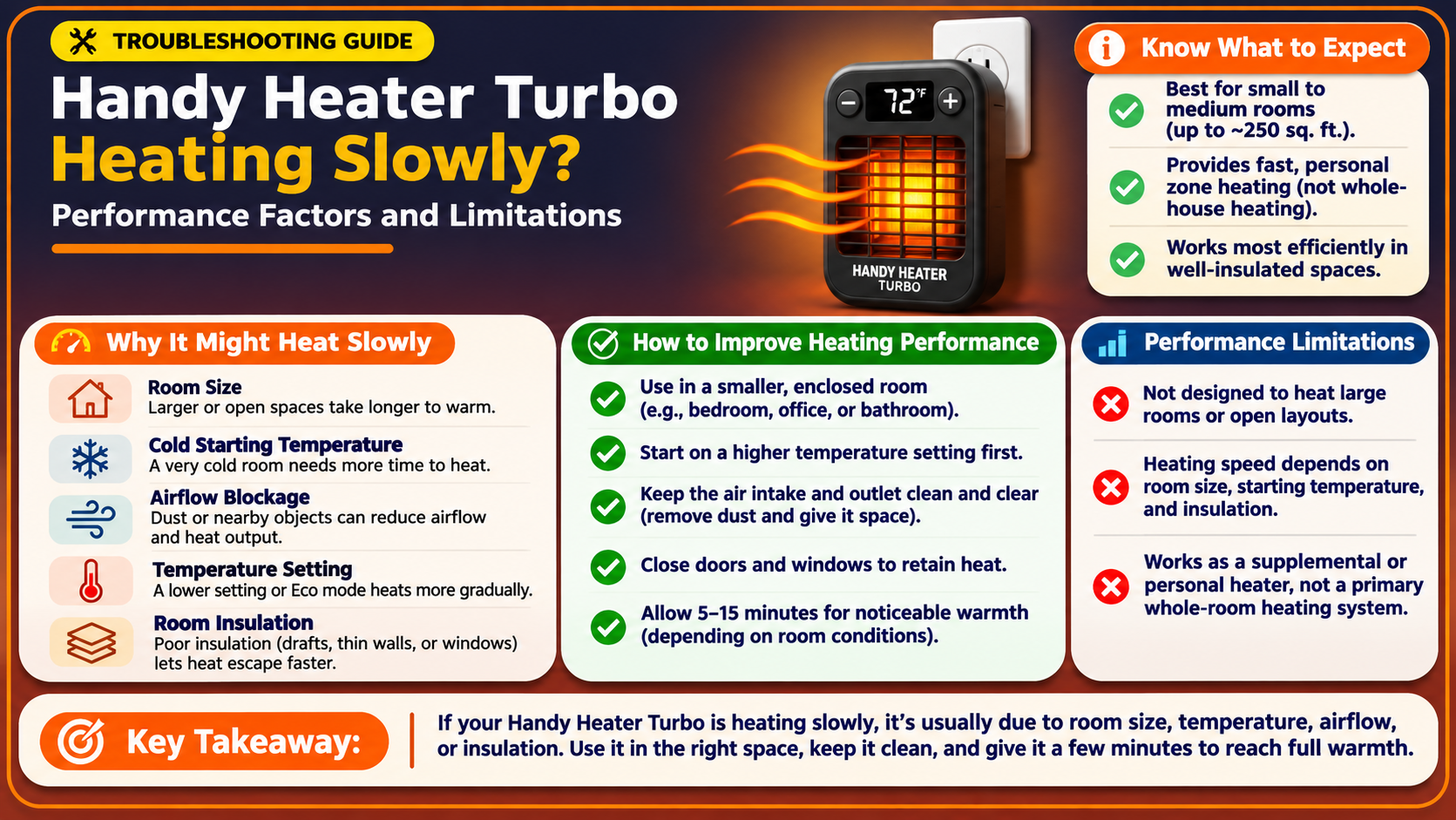
Yes, in most situations. The numbers above assume the heater draws 800 watts every minute it is switched on. In reality, the Handy Heater Turbo has a digital thermostat. Once the room reaches your chosen temperature, the heating element shuts off and only turns back on when the room cools down.
How much you save depends on the size of the room, how well it is insulated, and how cold it is outside. In a small, well-sealed room the heater may only run about half the time, which would cut the monthly figures above roughly in half. In a drafty room on a freezing night, it may run almost continuously. Treat the full-power numbers in this guide as a worst-case budget and your real bill as likely somewhere below it.
Handy Heater Turbo vs. a 1,500-Watt Space Heater
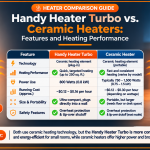
A standard portable space heater is typically rated at 1,500 watts, almost double the Handy Heater Turbo. That difference shows up directly on your bill, but it also shows up in how much heat you get.
| Handy Heater Turbo 800 | Typical 1,500W heater | |
|---|---|---|
| Power draw | 800 W | 1,500 W |
| Energy per hour | 0.8 kWh | 1.5 kWh |
| Cost per hour (19¢/kWh) | 15.2¢ | 28.5¢ |
| Heat output | About 2,730 BTU per hour | About 5,120 BTU per hour |
| Best for | Small rooms, desks, bathrooms | Larger rooms, faster warm-up |
It is worth understanding one important point here: electric resistance heaters, including ceramic models, convert virtually all of the electricity they use into heat. A 1,500-watt heater is not less efficient than an 800-watt one. It simply produces more heat per hour and costs more per hour. If the Handy Heater Turbo is big enough for your space, its lower wattage means a lower bill. If it is too small, it will run constantly and never feel warm enough, so a larger room may be better served by a different solution.
How Big a Room Can the Handy Heater Turbo Heat?
A common rule of thumb is that you need about 10 watts of heating power per square foot of floor area. By that estimate, 800 watts suits a room of around 80 square feet, such as a small bedroom, a home office or a bathroom. Some product listings claim larger coverage, but results vary with ceiling height, insulation, windows and outdoor temperature. In small, enclosed spaces the heater will feel effective. In a large open-plan living room it will mostly warm the area right around it.
Is the Handy Heater Turbo Cheap to Run?
Compared with other electric space heaters, yes, the hourly cost is on the low side because of the 800-watt rating. Compared with other ways of heating, it depends on how you use it.
- Good value: heating one small room you are actually using while keeping the rest of the home at a lower temperature, so you avoid heating empty space.
- Poor value: trying to heat a whole home, or running it 24 hours a day in a large or poorly insulated room.
- Versus a heat pump: a ductless heat pump can deliver the same heat using roughly one-third to one-half of the electricity, so it is cheaper to run if you heat for many hours, though it costs far more to install.
Ways to Lower the Handy Heater Turbo Running Cost
- Use the timer. The 12-hour programmable timer lets you warm a room before you wake up or while you work, then switch off automatically instead of heating all night.
- Set a sensible temperature. Every extra degree raises the time the heater runs. Around 68°F to 70°F is comfortable for most people.
- Close the door. Heating a single closed room is far more efficient than heating a space that is open to the rest of the house.
- Block drafts. Door sweeps, weather stripping and thick curtains stop heat from escaping and reduce how often the thermostat calls for heat.
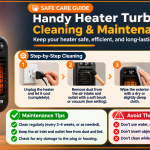
- Place it well. Keep the heater at least a few feet from furniture, bedding and curtains, and choose an outlet that is not behind large items that trap the warm air.
- Heat the person, not the building. If you sit at a desk for hours, a small heater plus a warm layer of clothing beats heating the entire room to a high temperature.
- Check your utility’s rates. If your utility offers time-of-use pricing, running the heater in cheaper off-peak hours can lower your cost per kWh.
Safety Tips for Plug-In Heaters
An 800-watt heater uses a lot of power for a wall outlet, so safe use matters as much as running cost.
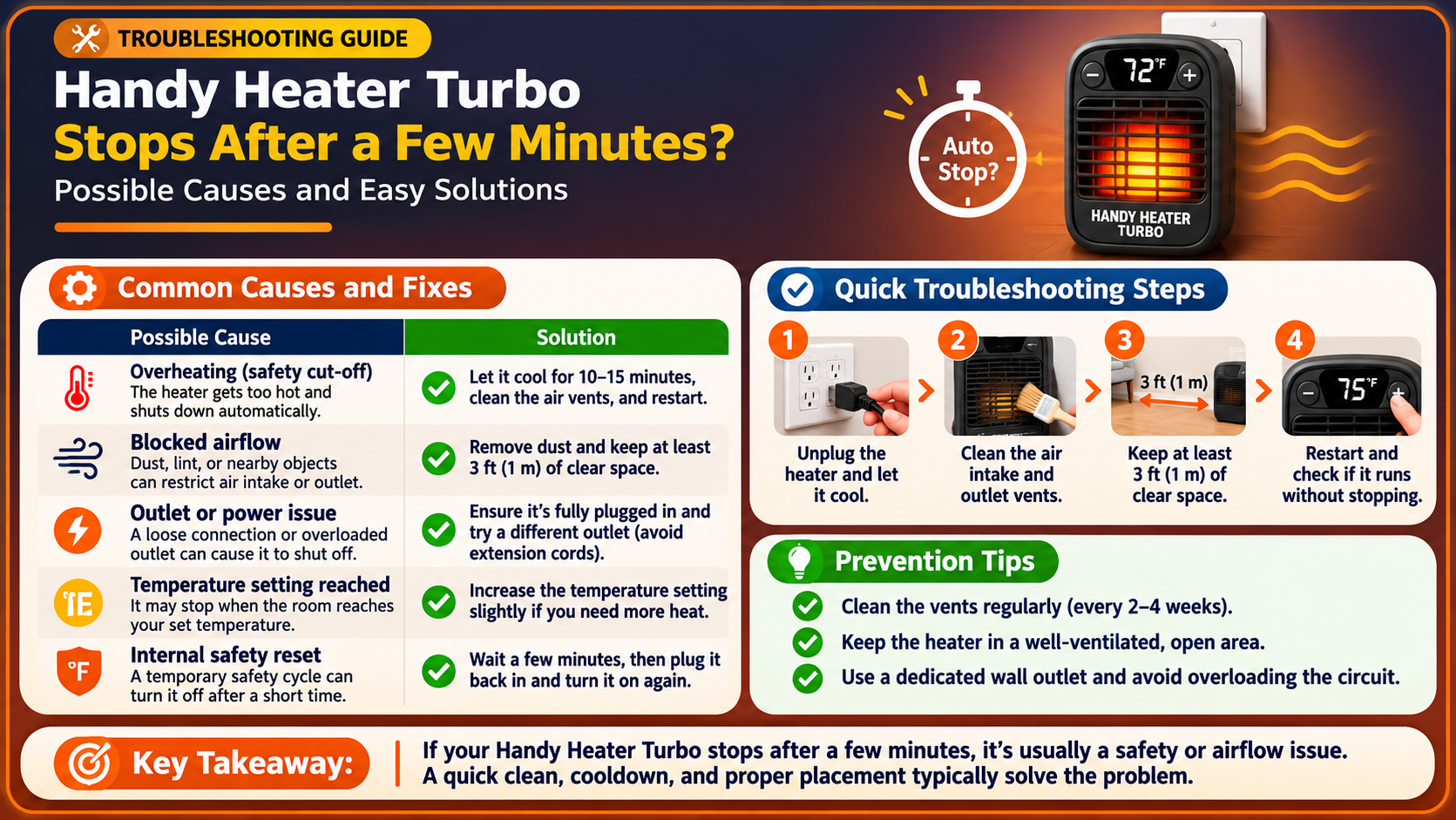
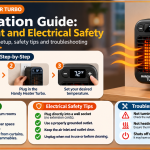
- Plug the heater directly into a wall outlet. Avoid extension cords, power strips and surge protectors, which can overheat under a heavy load.
- Do not share the same circuit with other high-draw appliances such as a microwave, hair dryer or another heater.
- Inspect the outlet, plug and cover plate regularly. If they feel hot to the touch, discolored or loose, stop using the heater and have the outlet checked by an electrician.
- Keep curtains, bedding, paper and other flammable materials well clear of the unit.
- Do not leave the heater running unattended for long periods, and use the timer when sleeping.
- Follow the manufacturer’s instructions, especially for use in bathrooms and damp areas.
Frequently Asked Questions
How much does it cost to run the Handy Heater Turbo for 24 hours?
At full power for a full day, the heater uses 19.2 kWh. At the U.S. average of about 19 cents per kWh, that is roughly $3.65. Because the thermostat cycles the heater off when the room is warm, the actual cost is usually lower.
How many watts does the Handy Heater Turbo use?
The Handy Heater Turbo 800 is rated at 800 watts and runs on a standard 120-volt household supply, drawing about 6.7 amps at full power.
Is the Handy Heater Turbo expensive to run overnight?
Running it for 8 hours at full power costs about $1.22 at the national average rate. Using the thermostat and timer will usually bring that figure down, and it is generally safer to use the auto shut-off timer rather than leave the heater on all night.
How much will it add to my monthly electric bill?
If you run it 4 hours a day at full power, expect roughly $18 per month at the U.S. average rate. At 8 hours a day, it is about $36. Your own number depends on your local price per kWh and how often the thermostat cycles the heater off.
Does a ceramic heater use less electricity than other electric heaters?
Not by itself. Ceramic and other electric resistance heaters convert nearly all the electricity they use into heat, so cost depends mainly on wattage and hours of use. Ceramic elements are valued for fast warm-up, quiet operation and safety features rather than for lower energy use.
Is the Handy Heater Turbo cheaper to run than central heating?
It can be, but only if you use it to heat a single small room while turning down the thermostat elsewhere. Heating several rooms with plug-in heaters usually costs more than a central system, especially when electricity is more expensive than gas in your area.
Can I use the Handy Heater Turbo with an extension cord?
Plug-in heaters like this are designed to be used directly in a wall outlet. Extension cords and power strips are not recommended for high-wattage appliances because of the risk of overheating.
Final Verdict: Is the Handy Heater Turbo Worth the Running Cost?
For its size, the Handy Heater Turbo is inexpensive to operate. At about 15 cents an hour at the average U.S. electricity rate, a few hours of use each day adds only $10 to $20 to a typical monthly bill, and the thermostat and 12-hour timer give you real control over what you spend. It makes the most sense as a personal or small-room heater for a bedroom, home office, nursery or bathroom, where you want quick, quiet warmth without heating the whole house.
If you need to heat a large room or run a heater for long stretches every day, the running cost adds up quickly, and a more efficient heating method will save money over time. Work out your own number with the simple formula above, and you will know exactly what to expect before the first bill arrives.
Note: Costs in this article are estimates based on an 800-watt rating and national average electricity prices in 2026. Your actual cost depends on your local rate, your room and how often the thermostat runs the heater.