
Disclosure: This article is for information only. If you buy a product through a link on this site, we may earn a small commission at no extra cost to you.
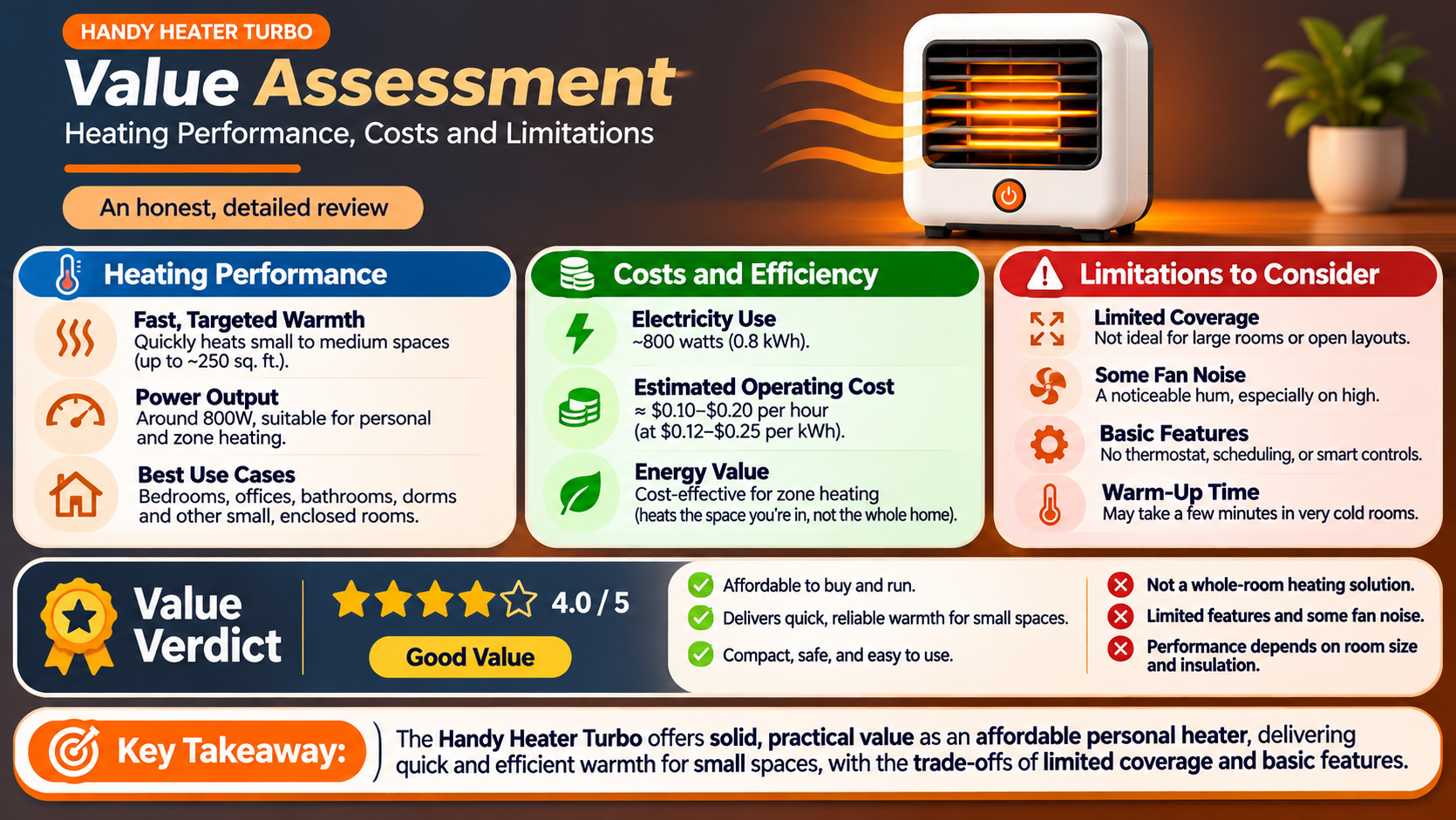
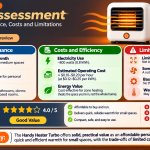
When the weather turns cold, heating a whole house or even a whole floor just to stay warm in one room feels wasteful. That is exactly why compact plug-in heaters such as the Handy Heater Turbo are so popular. They are small, easy to move, quick to start, and built to warm the area where you actually sit, study, work or sleep.
But a heater that is small and cheap is not automatically the right choice for every room. In this complete guide you will learn what a Handy Heater Turbo is, how it works, which room sizes it suits, how much electricity it uses, what the real pros and cons are, and the safety rules you should never skip. By the end, you will know whether a Handy Heater Turbo for a small room is a smart buy for you.
Quick Summary
- Best for: small bedrooms, study corners, home offices and personal spaces.
- Heating style: fan-assisted ceramic (PTC) warm air, with a Turbo / high mode for faster warmth.
- Typical power: roughly 400 W to 1500 W depending on the model. Always read the label.
- Not for: large rooms, open-plan spaces or replacing central heating.
- Must-haves: overheat protection, tip-over protection, a thermostat and a trusted seller.
What Is a Handy Heater Turbo?
A Handy Heater Turbo is a compact, portable electric room heater. Most models in this category use a ceramic PTC heating element with a small built-in fan. The fan pushes warm air into the room, and the word “Turbo” usually refers to the high-heat or fast-fan mode that delivers warmth more quickly.
Because many brands and sellers use the same or similar names, the exact power, size, safety features and build quality can differ from one product to another. That is why it is important to check the rated wattage, voltage, certification marks and safety features printed on the product or its box before you buy.
Typical Specifications at a Glance
| Feature | What to Expect |
|---|---|
| Heater type | Fan-assisted ceramic (PTC) heater |
| Power range | Roughly 400 W to 1500 W depending on the model |
| Voltage | Must match your local power supply (check the label) |
| Best use | Small rooms, bedrooms, study corners, home offices |
| Controls | Thermostat knob, heat or Turbo modes, sometimes a timer |
| Safety | Overheat protection and tip-over switch (varies by model) |
| Noise | Low to moderate fan sound |
| Size | Compact, light and easy to carry |
How Does a Turbo Handy Heater Work?
The working principle is simple, which is part of the appeal. Room air is pulled in by a fan, passes over a hot ceramic element, and is blown back out as warm air. A thermostat monitors the temperature and switches the heating on and off so the unit does not keep getting hotter and hotter.

PTC stands for positive temperature coefficient. In simple words, the ceramic material limits its own electrical current as it gets hotter, which is why PTC heaters are generally considered a safer design than old-style exposed heating coils. This still does not make them risk-free, so the safety rules later in this article still apply.
Why a Handy Heater Turbo Works Well for a Small Room
- Fast, focused warmth. It warms the air around you quickly instead of trying to heat an entire home.
- Compact and portable. You can move it from the bedroom to the study or the home office in seconds.
- Simple to use. Plug it in, choose a mode, set the thermostat and you are done.
- Heats only where needed. Warming one small room can cost less than heating several rooms you are not using.
- Takes little space. It fits on a floor corner, shelf or desk-side table, as long as the surface is flat and stable.
- Usually affordable. Entry-level cost is far lower than a fixed heating system or a large radiator.
Is It Right for Your Room? Wattage vs Room Size
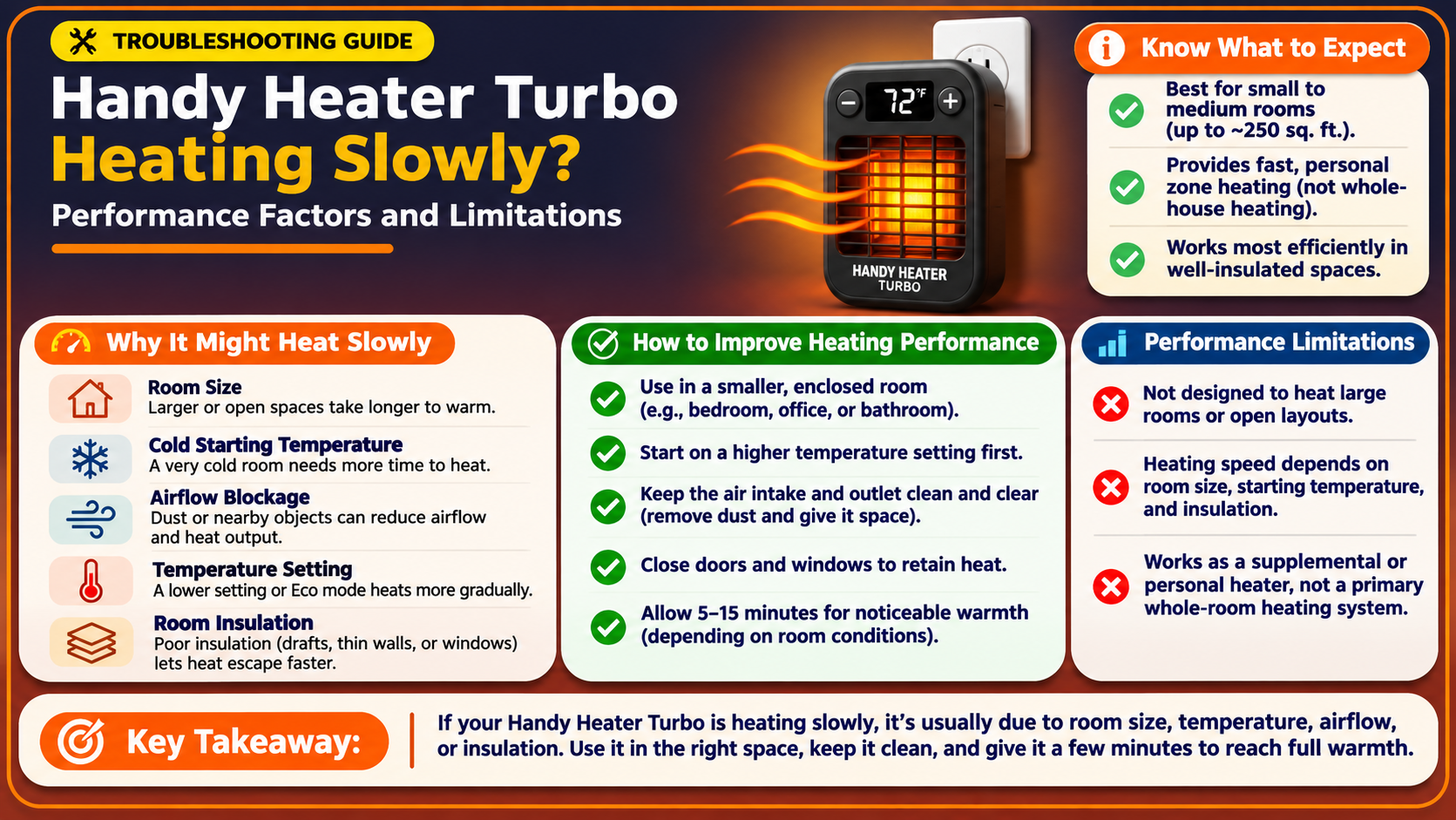
The most common mistake is buying a heater that is too weak for the room, then blaming the product. Heating power is measured in watts (W). A very rough rule of thumb is about 10 watts per square foot (around 100 watts per square metre) of floor area in a typical, reasonably insulated room, although cold climates and poor insulation can raise that number.

If your heater is rated at 500 W and your bedroom is 120 square feet, do not expect the whole room to feel cosy. It may still warm the area right in front of it, which can be perfectly fine if you just want a warm corner for working or reading.
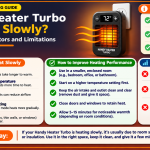
Things That Change How Warm Your Room Feels
- Insulation and drafts: gaps under doors and around windows let heat escape.
- Ceiling height: higher ceilings mean more air to warm.
- Outside temperature: the colder it is outside, the harder the heater has to work.
- Open doors: heating a room with the door open turns it into a bigger space.
- Distance: warmth is strongest close to the heater and fades with distance.
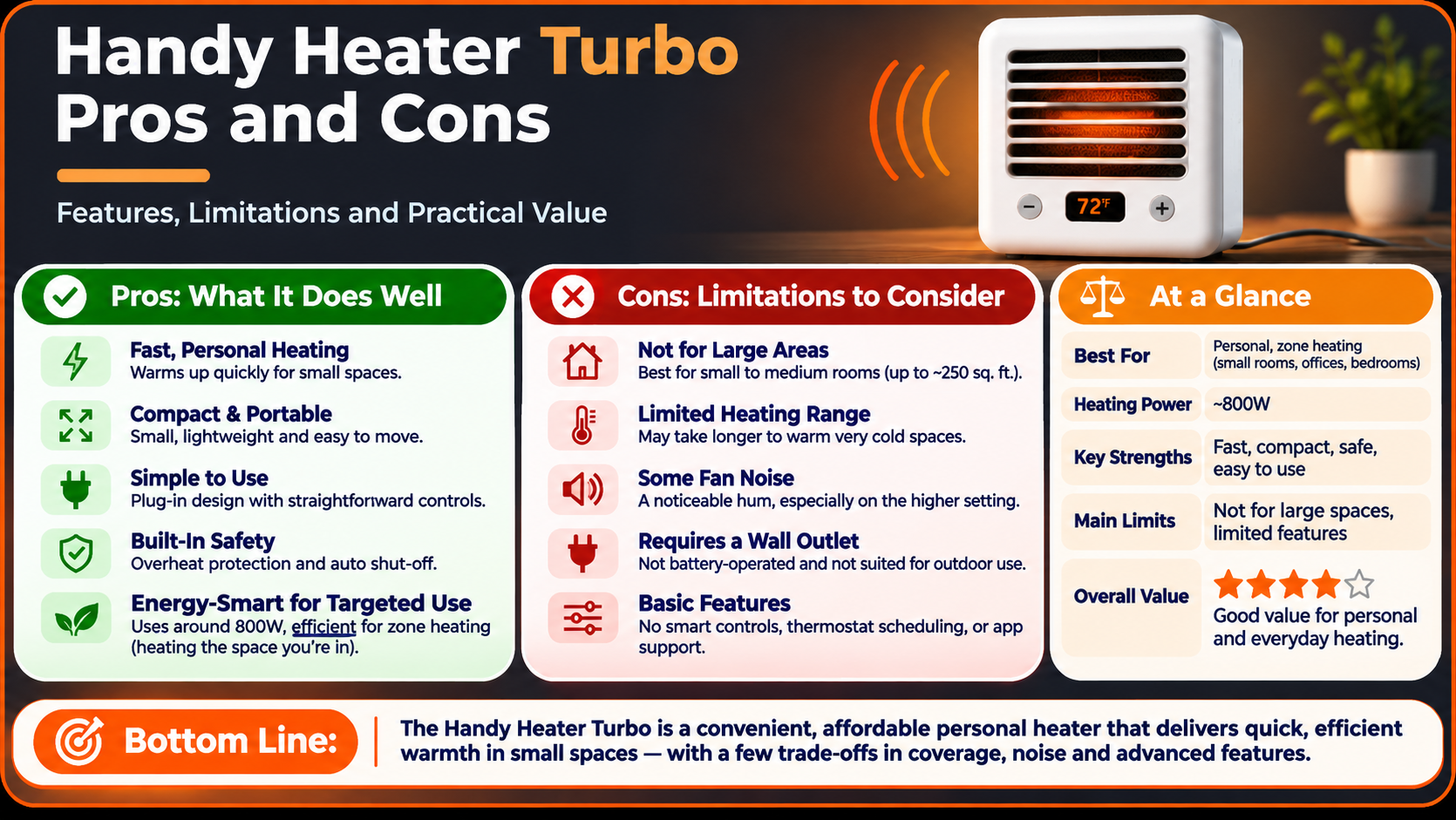
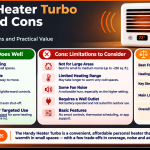
Handy Heater Turbo: Pros and Cons
| Pros | Cons |
|---|---|
| Quick warm-up and focused heat | Not enough for large or open rooms |
| Small, light and portable | Fan noise can bother very light sleepers |
| Easy plug-and-play use | Dries the air a little, which some people notice |
| Low upfront cost | Quality and safety features vary widely between sellers |
| Thermostat and safety cut-offs on good models | Needs supervision and sensible placement |
Honest Note
Be careful with product pages that promise to “save 80% electricity” or “heat any room in seconds.” An electric heater turns almost all the electricity it uses into heat, so a heater cannot magically heat more than its wattage allows. A lower-wattage heater simply uses less power and heats less.
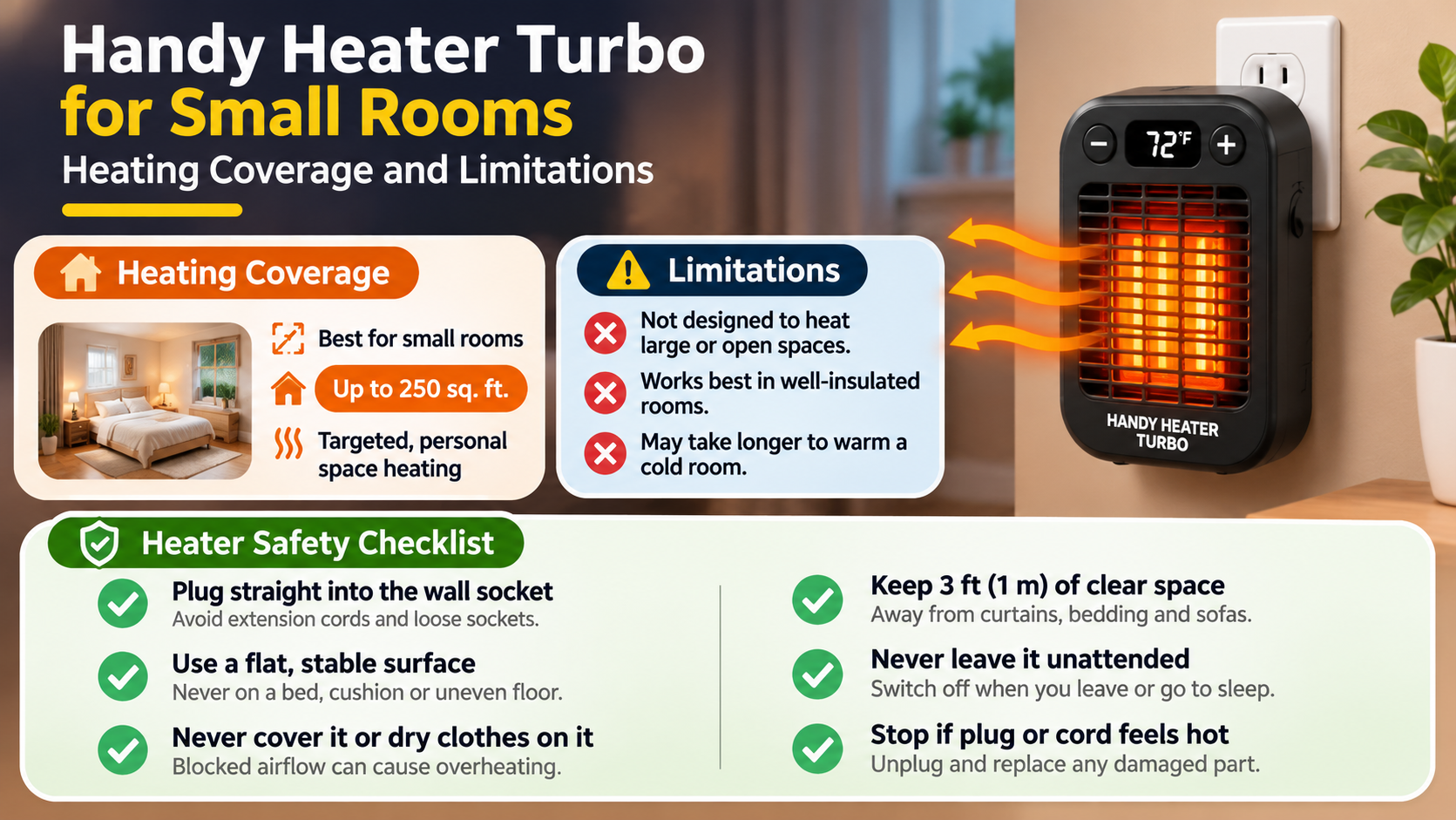
Safety Rules You Should Never Ignore
Any electric heater can become dangerous if it is misused. Following a few basic rules makes a big difference.

Extra Safety Tips
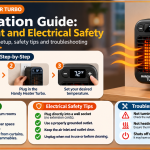
- Choose a model with overheat protection and a tip-over switch.
- Keep the heater away from water. Use it in a bathroom or damp area only if the manual clearly says it is designed for that.
- Keep children and pets away from the front of the unit, since the grille and surface can get hot.
- Do not use it near spray cans, petrol, paint thinner or other flammable liquids and vapours.
- Make sure working smoke alarms are installed in your home.
- If you notice a burning smell that does not go away after the first few minutes, sparks or a damaged plug, switch it off and stop using it.
Most manufacturers and fire-safety bodies advise against leaving a portable heater running while you sleep or while nobody is in the room. Warm the room first, then switch the heater off before you go to bed, or follow your product manual closely if it includes an auto shut-off timer.
How Much Electricity Does It Use?
You can estimate running cost with one simple formula:
Power in kW × hours used × price per unit (kWh) = cost
Here is how much energy different heater ratings use if you run them for 3 hours a day:
| Heater Power | Energy in 3 Hours | Energy in 30 Days (3 h/day) |
|---|---|---|
| 500 W (0.5 kW) | 1.5 kWh | 45 kWh |
| 1000 W (1 kW) | 3 kWh | 90 kWh |
| 1500 W (1.5 kW) | 4.5 kWh | 135 kWh |
Multiply the energy figure by the per-unit rate on your own electricity bill to see your real cost. Remember that the thermostat switches the element on and off, so actual use is often lower than the full-power figure when the room has already warmed up.
What to Check Before Buying a Handy Heater Turbo
- Rated wattage: match it to your room size using the guide above.
- Voltage and plug type: make sure they match your country’s supply and sockets.
- Safety protection: look for overheat cut-off and tip-over protection.
- Certification marks: check for recognised safety or quality marks that apply in your country.
- Thermostat and modes: an adjustable thermostat helps avoid wasted energy.
- Noise level: check reviews if you plan to use it in a bedroom or while studying.
- Build quality: look for a solid plug, firm casing and flame-retardant material.
- Seller and warranty: buy from a trusted seller that offers a return or warranty policy.
- Realistic claims: avoid products with exaggerated promises and no clear specifications.
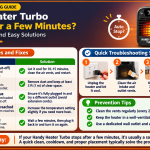
Tips to Get the Best Warmth From a Small Heater
- Close the door and windows so the warm air stays in the room.
- Use Turbo or high mode for the first few minutes, then lower the setting or let the thermostat take over.
- Place the heater on a flat floor or stable surface, with free space around it and the airflow pointing into the room.
- Block draughts under the door with a rolled towel or draught stopper.
- Use rugs and curtains to reduce heat loss through floors and windows.
- Put a small bowl of water in the room if the air feels too dry, but never next to the electric plug or heater.
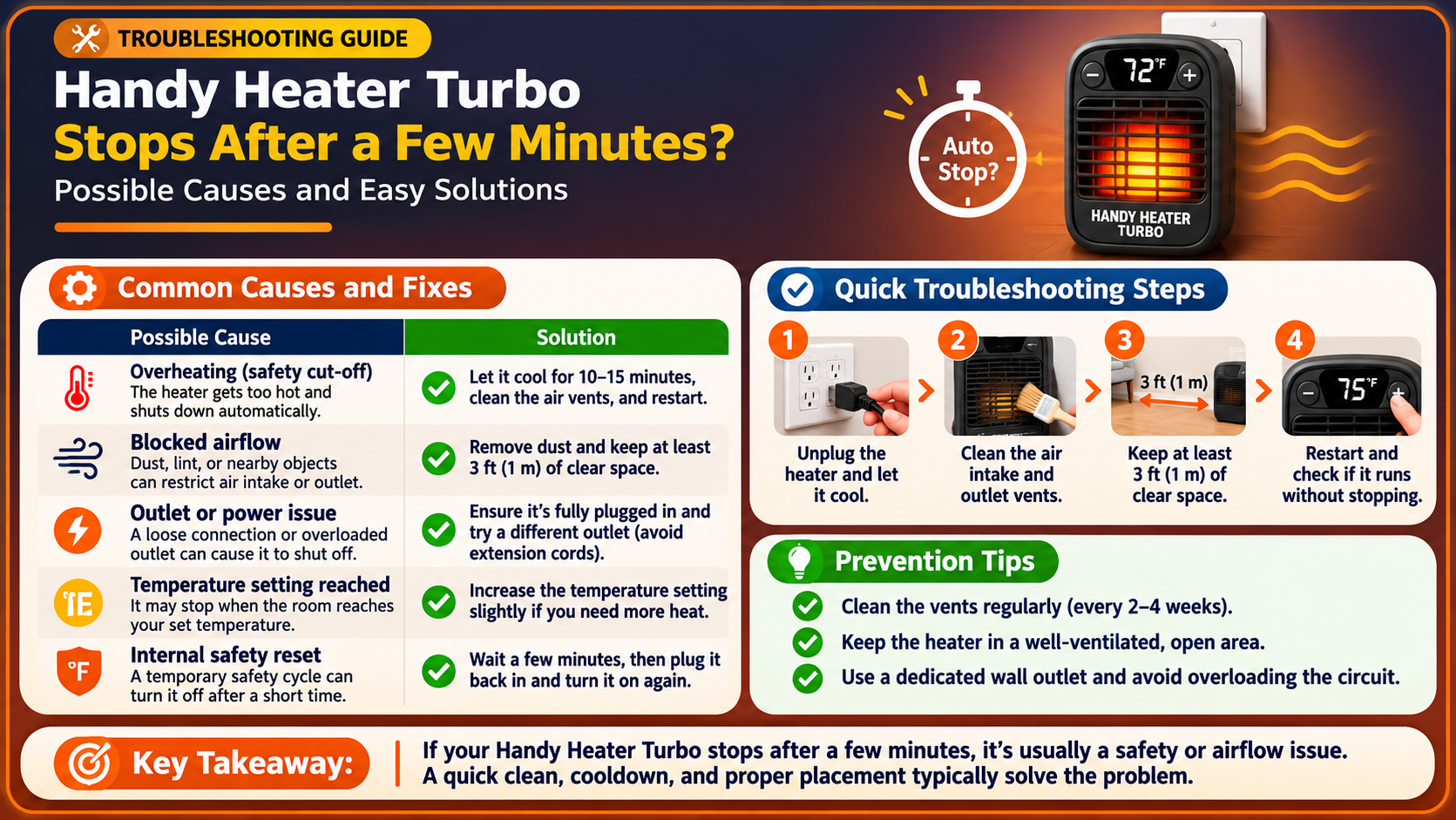
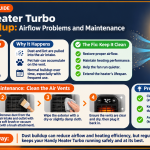
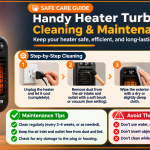
- Clean the grille and air vents regularly. Unplug the unit and let it cool fully first.
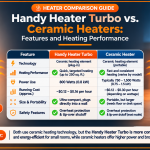
Handy Heater Turbo vs Other Small Room Heaters
| Heater Type | Speed of Warmth | Noise | Best For |
|---|---|---|---|
| Handy Heater Turbo (fan ceramic) | Fast | Low to moderate | Quick warmth in small rooms and personal spaces |
| Oil-filled radiator | Slow to start, holds heat well | Very quiet | Longer, quieter heating in bedrooms |
| Infrared / quartz heater | Instant feeling on your body | Quiet | Warming a person rather than the whole room |
| Panel / convector heater | Moderate | Quiet | Steady background warmth |
Who Should Buy It, and Who Should Skip It?
A Handy Heater Turbo makes sense if you:
- want quick warmth in a small bedroom, study or home office
- need a lightweight heater you can move around
- are on a budget and only need heat for a few hours a day
- will be present while it runs and follow the safety rules
You may want a different heater if you:
- need to heat a large living room or open-plan space
- want silent, all-night heating (an oil-filled radiator with a thermostat may suit you better)
- cannot supervise the heater or keep children and pets away from it
Frequently Asked Questions (FAQ)
Can a Handy Heater Turbo heat a small room?
Yes, if its wattage is suitable for the room size and the room is reasonably closed and insulated. Lower-wattage models are better for desk areas and very small rooms, while 1000 W or more suits a larger small room.
Is it safe to use overnight?
Most safety guidance recommends not leaving portable heaters running unattended or while you sleep. Warm the room beforehand and switch the heater off before bed unless your manual specifically allows timer use.
Does it use a lot of electricity?
It uses electricity according to its wattage. A 1000 W heater uses 1 kWh for every hour it runs at full power. The thermostat reduces use once the room reaches your chosen temperature.
Can I use it in the bathroom?
Only if the manual clearly states the model is made for bathroom or damp use. Never use a regular heater near water, showers or wet hands.
Can it replace central heating?
No. It is designed for small, short-term heating of one room or area, not for heating a whole house.
Why does it smell the first time I use it?
A light smell during the first use is common as dust or manufacturing residue burns off. Ventilate the room. If a strong burning smell continues, switch it off, unplug it and stop using it.
How do I clean it?
Unplug the heater and let it cool completely. Remove dust from the grille and vents with a soft brush or a vacuum on low suction, then wipe the casing with a dry or slightly damp cloth. Never let water enter the unit.
Final Verdict: Is a Handy Heater Turbo Worth It for a Small Room?
For a small bedroom, study corner or home office, a Handy Heater Turbo can be a practical, budget-friendly way to add quick warmth without heating your whole home. It is compact, simple and fast. The key is to choose a model with the right wattage, proper safety protection and honest specifications, then use it sensibly.
Do not expect miracles, and be careful with exaggerated claims. If you treat it as a small, supervised, short-term heater, it can make cold days far more comfortable. Compare the specifications and safety features carefully, read the manual, and pick a trusted seller before you buy.
Bottom Line
Right wattage + safety protection + sensible use = a warm, comfortable small room without wasting electricity.